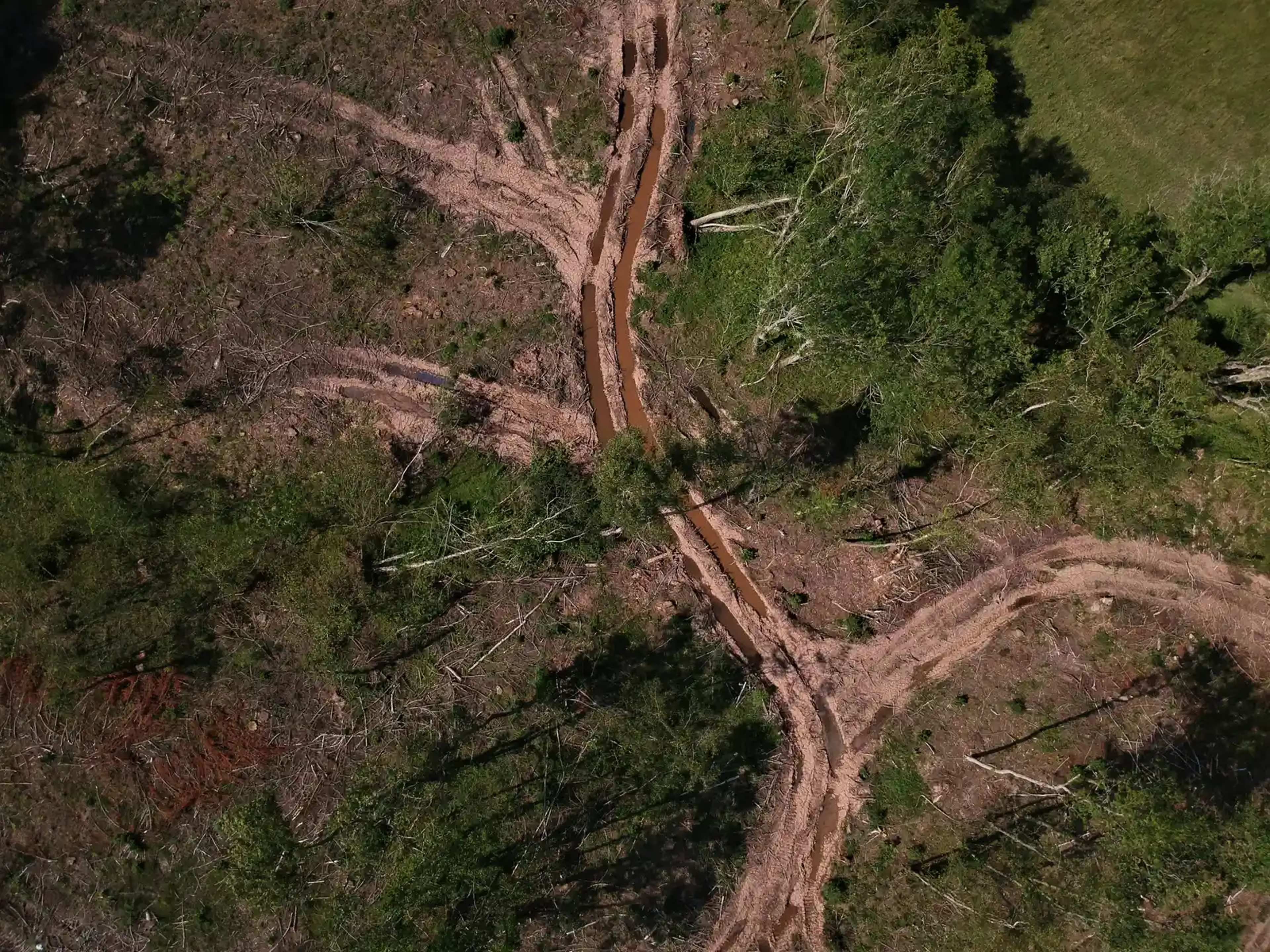
The trail is quiet.
Your phone has no signal.
And yet, something inside you is already apologizing.
That sensation – that low, grey hum of guilt for being unreachable – isn’t weakness. It isn’t neurosis. It is the sound of two fundamentally incompatible operating systems running simultaneously inside the same skull. One is ancient, biological, and built for pine needles and open sky. The other was installed fifteen years ago and demands you be available at all times, in all places, for everyone, forever.
You walk into the wilderness wearing one self – the person who craves silence, who booked the trail, who told everyone they needed this – and you discover almost immediately that another self came along uninvited. The one who is already composing the apology text you’ll send the moment you get signal back. The one who isn’t really here.
1. The Phantom Obligation

You are three miles up a ridge. No bars. No Wi-Fi. Nothing.
And you still feel late.
The constant availability of a smartphone has been suggested to induce a perceived obligation to be accessible at all times – a notion that has been linked to feelings of stress, depression, and guilt. Notice that word: *perceived*. The obligation isn’t real. The deadline doesn’t exist. Nobody is bleeding. Nobody is on fire. And yet your nervous system cannot distinguish between those realities.
This is the Phantom Obligation – the ghost of a notification that hasn’t arrived yet, haunting you anyway.
It is a performance of availability with no audience present. You are standing in a forest, rehearsing apologies for a play no one is watching. Notifications are engineered to trigger anticipation. That tiny buzz promises novelty or reward, nudging your brain’s threat/reward system. Even when you don’t check, your attention splinters. The splinter, it turns out, travels with you. Up mountains. Into dead zones. Into what should have been rest.
2. The Evolutionary Mismatch
Your brain did not evolve for this.
Full stop.
Our stress response system evolved over approximately 300,000 years of human existence. Smartphones have been ubiquitous for roughly 15 years – about 0.005% of that evolutionary timeline. Our brains are essentially running software hundreds of millennia old on hardware that’s barely a decade and a half old.
That is the fundamental architecture of your guilt. You are not broken. You are simply a Paleolithic machine operating in a notification economy.
Understanding this mismatch helps frame digital stress not as a personal weakness but as a predictable collision between biology and technology. The hiker who feels guilty for going offline is not failing at modern life. They are succeeding at being human – a human dropped into a context their neurology was never designed to navigate.
The trail, paradoxically, is the most natural place you could be. The guilt is the aberration. Not the silence.
3. The Dopamine Contract
Here is what no one tells you when they hand you the smartphone.
You are signing a contract.
Every ping, buzz, or notification taps into our reward system, releasing small hits of dopamine – the same chemical that fuels habits and addiction. Over time, checking our phones becomes automatic. You didn’t choose this consciously. You were conditioned into it, gently and relentlessly, one dopamine hit at a time.
So when the dead zone strips the signal away, the contract feels broken. Your brain expected a reward and received only wind and birdsong instead. Participants in digital detox studies unanimously reported the habitual need to check their devices during initial detox days. It was a feeling of missing something – the constant notification high, or the informational input.
The guilt you feel on the trail is, in part, withdrawal.
Biological, chemical, measurable withdrawal. You are not being dramatic. You are being honest about what the machine has done to you.
4. The Cortisol Trail
There is a physiological story happening beneath all of this.
Stress leaves a chemical residue.
Digital stress refers to the physiological and psychological stress response triggered by technology use, characterized by elevated cortisol levels, increased heart rate, and cognitive overload. Unlike traditional stressors that resolve, digital stress is continuous – driven by notification anticipation, information overload, social comparison, and the always-on culture of modern work environments.
That continuous cortisol drip has consequences. The hippocampus, essential for memory formation and learning, exhibits noticeable volume reduction under chronic stress. This atrophy is largely attributed to the neurotoxic effects of elevated cortisol levels, which impair neural plasticity and decrease the production of new neurons. Consequently, individuals may experience memory deficits or increased difficulty in learning and retaining information.
You carried that cortisol up the mountain with you. It is in your bloodstream right now, even here, even in the quiet. The guilt you feel is partly cortisol’s last transmission. Your body is still checking in, even when nothing requires it.
5. The Attentional Debt
I want to tell you something I noticed on a trail in the Cascades two years ago.
I was forty minutes in, signal gone, pack on, boots doing what boots do. And I kept reaching for my phone. Not consciously. Not with intention. My hand simply moved toward my pocket – a reflex worn smooth by ten thousand repetitions. When I finally left it in the bag, I felt something strange. Not peace, exactly. More like the early, uncomfortable silence after a very loud party.
That silence, research tells us, is productive.
Micro-interruptions force your brain to reorient repeatedly, which increases mental fatigue and the sense that you’re “always behind.” Over time, this state of partial attention can heighten anxiety, irritability, and self-criticism. The hike is not adding to that debt. The hike is the only place you are actually paying it back. Taking time away from digital distractions allows the brain to reset and recover from cognitive overload. The guilt you feel during that reset is the debt complaining about being settled.
6. The Restoration Paradox
Nature is not being cruel to you when it cuts the signal.
It is doing the only thing that actually works.
Attention Restoration Theory suggests that exposure to nature can restore prefrontal cortex-mediated executive processes. Consistent with this, research indicates that exposure to natural settings replenishes some lower-level modules of the executive attentional system. In plain language: the trail is literally rebuilding the part of your brain that your phone has been dismantling. Four days of immersion in nature, and the corresponding disconnection from multimedia and technology, increases performance on a creativity and problem-solving task by a full 50% in a group of naive hikers.
Fifty percent.
And you felt guilty about taking the afternoon off.
This gives your brain a chance to restore its directed attention abilities, thereby reducing mental fatigue. Soft fascination with nature is an entry into a brain state called the “default mode network” – the resting state of your brain. The dead zone didn’t strand you. It let you arrive.
7. The Identity Performance
Here is the uncomfortable truth at the center of the guilt.
You are afraid of who you are when no one is watching.
Our online presence often serves as a reflection of our identity. We seek validation through the approval of others, whether in the form of likes, comments, or shares. This pursuit of social recognition can make us more dependent on staying digitally connected. Offline, on a trail with no signal, the performance stops. And without the performance, the question becomes: who is performing, and for whom?
The maintenance of digital identities represents a significant form of “identity labor” – cognitive and emotional work that remains largely unrecognized yet occupies increasing bandwidth in our daily lives. This labor includes decision-making about self-presentation, managing privacy boundaries, and navigating the emotional aftermath of online interactions.
In the dead zone, the labor is suspended. The notification guilt is the labor refusing to rest. It is your curated self, pacing nervously, wondering what’s being said while you’re gone.
8. The Fight-Or-Flight Notification
Your body doesn’t know the difference between a work email and a threat.
It only knows the alert.
Every notification is a micro-interruption. It pulls your attention away from what you are doing and demands a response. This constant stream of alerts keeps your nervous system in a state of low-grade activation, similar to the fight-or-flight response. Your body doesn’t know the difference between a work email and a tiger; it just registers the alert.
Now multiply that by hundreds of alerts a day, every day, for years.
Your nervous system is not overreacting on the trail. It is exhausted. It has been running the fight-or-flight protocol on a near-continuous loop, and now – in the silence of a dead zone – it doesn’t trust the quiet. The constant state of alertness fostered by always-on connectivity can create a cognitive pattern similar to generalized anxiety disorder – a baseline of worry and vigilance that becomes the new normal. The guilt is your nervous system still pulling watch duty. Long after the enemy has left the building.
9. The FOMO Underneath
Beneath the guilt is something older and more primal.
The fear of being left out.
One of the main reasons people find it hard to disconnect from the digital world is the fear of missing out. The constant stream of updates from friends, news, and events can create anxiety about being left out or uninformed. This is not a modern pathology. The fear of social exclusion is ancient. Tribal. It kept early humans close to the group, because separation meant death.
Completely disabling notifications increases anxiety and worries over missing out. The dead zone, in your nervous system’s threat assessment, looks like voluntary exile. And voluntary exile, evolutionarily speaking, is a very bad idea.
But the tribe is fine. The thread will still be there. This overdrive state can trigger anxiety. You start to feel like you’re missing out on something essential, even when you’re not. This might manifest physically: tension, restlessness, darting eyes, or nervous checking. The key phrase is: even when you’re not. You are not missing anything. You are present, perhaps for the first time all week.
10. The Permission You Keep Waiting For
Nobody is going to give it to you.
The permission. The clearance. The blessing to be unreachable for an afternoon.
Because the entire architecture of the modern digital obligation is built on the assumption that you are always available – that your attention is a resource that belongs to everyone who wants it. Self-Determination Theory prioritizes intrinsic motivation and autonomy as essential to psychological well-being. Excessive focus on external validation – likes, followers, shares – can undermine intrinsic motivation and shift the focus from authentic self-expression to performance-based behavior.
The notification guilt you feel on the trail is the final proof of how deep the conditioning runs. You have internalized the obligation so completely that even in a place with no signal – a place where response is physically impossible – you still feel guilty for not responding.
Guilt, low-level anxiety, and the fear of missing something important can make stepping away feel risky rather than restorative. But stepping away is exactly what the biology requires. The mental health benefits one can gain from temporarily disconnecting from digital devices includes reduction in stress and anxiety, improvement in sleep quality, enhancement in focus and productivity, and stronger real-life social interactions. The body knew this before the research confirmed it. The trail knew it before you arrived.
The permission was always yours to give yourself.
There is something that happens around the second hour of a hike in deep wilderness. The guilt doesn’t vanish – it’s too well-trained for that – but it gets quieter. The body stops rehearsing the apology texts. The hand stops drifting toward the pocket. Something older and slower takes over, something that remembers what attention felt like before it was monetized, before it was fragmented, before every moment of stillness became a productivity failure.
That something is not nostalgia. It is not anti-technology posturing. It is your actual nervous system, doing exactly what it was designed to do inside the environment it was designed for. The human brain evolved in natural environments for millions of years. The attentional system that nature restores was shaped by, and optimized for, the kinds of stimuli that natural environments provide. The guilt will still be waiting when you get back to signal. The notifications will stack up like unopened letters. The digital self will resume its labor. None of that is going away.
But for now, on this ridge, in this dead zone – your brain is not malfunctioning. It is navigating ten simultaneous conflicts between who you were built to be and who the modern world has spent fifteen years training you to become. It is doing this work faithfully, without complaint, without reward, on a trail that asks nothing of you except that you keep walking.
That might be enough for today.