The hotel room is dark. You are not.
The sheets smell clean. Your mind smells danger.
You are exhausted. Every single cell in your body is asking for rest. And yet something inside you is still standing at a window, scanning the treeline.
We call this insomnia. We blame the mattress, the ambient hum of the air conditioning, the unfamiliar pillow. We order chamomile tea and scroll our phones until 2 AM, convinced that one more video will finally tip us into unconsciousness.
But the real culprit is older than hotel rooms. Older than cities. Older than language.
The real culprit is you – the ancient, undefeated, deeply inconvenient version of you that never quite made peace with sleeping somewhere new.
1. The Battlefield You Never Agreed to Enter
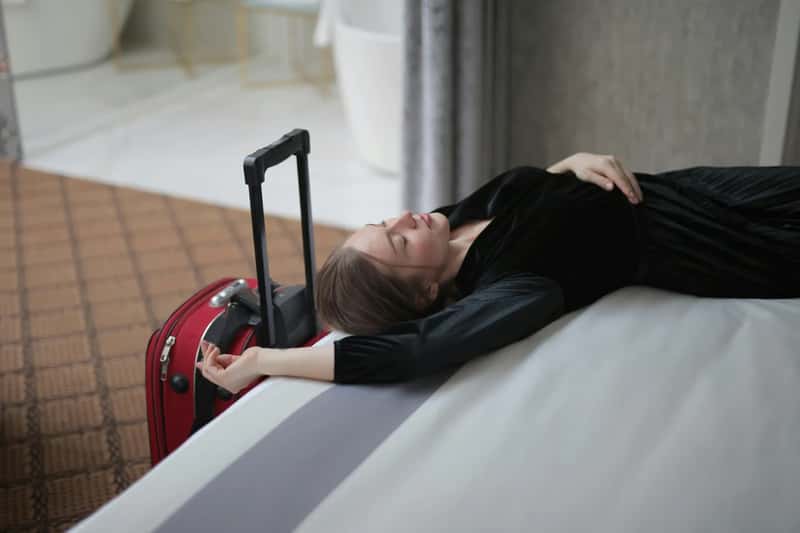
You didn’t sign up for this. But your brain did. A long time ago.
We often experience troubled sleep in a novel environment – a phenomenon known as the first-night effect (FNE) in human sleep research, long regarded as a typical sleep disturbance. Typical. As if the brain’s mutiny against rest is simply a clerical matter to be noted and filed.
It is not a clerical matter.
It is your nervous system doing exactly what it was built to do: treat every unfamiliar space as a potential threat vector until proven otherwise. The hotel room is not just a room. It is an unknown variable. And unknown variables, to the ancient brain, carry the same charge as predators.
Troubled sleep in an unfamiliar environment is an act for survival – a way of keeping one hemisphere partially more vigilant than the other as a night watch, which wakes the sleeper up when unfamiliar external signals are detected.
You are not anxious. You are ancient. There is a difference.
2. The Night Watch
Here is the part that should unsettle you, in the best possible way.
Your brain does not fully sleep on the first night somewhere new. Half of it doesn’t sleep at all.
On the first night in a new place, one brain hemisphere remains more awake than the other during deep sleep, apparently in a state of readiness for trouble. Readiness for trouble. That phrase deserves to sit with you for a moment.
Only half of your brain enters deep sleep when you try to sleep in an unfamiliar place. The other half “keeps watch,” remaining responsive and vigilant to possible threats.
Think about what that means. You are lying in a bed. You appear to be sleeping. And inside your skull, a sentinel is still awake, cataloguing every creak of the building, every shift in the ventilation, every footstep in the hallway – filing each sound under: known or unknown. Safe or not yet safe.
This is not dysfunction. This is loyalty. Your brain is loyal to a version of your survival that you have long since outgrown. And it does not care about your morning presentation.
3. The Left Hemisphere Never Clocks Out
It gets more specific, and more extraordinary, than a simple “on guard” mode.
Science has identified the hemisphere doing the watching. It is the left.
“The left side seems to be more awake than the right side,” says Yuka Sasaki, an associate professor of cognitive, linguistic and psychological sciences at Brown University.
During the first night, the left hemisphere showed reduced deep sleep activity compared to the right, as if it were on guard for potential threats.
It scans for what doesn’t belong. The hemisphere with reduced sleep depth shows enhanced evoked brain response to deviant external stimuli. Deviant external stimuli detected by the less-sleeping hemisphere cause more arousals and faster behavioral responses than those detected by the other hemisphere.
A sound that “doesn’t fit” – the unfamiliar pitch of a heater, a voice pattern through the wall – gets flagged. Gets escalated. Gets you.
The left hemisphere is the one reading the room. All night. Without your permission.
4. The Dolphin in the Hotel Bed
You are not alone in this particular architecture of vigilance. You are, in fact, in very good company.
Unihemispheric sleep has been linked to a protective mechanism in some birds and marine mammals to monitor the environments and detect predators.
Dolphins do it. Certain migratory birds do it. They sleep with half the brain while the other half navigates, watches, prepares.
When ducks settle down for the night near a pond, those on the outer edge of the group are far more likely to keep their outward eye open and on the lookout than those in the center of the group.
In a strange hotel, you are always the duck on the edge of the pond. You are always the one facing outward. The threat isn’t real. But the posture is hardwired.
The human brain was shaped during a time when nights were dark and full of terrors. “When we’re sleeping in a new environment and we don’t know how many predators are around, it would make sense to keep half the brain more alert and more responsive to bumps in the night.”
You carry that evolutionary logic in your skull. Every trip. Every time.
5. The Night I Understood What My Brain Was Doing
I remember a specific hotel in a city I had been to many times before. I was not nervous. I was not anxious. I was, by any rational measure, fine.
And yet at 3 AM I was wide awake, lying perfectly still, listening to the specific low hum of the elevator shaft with the focused attention of a man defusing something.
I catalogued it. The hum. The intermittent ice machine. The sound of a door two floors up. None of it was threatening. All of it was unfamiliar. And unfamiliar, I’ve since learned, is exactly the frequency my brain treats as a standing emergency.
Unfamiliar sounds, temperature changes, bedding texture, and new smells keep attention active at night – even subtle differences like traffic noise, air conditioning hum, or hallway movement force the brain to monitor the environment.
I wasn’t being neurotic. I was being mammalian. The distinction matters more than we admit.
And somewhere between the third hour of wakefulness and the moment the room finally felt like a room and not a variable – something clicked. My brain had finished its audit. It had catalogued the sounds, mapped the exits it would never use, and quietly stood down. Sleep came like permission granted.
6. The Amygdala’s Travel Agenda
There is a deeper machinery at work beneath the hemispheric division of labor. A threat-detection engine that doesn’t distinguish between “new neighborhood” and “new danger.”
A study published in the Proceedings of the National Academy of Sciences examined how the brain links unfamiliar environments to sustained wakefulness, focusing on a specific region inside the extended amygdala – a network of stress-sensitive structures surrounding the brain’s threat-detection center.
Researchers found that a group of neurons responsible for releasing stress hormones became highly active during environmental novelty. These are the same cells that initiate the body’s fight-or-flight cascade under threat – but responding not to danger itself, but to the mere unfamiliarity of the surroundings.
Not danger. Novelty.
Your amygdala does not file these under separate headings. To the amygdala, the unknown is the threat. The new room is the predator. The unfamiliar ceiling is the reason to stay alert. It is not irrational. It is the most ancient form of rational there is.
The body you inhabit was built for a world where novelty was almost always dangerous. It is still operating under those terms.
7. The Vanishing Act of Deep Sleep
There is a cost to running the night watch. A real, measurable, neurological cost.
Individuals experiencing the first-night effect suffer from delayed sleep onset, increased wake time after sleep onset, and decreased time in deep sleep.
Deep sleep is where the body repairs itself. Where memories consolidate. Where the cognitive debris of the day gets processed and cleared. First-night vigilance robs you of that.
Newer studies confirm that when people spend a night in a new place, they often show higher wakefulness, lower sleep efficiency, and less deep sleep compared to subsequent nights.
The morning-after feeling is not jet lag. It is not the mattress. It is the specific fatigue of a brain that spent the night on patrol instead of in recovery.
You wake up with that particular hollowness behind the eyes. That sense of having rested without having actually rested. Your body was in the bed. But part of your mind was out there, checking the perimeter. And it is tired in a way that coffee does not fully address.
8. The Routine as a Weapon
Here is where the neuroscience becomes quietly tactical.
Your brain does not calm down because the environment becomes objectively safe. It calms down when it receives signals it has learned to associate with safety.
Bedtime rituals act as learned safety signals that train the brain through repetition. When you repeat the same actions each night, your nervous system associates those steps with reduced alertness. Removing them removes that signal.
The familiar pillow. The specific order of the bedtime ritual. The same playlist. The same few pages of the same book.
Simple cues such as a familiar pillow, natural bedtime beverage, or lighting pattern act as signals that tell your nervous system it’s safe to power down. When those signals disappear, sleep becomes harder even if physical tiredness increases.
This is why frequent travelers become ritualistic. It is not neurosis. It is negotiation. A way of saying to the ancient part of themselves: I have mapped this place with familiar objects. Stand down. We are not in danger. We are just in Cleveland.
9. The Second Night Mercy
Here is the quietly beautiful part of this entire phenomenon.
It stops. It always stops.
This protective mechanism only seems to occur on the first night in a strange place. By the second night, both sides enter deep sleep.
The brain learns. It updates its threat model. It accepts the hum of the elevator shaft as a hum and nothing more. It files the specific acoustics of this building under “mapped and cleared.” The night watch stands down.
None of the asymmetries that mark the first night are evident during subsequent sleep sessions.
The second night in the same hotel room is profoundly different. Not because the room changed. Because the brain changed. It catalogued enough data to make a decision: this place is not a battlefield. This place is just a place.
The tragedy is that many of us leave on the second morning. We check out just as the brain checks in. We pay for the room but we never get to sleep in it. Not really. Not fully.
10. The Identity That Travels With You
None of this is just about sleep. It never was.
Every time you travel, you carry two things: your luggage and your nervous system’s complete threat assessment protocol. And the second one is considerably heavier.
When your sleep falls apart in a new environment, the problem isn’t that you’re not tired enough. Your brain is reading unfamiliar surroundings as uncertainty – and it’s keeping your alert systems dialed up in response.
What travels with you is not just you. It is the version of you that was formed before hotels existed. Before streets had names and locks had keys. The version that understood the world as a series of territories – known and unknown – and treated every new territory as a negotiation with potential danger.
That version of you does not have a passport. It does not check in. It is simply there, in every new room, doing what it always does: standing between you and sleep until it is satisfied that you are safe.
The built-in alertness meant to keep you safe can also affect your health, focus, mood, and overall well-being – rippling through the next day with a weight you mistake for the city, the travel, the unfamiliar food. But it is not the city. It is the cost of the audit.
The modern traveler is a strange creature. We move through the world at a speed our neurology was never designed for. We are in London and then Tokyo and then home, and each new room triggers the same ancient machinery – the same night watch, the same hemispheric divide, the same quiet vigil behind the eyes.
We call ourselves citizens of the world. And perhaps we are. But our nervous systems are still citizens of the savanna. Still lying in the dark. Still listening for what doesn’t belong.
There is something almost tender about that. The most sophisticated animal on the planet, with every comfort of modernity at its fingertips, still cannot fully sleep somewhere new on the first night. Still insists on standing guard. Still refuses to fully surrender to rest until the unknown becomes the known.
You are not broken because sleep escapes you the first night. You are, in the most literal neurological sense, alive – still running the oldest software your species ever wrote.
And somewhere between 3 AM and dawn, when the building finally settles into a sound you recognize and the left hemisphere quietly releases its grip – you will drift. Not because the world became safe. Because you decided, in that wordless way the body decides things, that this particular darkness is yours.