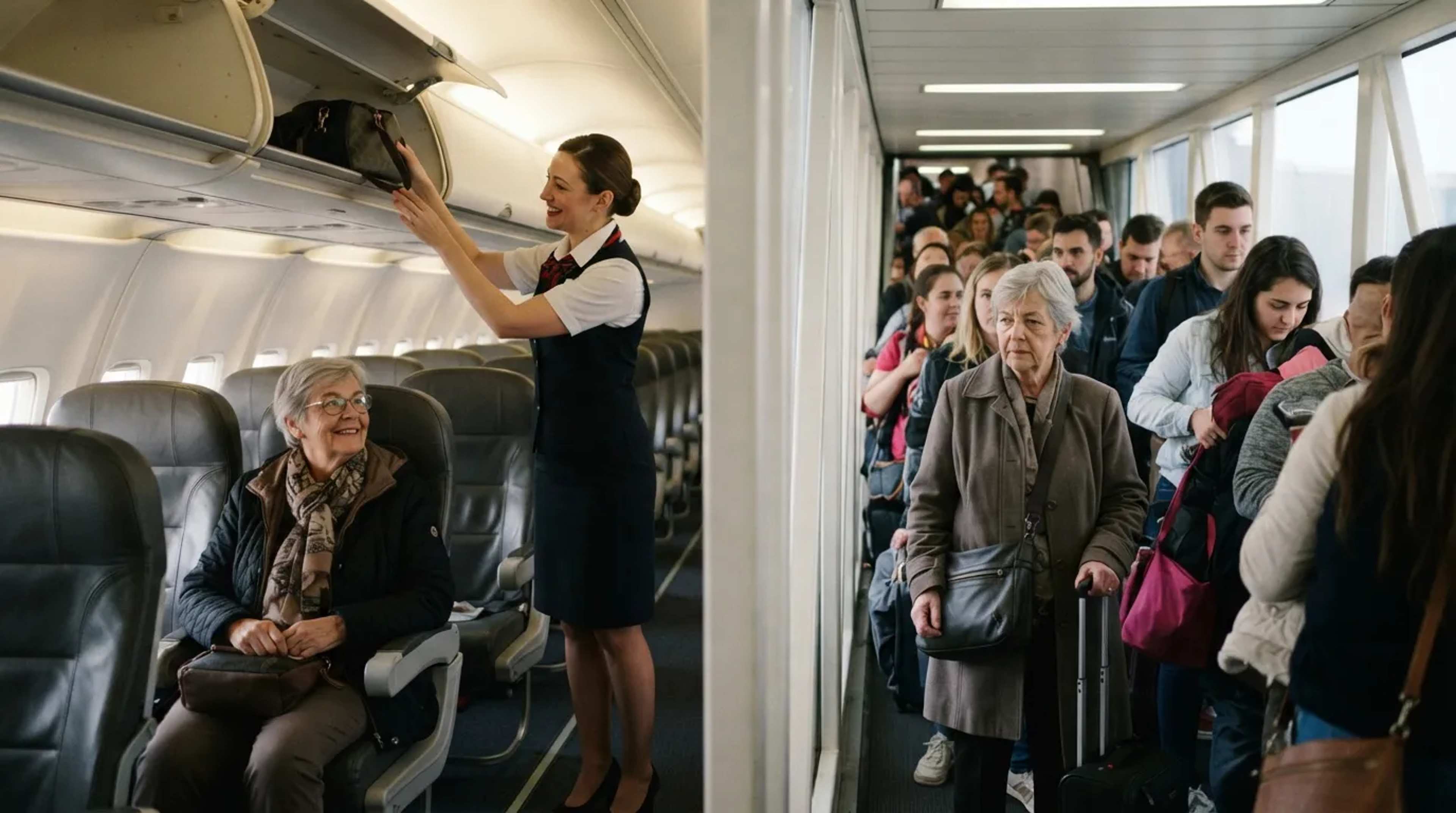
The doors slide open.
Strangers fall into each other’s arms.
And you – luggage at your feet, no one’s name on a sign – feel something crack open in your chest.
You blink too fast. You look away. You tell yourself you’re just tired from the flight.
You’re not tired. You’re witnessing something your nervous system has been quietly starving for: proof that someone, somewhere, is being found.
We have built entire lives around being in motion. We chase opportunity across time zones, collect passport stamps like merit badges, and call the restlessness “ambition.” But airports create a sense of disorientation, because we define ourselves in terms of time and place – we know who we are in relation to our daily routines and our familiar environments. Strip those away, and something raw and honest surfaces. Something that doesn’t care about your itinerary.
The modern traveler is expert at forward motion. What they are less practiced at is standing still long enough to feel the weight of what they’ve left behind – and what they’re still hoping someone will hand back to them.
1. The Mirror That Ambushes You
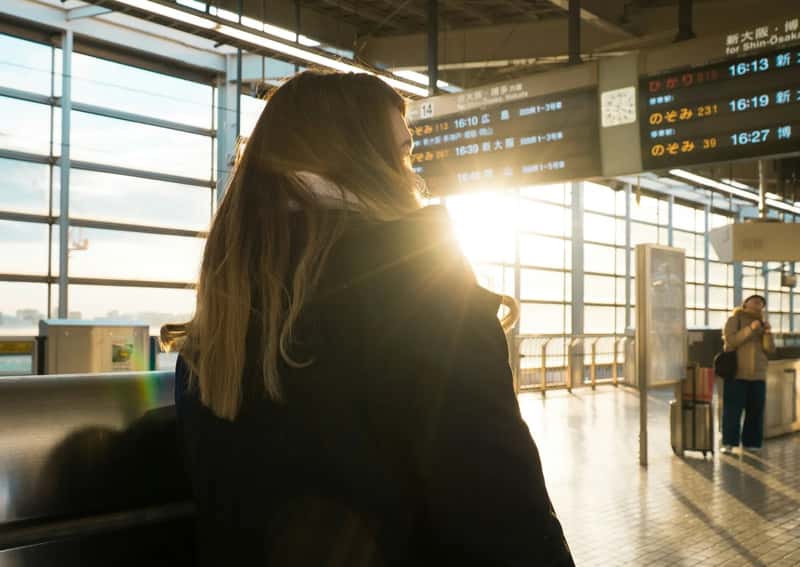
You weren’t expecting to feel anything.
You were between connections. Between cities. Between versions of yourself.
And then – two strangers collided in the walkway, and something inside you detonated quietly.
Evidence suggests that a mirror neuron mechanism exists in humans, extending beyond physical actions to emotional ones. When you witness someone in the grip of a powerful feeling, your brain begins to run something close to a simulation of that experience. Not a polite approximation. A full-bodied rehearsal.
The thing about this system is that it doesn’t wait for your permission. The response is automatic, which is partly why it catches people off guard. You’re not deciding to feel something about two strangers at gate 12. Your brain just goes there.
It goes there because it’s been there before.
It goes there because it knows exactly what that kind of holding on feels like.
The arrivals gate is not a sentimental place. It is a neurological one. And your tears are not weakness. They are your brain doing the most human thing it knows how to do.
2. The Emotional Archive You Forgot You Kept
Every goodbye you’ve ever survived is still in there.
Filed. Catalogued. Waiting for the right key to unlock it.
What the mirror system appears to do is pull from your own emotional history to fill in the details of what you’re seeing. It’s not generating some generic “reunion” feeling. It’s producing something far more personal, built from everything you’ve already lived through. Your brain is matching the scene in front of you to something already stored inside you, and the response follows from there.
Every significant emotional experience leaves something behind. The goodbyes that cost you. The times someone came back when you needed them to. The times they didn’t.
This is not nostalgia. Nostalgia is soft and golden.
This is sharper. This is the precise, specific weight of your own unfinished stories.
The woman dropping her bag to run toward someone? She just unlocked yours.
3. The Longing That Lives Ahead of You
Part of what you’re crying for hasn’t happened yet.
That is its own particular kind of ache.
The tears aren’t only about the past. Part of what gets activated in these moments is anticipatory – a kind of longing for reunions that haven’t happened yet.
Someone you haven’t seen in too long. A relationship that drifted without either of you fully meaning it to. A version of something you’re still hoping to find your way back to.
Chronic travelers know this feeling intimately. The forward motion keeps it manageable.
Until the arrivals gate holds it up like a mirror and asks: who are you still waiting to walk through those doors for you?
That question doesn’t announce itself politely. It just arrives. Usually while you’re holding an overpriced coffee and pretending to check your phone.
The anticipatory grief of belonging – the longing for connection you haven’t built yet – is one of the most quietly corrosive forces in a traveler’s life.
4. The Chemistry of Witnessed Relief
Your body responds to what your eyes see.
Biologically. Measurably. Whether you consent to it or not.
When you watch a reunion and feel that familiar pressure behind your eyes, your body is performing a subtle chemistry experiment. Stress hormones that may have been simmering quietly – cortisol, adrenaline – begin to shift. The sigh you didn’t realize you were holding escapes. Oxytocin, often nicknamed the “bonding hormone,” may rise as you watch gestures of care and affection. Dopamine might flicker in your reward pathways at the simple, ancient story: separation and then return.
Your tears are not just water. They are tiny chemical messengers, part of a cascade that says, “Something important is happening.”
The arrivals gate is, neurochemically, one of the most potent environments a human body can stand in.
Hundreds of emotional climaxes per hour. All of them broadcasting on a frequency your nervous system is tuned to receive.
You absorb it all. Whether you mean to or not.
5. The Gap Between Your Public Self and the One That Weeps in Terminals
I have stood at arrivals gates in four countries, alone, watching strangers embrace.
I told myself I was people-watching. A habit of the trade.
But the truth was simpler and less comfortable: I was watching people be witnessed. And I was measuring the distance between what I saw and what I had allowed myself to have.
So much of our emotional life is managed, trimmed, made presentable. We keep moving. We show up. We answer emails, pay bills, board flights on time. Reunion scenes slice through that careful management. For a second, it’s not necessary to be composed.
The traveler who cries at arrivals – alone, unbidden, slightly ashamed – is not falling apart.
They are briefly, terrifyingly, honest.
That is a different thing entirely. And rarer than we admit.
The identity gap lives right here: between the self that books the next flight, and the self that stands at the barrier, quietly hoping someone is coming.
6. The Ultra-Social Animal in the Anonymous Crowd
We were never designed for this kind of loneliness.
The specific modern loneliness of being surrounded by thousands and known by none.
Behavioral science often talks about humans as “ultra-social” animals, wired less like lone wolves and more like migratory birds – moving, sensing, and adjusting in relation to one another. In this framework, your tears are not rogue, inappropriate reactions. They are signals that your internal system is still tuned to the presence and emotions of other humans, even when they’re strangers.
Think about how often modern life places us side-by-side without much genuine contact: scrolling in parallel on buses, staring forward in elevators, sharing walls but not stories.
The arrivals gate is the rupture in that silence.
Two people refuse to be strangers to each other. Loudly. Physically. In front of everyone.
And something in the watching crowd exhales. Because we were all holding it. We were all waiting for someone to go first.
7. Emotional Contagion: The Invisible Currency of Public Space
You don’t choose to absorb it. It moves through you like weather.
Emotional contagion is the process by which we unconsciously “catch” the emotions of those around us – we tend to mirror the moods, expressions, and energy of other people as if their feelings were our own.
Scientists studying emotional contagion find that we copy not only facial expressions but also posture, tone, and even breathing patterns. We do it in microseconds, often below conscious awareness. Over time, that constant low-level syncing helps align us with the people around us. It’s harder to be cruel to someone if your own body keeps echoing their hurt.
The arrivals gate concentrates this effect.
Dozens of emotional peaks happening in close proximity.
Your nervous system is not passive in this environment. It is taking notes, syncing frequencies, updating its own emotional register with everything it witnesses.
You are, without knowing it, briefly belonging to all of it.
8. The Reunion You’re Rehearsing for Yourself
Here is the part no one mentions.
When you watch someone be received – really received, with the full-body, no-performance variety of human embrace – you are not just observing.
You are rehearsing.
From a behavioral perspective, those moments may be some of the most important training sessions your empathy ever gets. Each time you allow yourself to feel someone else’s joy, fear, or relief, you strengthen pathways in your brain that recognize and respond to emotional states.
It can make you a slightly safer person to stand next to on the bus, to work with, to live beside. You are quietly rehearsing the art of tuning in, of letting other people’s experiences matter to you.
Every witnessed reunion is a blueprint. A reminder of what you are capable of receiving, if you stay still long enough to let it reach you.
The tears are not grief. They are preparation.
9. The Identity That Only Exists in Transit
There is a version of you that only appears in airports.
Unmoored from routine. Unnamed by occupation. Unrecognized by anyone in the terminal.
A sense of identity is important to our psychological health but can become constricting. Like actors who are stuck playing the same character in a soap opera week after week, we enjoy the security of our roles but long to test and stretch ourselves with new challenges. So to step outside our normal routines and environments feels invigorating.
This transit-self is the most honest self many frequent travelers ever meet.
It has no LinkedIn profile to protect. No social performance to maintain.
It just stands at the arrivals gate and feels things without permission.
This is not instability. This is not a symptom of something broken.
This is the self that got lost somewhere between the last departure and the one before that, quietly trying to remember what it feels like to be somewhere, with someone, and stay.
10. The Specific Weight of Witnessed Belonging
This is the heaviest truth of the arrivals gate.
You are not crying because you are sad.
You are crying because you are witnessing proof – live, embodied, undeniable proof – that belonging is real. That it exists. That it happens to actual people in fluorescent-lit terminals between gate announcements and overpriced vending machines.
This is the reason people cry at airport gates, at train stations, at the arrivals lane where a car door opens and someone steps out into the arms of someone else. It is not primarily nostalgia or romanticism. It is your mind running an ancient program: “Connection found. Separation ended. Threat level lowered.” And when the body stands down from threat, emotion rushes in like water returning to a riverbed after a drought.
Anywhere people vanish and return, anywhere the thread between them stretches thin and is then pulled taut again, you find onlookers quietly dabbing at their eyes. That pattern itself is a kind of map – a sketch of how our bodies are designed to care, even when we pretend otherwise.
Witnessed belonging is its own category of emotion. It is not envy. It is not loneliness, exactly. It is the acute recognition that the thing you have been orbiting – connection, permanence, someone who marks your arrival with their body – is not a fantasy. It is available. It is happening right now, twelve feet away, between two people who found their way back to each other.
And you are standing at the edge of it, bag in hand, passport in pocket, and something in you is taking the whole scene in like oxygen.
The traveler who weeps at arrivals gates is not broken. They are, in fact, the most functional version of a human being in that building – the one whose system is still sensitive enough to register what matters, whose internal architecture hasn’t been insulated by too many departures, too many practiced goodbyes, too many cities slept in and left before the sheets had time to cool.
The ones who feel nothing at the arrivals gate are not stronger. They have simply traveled further from themselves.
There is no final destination in this kind of reckoning. No gate number where the announcement comes and the identity question resolves itself into clean certainty. But there is this: the arrivals gate as confessional, as diagnostic, as the one place in your carefully managed itinerary where your body tells the truth your schedule won’t allow. Listen to it. Not tomorrow. Not after the next connection. Now, in the fluorescent quiet, with the rolling suitcases and the held signs and the arms that refuse to let go – let yourself be a witness to what you still need.
The doors slide open again. Someone else is coming home. And for just a moment, standing there in the gap between who you are in motion and who you might become if you stopped – so, quietly, are you.