The key card doesn’t work on the first try.
You stand in the hallway.
You try it again. Slower this time. More deliberate.
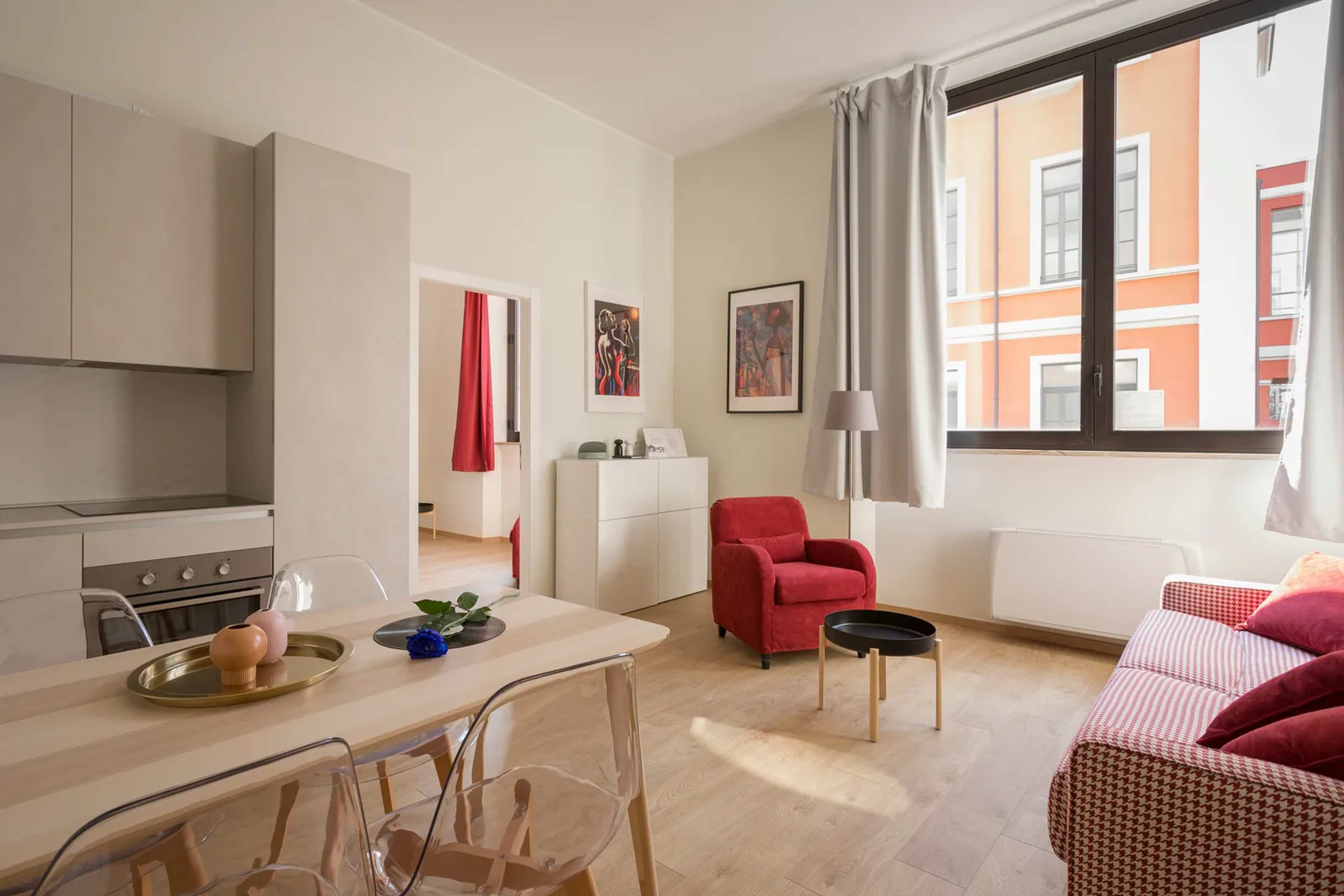
The door opens. You step inside. And the first thing you do – before you check the wifi, before you drop your bag – is straighten the throw pillow on the couch.
Nobody asked you to. The host certainly didn’t. And yet your hands move like they have a mandate.
This is the distance between the version of you who booked this place with confidence and the version standing in a stranger’s living room, touching things to prove you belong. We travel to find ourselves. We arrive and immediately start auditioning for the role of “person who deserves to be here.” The deepest bruise of travel is not the jet lag. It is the belonging gap.
The Borrowed Room

You paid for it. The receipt is in your inbox. The host left a welcome note with the wifi password and a small candle that smells like bergamot and expensive choices.
And still.
Still, you move through the space like a guest at someone else’s dinner party – careful, considered, one degree too polite.
Territoriality, as a concept in environmental psychology, plays a crucial role in how we interact with spaces and places, influencing our sense of ownership, belonging, and control. But you can’t buy territoriality with a credit card. You can’t check it in with your luggage. The borrowed room is yours and not yours simultaneously, and your nervous system knows the difference even when your rational mind refuses to admit it. So you fix the towels. You level the framed print that was already level. You perform occupancy because you cannot yet feel it.
The Ritual of Claiming
Watch yourself closely the next time you arrive somewhere temporary.
There is a sequence. It’s almost liturgical.
You set your toiletries on the bathroom shelf in a specific order. You plug your charger into the outlet closest to the bed. You move the decorative pillow – the useless one, the tiny one – to the chair in the corner.
Territorial indicators are the physical signs that communicate ownership or control of a space, and they exist on a spectrum – from highly temporary to deeply permanent. Your rituals are at the shallow end of that spectrum, and somewhere beneath conscious thought, you know it. The ritual isn’t about cleanliness or order. It’s a negotiation. A whispered agreement between you and the room: I will make you mine, and in exchange, you will make me real.
The Anxiety Architecture
Your hands know things your brain hasn’t admitted yet.
Travel entails less structure and control than our daily lives. Travel is unpredictable. Feeling anxious doesn’t always mean you dislike travel itself – it might mean you’re nervous about the loss of control, the unknown, or the “what ifs” that come with leaving home.
The towel-folding is not about the towel.
It is about the part of you that needs a foothold. That needs one thing – just one – to be exactly the way you decided it should be. Cozy spaces promote a sense of predictability and control, which are potent antidotes to anxiety. When the space isn’t yours, you manufacture that predictability manually. With your hands. With small acts of domestic authority that nobody will notice and everyone would understand.
The Imposter in Room 4B
Here is the thing nobody says out loud in the checkout queue at the airport bookshop.
Travel – even the voluntary, well-funded, five-star-reviewed kind – can activate something that looks remarkably like imposter syndrome.
The impostor phenomenon refers to the notion that some individuals feel as if they ended up in esteemed roles and positions not because of their competencies, but because of some oversight or stroke of luck. Translate that to the traveler standing in a beautifully curated Airbnb in a neighborhood they’ve only seen in photographs, and you have the same architecture of feeling. You got here. But did you earn it? The folded towel says: yes. The folded towel says: I am someone who takes care of things. Someone who belongs in spaces that are taken care of.
The Switching Cost
I remember standing in a studio apartment in Lisbon, holding a dish towel.
I had not used the dish towel. I had arrived twelve minutes earlier. I was holding it because I had picked it up from the counter, and folding it felt like the only sentence I knew how to say in the language of this room.
I folded it. I set it back down. I felt, briefly, like I lived there.
Travel loads the nervous system with new routes, faces, and sounds. When we return or arrive somewhere unfamiliar, executive function lags. Psychologists sometimes call this a “switching cost” – the time and energy it takes to move between contexts. What I was doing with that dish towel was paying the switching cost in a currency I could afford: a small, quiet act of order in a world that had just changed completely.
The Psychological Ownership Illusion
You cannot own what you have borrowed. But the mind doesn’t entirely accept this.
Psychological ownership refers to the deep-seated feeling of possession that can arise even in the absence of legal ownership. It is one of the most human things about us – this ability to feel a thing without it being technically true.
The Airbnb guest who re-folds the towels, re-centers the soap dish, and quietly tilts the lampshade two degrees to the left is not being controlling. They are building psychological ownership from scratch, in a space that already has an owner, with tools that are entirely invisible. The unpacking is the nervous system’s way of trying to collapse that timeline – to achieve belonging through the placement of objects, since it cannot achieve it through time and memory. The towel is just the object nearest to hand.
The Perfectionism Disguise
People will tell you it’s just a personality trait. That you’re a neat person. A detail-oriented person. A person who has high standards.
Maybe. But look closer.
One study in the journal Current Biology posits that rituals like cleaning and organizing might even be an effective coping mechanism for anxiety, with higher-anxiety individuals making more rigid and repetitive movements as a coping strategy.
The compulsive straightener in the borrowed space is not performing tidiness. They are performing competence. They are leaving evidence – for themselves, for no one else – that they are the kind of person who can handle this. Who can walk into a stranger’s space and make it behave. Imposters may rely more on avoidant coping – disengagement, overworking, perfectionism – because they perceive a high psychological cost in revealing thoughts or concerns of professional legitimacy. Even in a vacation rental. Even when nobody is watching. Especially then.
The Exit Strategy
Notice how, the day before you leave, you start to undo everything.
You refold the towels back to the original configuration. You move the pillow back. You erase yourself from the surfaces with the efficiency of someone destroying evidence.
This is not courtesy. This is not the checkout instructions. This is grief with a deadline.
When attachment to place is disrupted – through forced relocation, natural disaster, or simply movement – the psychological effects can be severe. The psychiatrist Mindy Fullilove has described the emotional consequences of displacement as comparable to grief, noting that losing a meaningful place can trigger feelings of anxiety, depression, and identity fragmentation. Even a place you occupied for four nights. Even a place you never truly owned. The exit strategy is the final performance – dismantling the home you built in six days so a stranger can build theirs in the same walls next week.
The Belonging Gap
The deeper question is not why you fold the towels.
The deeper question is: why do you feel like you need to earn your right to be somewhere you have already paid to be?
These internalized, negative perceptions of the self are borne out of environments and social interactions that lead people to question their abilities and worth. For the chronic traveler – the one who moves between cities, between short-term leases, between borrowed spaces – this questioning becomes ambient. A background frequency. A low hum of not-quite-here that follows you from checkout to check-in.
You can love a place passionately and still be a stranger in it. The belonging gap is not a flaw in the traveler. It is the honest report from a nervous system doing its job – scanning the environment, calculating risk, finding ways to feel safe in rooms that don’t yet know your name.
The Weight of Temporary
Every space you’ve ever stood in has eventually required you to leave.
Every bed. Every view. Every window with its particular quality of morning light that you memorized without meaning to.
The towel you fold in a rental in Seville. The lampshade you adjust in a sublet in Montreal. The throw blanket you refold in a studio in Seoul. These are not acts of obsession. They are acts of presence – the small, physical insistence that you were here. That this space knew you, even briefly. That you mattered to a room that will be reset before Tuesday.
Surrounding ourselves with objects that hold meaning creates a sense of identity and belonging. Familiarity breeds comfort and reassurance, making a space truly your own and thus truly safe. The tragedy of the temporary is that by the time you have built enough familiarity to feel truly safe, the checkout window is already open on your phone.
And so you stand at the door with your bag. You take one last look at the room – the towels square, the pillow centered, the lampshade exactly where you found it. The room looks like you were never there. But you were. You were entirely there. You were so thoroughly there that you needed to build it from scratch just to feel it.
The question that follows you into the elevator, into the cab, into the departure hall, is not “where are you going next?” It is quieter than that, and harder: when you stop moving, will any room feel like it already knows you? Or have you traded the permanence of belonging for the clean, addictive grief of always arriving?
Sit with that for a moment. The answer isn’t urgent. But it is yours.