The key card doesn’t work on the first try.
You try it again. Slower.
The door opens. You step inside and feel – nothing. Or worse, something you can’t name.
The light is slightly wrong. The pillow smells like industrial detergent and someone else’s careful choices. You walk to the window, look out at a view you didn’t choose, and begin, without thinking, to straighten the complimentary notepad on the desk. You didn’t come here to straighten notepads. You don’t even need the notepad. But your hand moved anyway, because your brain was already doing the thing it does – negotiating.
Psychologists have long recognized that our surroundings act as an extension of identity – the objects, colors, and routines that make up “home” help to stabilize our sense of self. Strip those anchors away and the self gets nervous. It starts reaching for small acts of control. A notepad straightened. A curtain adjusted or a lamp moved two inches to the left.
1. The Territorial Pulse
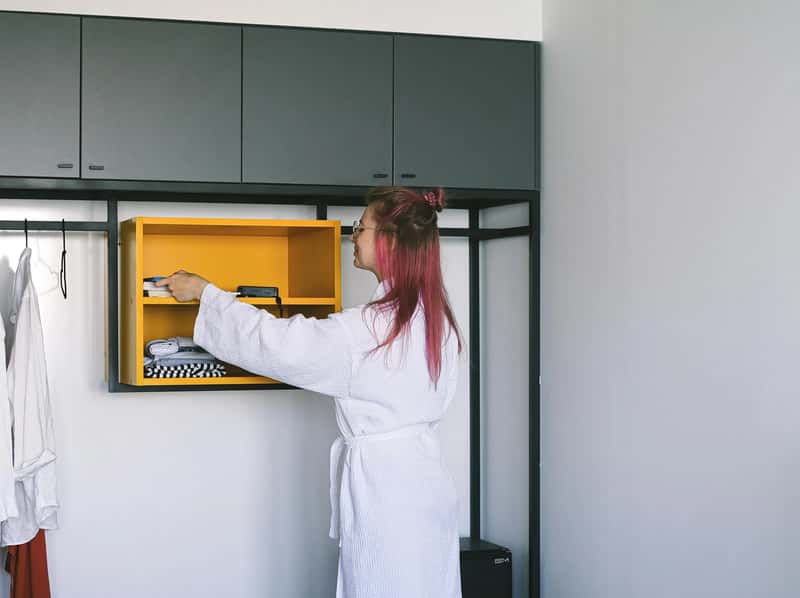
You walk in and your hands start moving before your brain gives the order.
You’re not cleaning. You’re not tidying. You are claiming.
Every day, without thinking about it, we claim spaces as our own – placing a bag on a chair to “save” it, arranging personal items on a desk, feeling a jolt of discomfort when a stranger stands too close. These are all expressions of territoriality: a deeply rooted pattern of behavior in which individuals assert control over physical spaces, objects, or even ideas.
In a hotel room, that pulse fires with a particular urgency.
In a foreign space, the territorial pulse fires loudly because the environment offers no reciprocal signal. Nothing in that room knows you. Nothing reflects you back.
So you fix the crooked lampshade. You hang your coat on a specific hook as if you own the hook. You are not being fussy. You are being human. One of the most influential explanations for this comes from evolutionary psychology, which argues that territoriality evolved as an adaptive strategy to help humans secure access to essential resources – individuals who successfully defended their territory had a better chance of survival, passing on these tendencies to future generations.
Your body doesn’t know it’s a Marriott. It thinks it’s a clearing in the woods.
2. The Ritual of Arrival
There’s a sequence. You always do it in the same order.
Bag on the luggage rack. Phone on the nightstand. Shoes off at a specific spot near the door. Curtains checked. Thermostat adjusted even when the temperature is fine.
You’ve performed this ritual in a dozen different cities. The cities change. The ritual doesn’t.
There is the repetitive, almost compulsive sequence of actions we perform upon arrival in any unfamiliar space. Scientific evidence supports the correlation between stress and ritualization – redundant, repetitive behaviors like washing or organizing. One study posits that rituals like cleaning and organizing might even be an effective coping mechanism for anxiety, with higher-anxiety individuals making more rigid and repetitive movements as a coping strategy.
The ritual is not about the room. The ritual is about you.
The ritual is not the point. The calm that follows the ritual is the point.
You are not arranging toiletries on a bathroom shelf. You are filing down the sharp edges of being somewhere new, somewhere that hasn’t agreed to know you yet. The act of doing something familiar – in an unfamiliar place – is the brain whispering to itself: we’ve done this before. We survived before. We’ll survive this too.
3. The Sensory Audit
Before you fix anything, you scan everything.
You don’t decide to scan. It simply happens.
The lighting is wrong. The pillow smells like someone else’s detergent. The ambient sound of the neighborhood is unfamiliar – wrong kind of traffic, wrong frequency of sirens, wrong quality of silence. Every sensory mismatch is a small alarm. The brain catalogues them. It does not sleep until it has processed them.
This is why you move the lamp. Not because the lamp is offensive. Because the light it throws doesn’t match the light your nervous system expects at this hour, in a place it’s trying to call safe.
The psychological process of place attachment includes three components – affect, cognition, and behaviour. Affective bonds often arise from experiences that fulfil fundamental needs such as safety, comfort, and belonging. When those sensory anchors are absent – your specific light, your specific smell, your specific acoustic texture – the affect goes unmoored.
You are not a difficult guest. You are a highly calibrated one. Your brain is simply doing its job. Unfortunately, its job was designed for a world that didn’t have blackout curtains and a Bluetooth speaker you can’t pair.
4. The Psychological Ownership Play
You rearrange the chair slightly. You don’t need it rearranged. But it feels better angled toward the window.
You put your book on the nightstand as if staking a claim.
You don’t own it. You know you don’t own it. You will leave in three days and someone else will arrive and the room will reset like a factory default. None of your arrangements will survive checkout.
And yet.
In a temporary space, psychological ownership is the brain’s workaround for the absence of time. You cannot build belonging through years of memory. So you build it through the placement of objects, and you call it home, and it almost works.
That “almost” is doing a lot of heavy lifting in the human condition.
The chair angled toward the window. The shoes placed just so. Personalization is one of the most visible expressions of territoriality – it involves adding personal items or modifications to a space to make it reflect your identity. You are not decorating. You are asserting. You are quietly, desperately insisting that a person lives here now, even if only until Thursday.
5. The Identity Anchor
I need to tell you something personal here.
There was a hotel in a city I’d visited a dozen times – a work trip, a conference, somewhere I should have felt comfortable. I walked in, set my bag down on the luggage rack, and immediately moved the desk lamp. Then I moved it back. Then I arranged my notebook on the desk, my pen beside it, my reading glasses folded on top as if I were someone who had always kept his glasses folded on a desk in this specific room.
I wasn’t organizing. I was introducing myself to a space that did not care I existed.
The room was a category, not a place. And I needed, urgently, to be a person and not a category myself.
This is the Identity Anchor. The small object – the familiar book, the notebook, the worn toiletry bag – that you place in the room not because you need it, but because it carries information about who you are. When we step out of our everyday environments and routines we undergo a temporary rearrangement of our identities – one that lets us imagine other possibilities for ourselves. The anchor stops the rearrangement from going too far. It holds the thread back to the person you were before you checked in.
6. The Control Bargain
The thermostat is set to 68. You change it to 70.
Not because you’re cold. Because you can.
In a world where the room was pre-configured for a guest who isn’t you, where the art was chosen by a committee, where the mattress was selected for the average human back – the thermostat is one of the very few things you actually control. And so you control it, emphatically.
Research into hotel guest behavior has found that safety, security, and control emerge as paramount psychological needs in the hotel room environment.
Perceived control is perhaps the single most powerful moderating factor. People who feel they can leave a situation, have some private space to retreat to, or have chosen to be there voluntarily experience significantly less distress.
This is why you rearrange the toiletries into your own specific order on the bathroom shelf. The hotel arranged them one way. You arrange them your way. It is a small act of sovereignty. It costs nothing. It means everything to a nervous system that spent six hours in an airport being managed, scanned, and directed.
You are not high-maintenance. You are reclaiming the only square foot of autonomy available to you.
7. The Competence Signal
The shower fixture is baffling. You figure it out in forty-five seconds and feel unreasonably satisfied.
The TV remote works on the third try. Small victory.
You find where the safe is, how the blackout curtains work, which USB port charges fastest. You are solving a room. And every small solve sends a signal to your brain: you belong here. You’ve earned your place. Look at how well you operate in this space.
Discomfort during travel fuels personal growth by forcing you outside comfort zones and building confidence through uncertainty. Even micro-discomfort. Even the uncertainty of a shower with three unlabeled levers.
The “fixing” behavior – tightening the loose towel bar, figuring out how the closet light works – is competence-seeking dressed as tidiness. Unfamiliar environments force your brain to create new neural pathways rather than relying on established patterns. In essence, discomfort signals your brain that standard operating procedures won’t suffice. The brain responds by solving. By fixing. By proving, one adjusted curtain rod at a time, that it is capable of being here.
8. The Unpacking Confession
Watch how you unpack. It tells you everything.
Do you unpack immediately, completely, with a kind of methodical urgency? Or do you leave the suitcase open on the floor, pulling items out reluctantly, one at a time?
Some travelers leave the suitcase open on the floor like a wound. They pull things out one item at a time, reluctantly, as though committing to the space means surrendering to it.
For these people, the unpacked suitcase is a refusal. A protest. A way of saying: I am not all the way here yet.
The people who unpack completely within minutes are not more organized. They are more urgent. They need the room to accept them faster.
The unpacking is the nervous system’s way of trying to collapse that timeline – to achieve belonging through the placement of objects, since it cannot achieve it through time and memory.
Either way – the refusal or the urgency – it’s an honest confession about where you stand with the room. About whether you’ve decided, yet, that you’re allowed to be there at all.
9. The Exit Strategy in Mind
Even as you settle in, part of you is already leaving.
You note where the fire exit is. You check the checkout time twice. You keep your passport in the same inner pocket it’s always in, because the cost of not knowing where it is – even for thirty seconds – is a specific kind of panic.
This is the Exit Strategy Mind. It runs in parallel with everything else.
Travel can be exhilarating, restorative, and fun, but it can also be quite stressful – and for many travelers, there is a particular brand of anxiety around arriving at a hotel or home away from home, opening the door of a space that is new.
The Exit Strategy Mind isn’t pessimism. It’s the brain’s insurance policy against the vulnerability of temporary shelter. You fix things in the room – tighten the loose shower head, prop the wobbly nightstand – because a room that functions properly is a room you can exit cleanly, on your own terms. Control over the space is control over the departure. Research on lodging theory began with the observed differences in human behavior while at home versus during an overnight stay at a commercial lodging establishment – and what it found, repeatedly, is that the hotel guest is always partly somewhere else. Already mid-checkout. Already half gone.
10. The Invisible Permission Slip
This is the heaviest one.
All the straightening, the rearranging, the thermostat adjusting, the lamp moving – beneath all of it lives a single, quiet question.
Am I allowed to be here?
Not in a legal sense. Your credit card settled that. But in the deeper sense. The sense that whispers: does this space accept you? Does it recognize you as someone worthy of its clean towels and its view and its quiet? Space is a vital component of an individual’s identity content, as locations can be grounds for activating certain identity content and provide a sense of security and belonging – or be challenging by testing one’s physical and psychological boundaries.
The brain, in the absence of a permission slip, issues its own.
Each small act of “fixing” is a signature on that slip. The adjusted pillow: I have made myself comfortable here. The rearranged desk: I have made this space reflect me. The lamp moved to the correct angle: I have imposed my preferences on this neutral space and the space has accepted them.
It is the self, relentlessly insisting on its own coherence. It is, quietly, one of the bravest things a person does without knowing they are doing it.
You move the lamp. You sign the slip. You earn – for a night, for three nights, for however long the key card works – your right to be there.
There is something worth sitting with in all of this.
The traveler who straightens notepads and adjusts thermostats and moves lamps two inches to the left is not being difficult or anxious or particular. They are navigating something genuinely complex – the gap between a self that requires context to feel real, and a world that keeps offering contexts that were built for no one specifically and everyone in general. Identity is very much influenced by context: what space are you in, who is with you, and what are their expectations of how you should be? In a hotel room, none of those questions have answers. The room has no expectations. It reflects nothing back. And so the self reaches, quietly, for a pen and a notepad and a lamp and a thermostat, and it builds, from those small materials, something that feels enough like itself to sleep in.
The psychiatrist Mindy Fullilove has described the emotional consequences of displacement as comparable to grief, noting that losing a meaningful place can trigger feelings of anxiety, depression, and identity fragmentation. Even temporary displacement, it turns out, costs something real. The hotel room is a short-term displacement that the body still processes as a loss – a brief severance from the familiar surfaces and specific silences that tell the brain who it is. The fixing behavior is grief management. Small, efficient, and disguised as tidiness.
The next time you find yourself straightening something in a room you don’t own, in a city that doesn’t know your name – notice the hand before you judge it. It is doing the only thing it knows how to do in the dark. It is reaching for something it can make right, in a world that keeps handing it things that are almost right, nearly right, close enough – and then checking out before you’ve had time to learn the difference.