You are standing in a crowded piazza.
A stranger is holding a selfie stick at the Colosseum.
You feel a specific, hot contempt rise in your chest.
You don’t know this person. You have never spoken to them. And yet, something about their presence – their camera angle, their shoes, their tour group lanyard – makes you furious.
Ask yourself why. Not rhetorically. Actually ask.
Because the thing about travel is that it promises a version of you that is more alive, more curious, more worthy. And the moment you see someone doing it “wrong,” you are not seeing them. You are seeing the version of yourself you are most afraid of becoming – the one who doesn’t deserve to be there.
The Label You Give Others Is the Label You Fear for Yourself
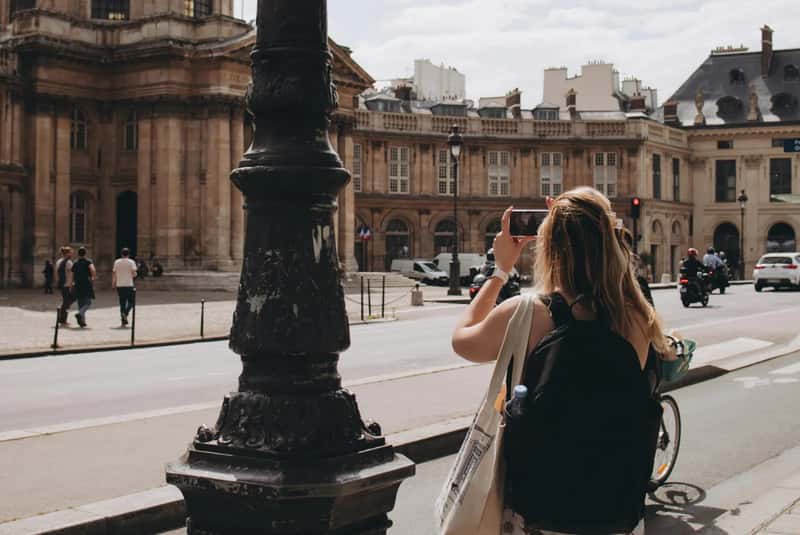
There is a pecking order among people who travel, and almost nobody admits to being at the bottom of it. Ask a hundred people on vacation whether they consider themselves a tourist, and most will reach for a different word – traveler, explorer, wanderer, or at the very least, just someone passing through who really tried to find the local spots.
Notice what that reaching feels like.
It feels like panic dressed up as preference.
The label of tourist has become something to avoid – a mark of shallowness, of following a crowd, of not quite getting it.
But the label was never really about the other person.
It was always a mirror. The anger you feel at the “bad tourist” is the sound of your own self-doubt echoing off cobblestone. You are not protecting the culture. You are protecting your fragile claim to being someone who deserves this moment.
The Hierarchy Has Always Been a Self-Portrait
The hierarchy has always been less about how you travel and more about who gets to define the right way to do it. The intellectual scaffolding for the traveler versus tourist argument was erected decades ago – American historian Daniel J. Boorstin laid out his case in his 1962 book The Image, where he argued that the modern tourist had become passive, preferring the pre-packaged and the comfortable over any genuine encounter with a foreign place.
This framing was seductive.
It was also deeply convenient.
This framing was seductive and, not coincidentally, flattering to the kind of person who read academic criticism of tourism while planning their next trip abroad. That person – that intellectual traveler – was always designing a costume. And the anger at “bad tourists” is simply part of the performance.
The hierarchy is a self-portrait you paint in someone else’s image.
The Superiority Complex Is a Disguised Wound
The tourist vs. traveler binary contributes to a superiority complex that seems rooted in a sense of competition – and that competition is focused on an individual’s personal “travel identity.”
Identity is a tender thing.
It bruises easily, especially in unfamiliar places.
When you arrive somewhere new, your usual markers of self-worth – your job, your neighborhood, your routine – dissolve. You are suddenly just a body in a place that existed long before you arrived and will exist long after you leave. The ego finds that unbearable. So it creates a new hierarchy. A new score to keep.
People throw around these terms to make themselves feel special, even superior. It’s the identity thing we’re obsessed with. We do it with our careers and where we come from, too.
The wound is older than the trip. The trip just makes it visible.
The “Authentic Experience” Is Also a Constructed Fantasy
You want the local restaurant. The back alley. The dish without a photo on the menu.
This desire is real. But examine its roots.
Research introduced self-congruity into the field of tourism and found that the higher the degree of self-congruity of tourists is, the more satisfied they are with the destination. People identify with brands or businesses that help define or reinforce, improve or enhance, and communicate their self-concept to others or society.
Your destination is always, partially, a self-concept.
The “authentic experience” you’re chasing is not purely about the place. It is about the person you want to be seen as – by strangers, by followers, and most brutally, by yourself. Destination images act as symbolic clues that stimulate associations between the place and personality characteristics. As a result, the destination image becomes an available resource for self-expression and an extension of self.
There is nothing wrong with wanting meaning from travel. There is something worth examining in the rage it produces when others seek meaning differently.
I Once Was the Person I Now Despise
I remember standing outside a market in Marrakech, watching a group of tourists take photos of a spice stall with matching luggage and identical white sneakers. I remember the specific, satisfied contempt I felt. I told myself I was different. I had been there three days. I spoke about ten words of Darija. I had read one book about Moroccan history on the plane.
I was not different.
I was just performing difference.
Imposter syndrome is a behavioral health phenomenon described as self-doubt of intellect, skills, or accomplishments. These individuals cannot internalize their success and subsequently experience pervasive feelings of self-doubt, anxiety, and apprehension of being exposed as a fraud, despite verifiable and objective evidence of their successfulness. That is exactly what travel-shaming is, dressed in linen pants and a vintage camera strap.
The rage at the tourist is the fear of being outed as one.
Attribution Theory Explains the Snap Judgment
The contempt happens fast. Almost involuntary. A flash of something ugly behind the eyes before you can interrogate it.
There is a psychological name for this.
Humans overwhelmingly attribute behavior to personality over situation – which is why things feel “judgy.” If a colleague is rude to us, we can attribute that rudeness to personality – they are a horrible person – or give them the benefit of the doubt and presume it is because they are tired or stressed.
We do not give tourists the benefit of the doubt.
We decide immediately. We decide based on their shoes, their volume, their accessories. We decide because making the decision about them is so much easier than sitting with the anxiety of our own presence in a place we are not sure we fully earned.
The snap judgment is a defense. It is fast because it has to be.
The Instagram Tourist Became a Convenient Villain
Every generation of self-identified “travelers” needs a villain. Someone lower on the hierarchy to point at.
In our era, we found one readily.
The rise of Instagram in the early 2010s didn’t dissolve the tourist hierarchy so much as it created a new tier at the very bottom of it. Instagram tourism has been characterized as a superficial consumption of, rather than sincere interest in, a place, with those engaging in it described as people coming to get a photo of the photos they’ve seen. This gave the self-identified travelers a fresh villain and a genuine point.
That last sentence deserves a long, quiet read.
A genuine point. Yes. And also: a convenient one. Because as long as there is someone below you on the ladder, you never have to examine your own grip on the rung. The Instagram tourist is not the problem. They are a mirror you have decided to treat as a window.
The Fear of Being Unworthy Is the Real Driver
Here is the interior monologue no one says out loud:
What if I am not the kind of person who deserves to be moved by this?
Feeling like a fraud or an impostor is often connected to the ways in which we feel about ourselves. It can be the source of high levels of stress and anxiety, and the cause and effect of self-doubt and low self-worth. Travel amplifies this because there is no performance review. No badge. No grade. Just you, standing in front of something ancient and enormous, wondering if you are feeling the right things deeply enough.
And when someone nearby seems to be feeling nothing – taking a photo, laughing too loudly, pointing at a menu in their native language – you feel a specific fury.
Not because they ruined the moment.
Because they reminded you that the moment’s value was never guaranteed in the first place. By doubting yourself, especially in areas where you excel, you can end up dealing with persistent patterns of self-doubt, negative self-talk, and missed opportunities – or you may end up trying to over-compensate for your extreme fear of failure, burning yourself out and creating a great deal of anxiety in the process.
The “bad tourist” didn’t take anything from you. Your fear did.
The Traveler Identity Is Not a Personality. It Is a Defense Mechanism.
It is as if the label somehow makes your experience more authentic. It does not.
The label is armor.
A backpacker who slums it in hostels and hangs out mainly with other backpackers is in no way more of a free-spirited and open-minded traveler than the person who stays in an expensive hotel, and some people who may seem stereotypically like tourists may actually engage more with local people and be more interested in local culture than those who like to flaunt a traveler persona. The distinction is usually vain and almost entirely self-serving. Everyone in a foreign city is an outsider. The locals can’t tell the difference, and they rarely care.
Read those last two lines slowly.
The locals cannot tell the difference. The identity you are performing, the one that requires the condemnation of others to sustain itself, is invisible to the only audience that might have made it meaningful. You are delivering a monologue to an empty theater and calling it depth.
The Most Courageous Thing You Can Do Is Admit You Are Also Just Passing Through
The Oxford Dictionary defines a tourist as “a person who is travelling or visiting a place for pleasure,” and Merriam-Webster states that a tourist is “one that makes a tour for pleasure or culture.” By these definitions, a trip to seek enlightenment with the monks in the Tibetan Mountains is just as touristy as a spring break vacation to an all-inclusive resort.
That is not a deflation. That is a liberation.
You are not diminished by being a tourist. You are freed by it. Call yourself a backpacker, call yourself a traveler, call yourself a digital nomad or a million other names – but the facts are that you’re a tourist when you travel in a new country, and being a tourist is not bad or wrong or anything to be ashamed of.
The courage is in dropping the performance entirely. In standing in the piazza next to the person with the selfie stick and thinking: we are both just here. Both temporary. Both trying to feel something real in a world that moves faster than feeling. That thought – that humble, unglamorous thought – is more “authentic” than any curated itinerary or knowing smirk at the tour group bus.
New sights, sounds, and smells play a significant role in creating memorable experiences. Personal growth is one of the core gifts travel offers – a genuine opportunity for learning and self-discovery. But that growth cannot begin until you stop spending your psychic energy policing others’ access to the same gift.
The “bad tourist” you see across the plaza is not your enemy. They are not even your problem. They are a stranger, doing the same frightened, hopeful thing you are doing – arriving somewhere unfamiliar and hoping, quietly, that it changes them.
The next time the anger rises – hot and immediate and certain – let it be a question instead of a verdict. Ask yourself what you are afraid they will reveal about you. Ask yourself what you are protecting. Ask yourself whether the version of yourself you are trying to be in this place actually requires their failure to exist.
Then put down the quiet contempt. Pick up your own uncertainty. And just – be somewhere.
That’s the whole point. It always was.