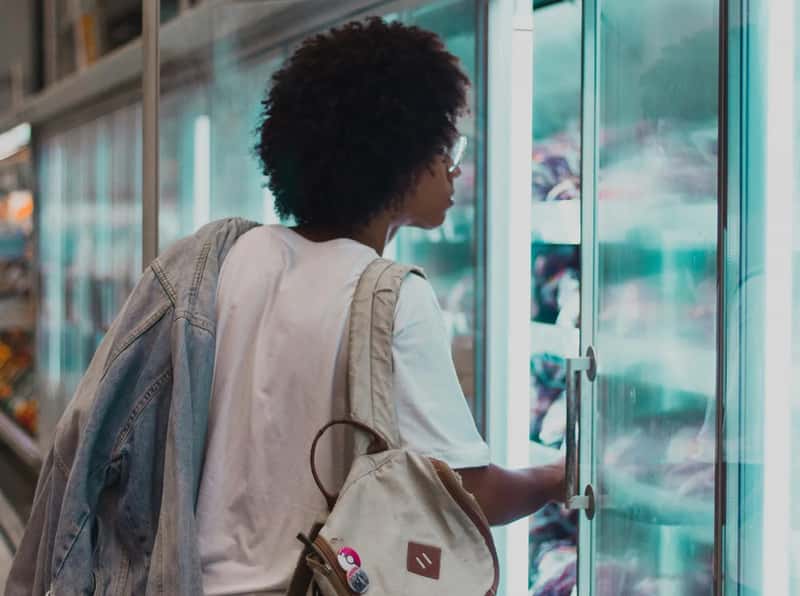
You are standing in a foreign supermarket aisle.
The fluorescent lights are the same everywhere in the world, and yet.
Something about the shape of a cereal box – a brand you haven’t thought about in eleven years – breaks you open like a fault line.
You are not crying about cereal. You know that. But knowing it doesn’t stop the pressure behind your eyes, the tightness climbing your throat, the sudden, nauseating vertigo of being a person who is nowhere and everywhere at once.
This is the Identity Gap. The chasm between the traveler you perform – passport-stamped, adaptable, allergic to sentimentality – and the person your nervous system actually is: a creature of pattern, of ritual, of sensory familiarity so deep it predates language. The traveler you perform moves through new cities like smoke. The person you actually are stands in a grocery store in a country that is not home, staring at a jar of the wrong brand of peanut butter, and mourns. The gap is not a flaw. It is the whole story.
1. The Smell That Preceded Every Memory You Have
It hits you before you even process it.
The bread aisle. Or the spice section. Or the detergent smell mixing with produce and cold air from the refrigeration units.
You don’t choose to feel it. It arrives.
Autobiographical memory triggered by olfactory stimuli is more emotional than memory triggered by alternate sensory input – a result of the direct neural link between the olfactory system and the amygdala-hippocampal system implicated in emotion and memory processing. In plain language: smell bypasses the part of you that has opinions about feelings. It goes straight to the archive. The archive does not care that you have a flight in four hours. The archive does not care that you are supposed to be a person who handles things.
What you smell in that foreign grocery store is not a product. It is the ghost of every kitchen that ever held you.
And the ghost doesn’t care what country it’s in.
It just wants you to remember.
2. The Fluorescent Light That Feels Like Childhood
Institutional lighting is the same everywhere on earth. That is the uncanny part.
The hum. The slight greenish cast. The way it makes everyone look a little tired and a little real.
Grocery stores are the antithesis of tourist traps – less likely to have English-speaking staff than popular attractions, yet there’s something familiar about supermarkets no matter where you go in the world, from fluorescent lighting to shelves stocked with basic food groups.
That familiarity is exactly the trap.
Your brain registers the visual template – aisle, cart, checkout – and whispers: you have been here before. You haven’t. But the architecture of mundane commerce is identical in every language, and your nervous system mistakes the template for the memory. You don’t feel at home in this store. You feel at home in the idea of a store. The Platonic grocery. The one that exists only in the accumulated sediment of every errand you ever ran as a child trailing behind someone who knew where things were.
You are not in a supermarket in a foreign city.
You are six years old, and someone is holding your hand, and you don’t have to know anything yet.
3. The Texture of Something That Was Always Just There
Reach for a can. Feel its weight.
That’s it. That’s the whole ambush.
The senses are powerful regulators. A song from your teenage years, the spice blend your family used, the texture of a childhood blanket – these cues can unlock comfort quickly. Sensory nostalgia is often grounding because it engages the body, not just the mind.
Texture is the most underestimated of the memory senses. We talk about smell, about taste. We forget touch. But the weight of a familiar jar, the cool curve of a glass bottle, the rough cardboard of a brand you grew up seeing – these are stored in the body, not the brain. Your hands remember things your conscious mind has long since filed under “irrelevant.”
In a foreign grocery store, the textures are wrong. And that wrongness is the very thing that surfaces the memory of rightness. The memory of a kitchen where you didn’t have to translate anything. Not the labels. Not yourself.
Grief, it turns out, has a very specific weight.
It feels like the wrong can in the right aisle.
4. The Sound Architecture of Safety
Background music you don’t recognize. A language you’re parsing but not absorbing. The specific percussion of wheels on tile.
These sounds are almost right. Almost familiar.
That almost is doing significant psychological damage.
Emotional peaks create “flashbulb memories” that resist forgetting. Emotions tag experiences as important, making them more accessible for nostalgic recall. Which means the sound architecture of a childhood supermarket – the particular echo of a high-ceilinged store, the beep of a scanner, the mundane PA announcements – is preserved in high definition somewhere in your hippocampus, waiting for a close-enough match to trigger playback.
This foreign store offers a close-enough match.
Your nervous system boots up the original file.
And for a half-second, suspended between the foreign and the familiar, you experience what grief theorists might call ambiguous loss – mourning something you cannot fully name because the thing you have lost never existed as cleanly as you remember it.
The sound of safety was always slightly out of tune.
You just didn’t notice until you heard the wrong version of it.
5. The Brand Recognition That Became Your Identity
I need to tell you something that happened to me in a supermarket in Lisbon.
It was three months into a long stretch of travel. I was doing fine – or performing fine, which I had confused for the same thing. And then I turned a corner in a grocery store and saw a box. An imported box, from a brand I hadn’t thought about since I was maybe nine years old. A breakfast cereal I didn’t even particularly like as a child.
I stood there for what felt like two full minutes. I didn’t buy it. I couldn’t explain why I was standing there. I just was. And when I walked away, something in my chest felt loosened and raw, like a knot that had been pulled tighter for months had suddenly, briefly, slackened.
That box wasn’t about cereal.
Nostalgia acts as a sort of psychological glue, helping us maintain a sense of who we are across time. By revisiting our past experiences and connecting them to our present selves, we create a coherent narrative of our lives. When we are in perpetual transit – new cities, new beds, new versions of ourselves assembled for new audiences – brand recognition becomes identity scaffolding. The logo is a fixed point in an otherwise shifting visual field. It says: you were a person before all of this movement. You will be a person after.
That box of cereal was evidence that I existed.
6. The Color of Home That Has No Name
Every country packages food differently.
The color palettes shift. The fonts change. The visual grammar of “safe” and “familiar” and “this product will not hurt you” is entirely cultural and entirely invisible until it isn’t.
The brain doesn’t separate taste from experience but stores them together. “Nostalgic flavors hit so hard because they’re tied to the limbic system, the part of the brain that processes both emotion and long-term memory.” But the same is true of color. Of visual design. Of the particular shade of orange that your childhood brand of juice happened to use. Your limbic system learned what safe packaging looked like before you were old enough to read the ingredients.
In a foreign grocery store, all the packaging is wrong.
Not objectively wrong. Not bad. Just – not the color of safety.
And that wrongness forces you to confront something uncomfortable: the color of home was never a universal truth. It was a personal accident. A series of exposures so early and so repeated that they fused with the concept of okay. The feeling that the world was legible. That you knew where you were.
You are learning, in this aisle, that you never actually did.
7. The Ritual of Knowing Exactly What You Need
In your home grocery store – or what used to be your home grocery store – you knew where everything was.
You didn’t have to think. You moved on autopilot. The list was already spatial, already mapped onto your body’s memory of the layout.
That autopilot is a profound psychological comfort, and you don’t know you have it until it’s gone.
During times of uncertainty or loss, nostalgia can become a sort of psychological anchor. The act of navigating a familiar store – knowing the produce is at the front, the dairy at the back, the cereal in aisle seven – is a small but structurally significant form of mastery. You are competent here. You are oriented. You are not having to translate yourself in real time.
In a foreign grocery store, you are back to being a beginner at everything. The cash register works differently. The bags are different. The checkout ritual is a small social performance you haven’t rehearsed. And for the traveler who spends months being a beginner in every context, this one tiny loss of autopilot compounds everything else.
The emphasis is not on big events, but on the affective charge of the everyday: “those little routines” that accumulate into a memory landscape.
Knowing where the cereal is was never about cereal. It was about not having to try so hard just to exist.
8. The Taste That Was Never Really About the Food
You find a product. An approximation. Something close enough to what you know that you put it in the basket.
You take it back to wherever you are staying. You eat it standing over the sink at 11pm in a city that is beautiful and completely indifferent to you.
It doesn’t taste right. Of course it doesn’t.
When we eat familiar foods from our childhood or cultural background, we are not just satisfying hunger. We are, in many ways, travelling back in time to moments where we felt safe, loved, and at home. Eating a certain dish can evoke powerful emotions, reminding us of family dinners, festive holidays, or even quiet afternoons with a snack we loved as a child.
The taste was never really about the food.
It was about the context the food lived inside. The table. The voices. The knowledge that you were expected somewhere and that someone would notice if you didn’t show up. The way food consumed in safety tastes different than food consumed alone in transit. The limbic system encodes the context along with the flavor. They are the same memory.
When the context is gone, the food is just food.
And for a moment, standing at a sink in a foreign city, you feel the full weight of that.
9. The Mythology of the Safe Kitchen That Raised You
Here is the part nobody wants to say out loud.
The home you are grieving, in that grocery store aisle, did not exist the way you remember it.
When we engage in nostalgia, we tend to focus on the positive aspects of our memories, often idealizing the past. This selective recall can serve as a mood booster, helping us navigate difficult times by reminding us of happier moments. But selective recall is, by definition, a distortion. The kitchen of your memory was warmer, quieter, safer, and more reliably loving than any kitchen you have ever actually stood in.
Nostalgia is a memory of past experiences imagined as homely and guiding home-building in a new place by fostering familiar feelings, which helps one to recreate the conditions that produced these feelings in the past.
You are not trying to return to what was. You are trying to return to what you needed it to be. The Safe Kitchen is a psychological construction, assembled from the best moments and smoothed of their edges by time and distance. Every foreign grocery store aisle is a kind of séance – an attempt to conjure a ghost that was always, on some level, fictional.
This is not sad. It is human.
But it is important to know you are looking for something that was always a little bit made up. Because then you can stop being surprised that you can’t find it.
10. The Longing for a Self That Felt Continuous
This is the heaviest one. This is what the grocery store is actually about.
Movement fractures identity. Not catastrophically – not all at once – but incrementally, aisle by aisle, city by city, hotel room by hotel room. You are a slightly different person in each new place. You adapt. You perform. You adjust your accent, your references, your level of explained context. Over weeks and months, the accumulated cost of this adaptation is a kind of quiet disorientation: who is the continuous version of me?
Nostalgia serves as a coping mechanism that allows us to navigate periods of stress, loneliness, or transition. By taking a mental trip down memory lane, we can foster a sense of personal continuity, easing feelings of discontinuity or disconnection that we might be experiencing in the present.
The grocery store is a portal to the continuous self. The self that existed before all the movement. The self that had a regular store, a regular route, a regular Tuesday. The self that was, in the most basic sense, known – by a place, by a rhythm, by the particular frequency of light on a particular afternoon.
Nostalgia isn’t just a thought. It’s an embodied experience. The brain doesn’t replay memory like a flat video; it reconstructs it, pulling in texture, color, sound, and feeling. That’s why nostalgia can show up in your throat as a tightness, in your skin as a small prickle, or in your chest as an expanding softness.
You stand in a grocery store in a country that does not know your name.
And something in you reaches backward through time toward a version of yourself that felt, however briefly and however imperfectly, located.
That reaching is not weakness. That reaching is evidence that you are a person who has loved specific places and specific rhythms. A person for whom the world was once small enough to be memorized. A person who carries, in their nervous system, the blueprint of belonging – even if the house it describes was always partly imagined, partly myth, partly the architecture of a child’s very reasonable need to feel safe in an unsafe world.
The philosopher Simone Weil wrote that to be rooted is perhaps the most important need of the human soul. What she did not say – because it is the darker corollary, the one we discover only in motion – is that the root and the ground are never quite the same shape. We remember roots that held more firmly than they did. We remember ground that was more solid. The “safe home” we are reaching for in foreign grocery stores is real enough to feel, too soft to hold, and too important to stop reaching for.
The emotion you feel, standing in that aisle, is not embarrassing. It is not a failure of adaptability or a crack in your traveler’s composure. It is your body conducting an honest audit – tallying what has been left behind, what has been temporarily suspended, what has gone quietly unnamed for too many weeks in too many cities. The grocery store just happened to have the right smell. The right light. The right impossible almost of home.
You don’t need to buy anything.