The beach chair is warm.
The ocean does what oceans do – moves without agenda, without deadline, without apology.
And you are on your phone.
Not because you have to be. Because somewhere deep in your wiring, stopping feels more dangerous than the thing you are supposedly resting from.
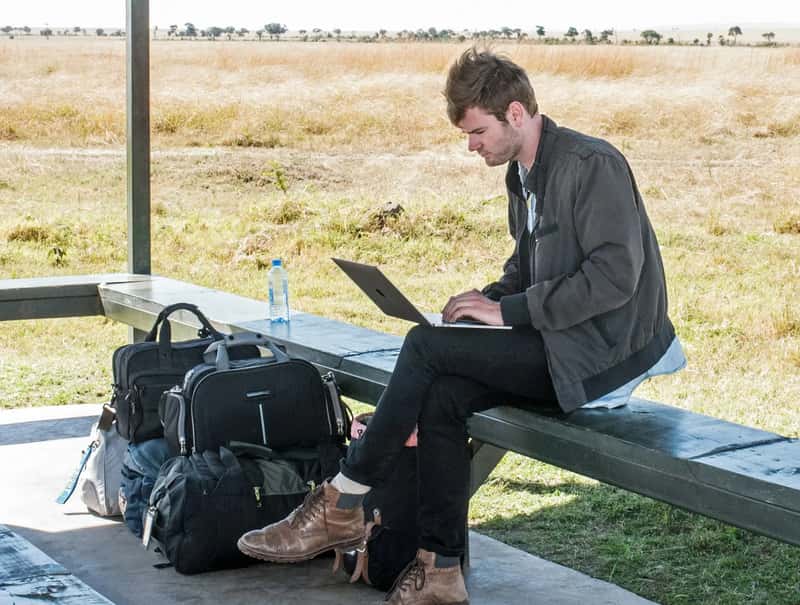
The Identity Gap here is wide and merciless: the person you told your colleagues you were going on holiday – relaxed, recharged, present – and the person who is actually there, hunched in a poolside lounge chair, laptop-screen-blue in the Aegean light, performing rest while secretly working through it.
This is not a story about ambition. Ambition is clean. Ambition has a destination. This is a story about the traveler who arrives somewhere beautiful and immediately sets up a second office, who confuses stillness with failure and silence with falling behind. Because this person only learned that to be worthy, they must be productive at all times. Even during a beautiful holiday.
1. The Productive Body
Your body is not on vacation.
It never got the memo.
When stress hormones like cortisol remain elevated for extended periods, the body adapts to functioning at a higher baseline of activation – and this makes relaxation feel genuinely unfamiliar, sometimes leading people to feel restless, irritable, or anxious when they attempt to slow down.
This is not weakness. This is adaptation.
Your body learned to run hot because running hot was once the appropriate response to your environment. The problem is that the environment changed – you booked a flight, checked into a hotel, hung a “Do Not Disturb” sign on the door – but your physiology did not receive the update.
You are sitting in paradise with a threat-response system that still reads every quiet moment as a potential ambush.
The laptop is your weapon. The to-do list is your armor. And rest? Rest is what happens to other people. People who, in the language of your nervous system, must not be trying hard enough.
The body on vacation is the most honest document you will ever read about who you have learned to be.
2. The Borrowed Identity
Nobody is born reaching for their inbox.
If someone grew up in environments where love, safety, or approval depended on performance, achievement, or caretaking, the nervous system may have learned that being productive keeps you safe – that rest, mistakes, or slowing down were associated with criticism, conflict, or withdrawal of support, and these early experiences shape adult patterns of overworking or over-functioning.
So the identity you carry into adulthood – the Achiever, the Provider, the One Who Gets Things Done – is not entirely yours.
It was issued to you. Like a uniform. Like a coping mechanism that was once a survival tool and is now a lifestyle.
You adopted it because it worked. You got praise. You got safety. You got love, conditional and transactional, but love nonetheless.
And now you are forty-one years old on a terrace in Lisbon, and the borrowed identity has followed you across the Atlantic, settling into the seat beside you like a quiet business-class companion who never takes off his tie.
The question is not whether the identity served you. It did. The question is whether it is still you.
3. The Respectable Addiction
Call it what it is.
Workaholism is also called the “respectable addiction” and is often found in perfectionists who live their life addicted to pressure and productivity.
Nobody stages an intervention for overworking.
Nobody sits you down and says: we’ve noticed you haven’t taken a guilt-free afternoon in three years, and we’re worried about you. Instead, the culture applauds you. Promotes you. Holds you up as evidence that the system works.
Society often glorifies and rewards workaholics, which sends the message that work must always come first, despite any personal cost.
The addiction is sophisticated. It does not smell like whiskey. It does not show up with track marks or shaking hands. It shows up in Slack messages sent at 11 PM from a hotel in Barcelona. It shows up in the inability to sit through dinner without checking something, answering something, producing something.
It shows up most nakedly on vacation, when all the scaffolding of routine is stripped away and the raw mechanism is exposed: you are not working because you want to. You are working because not working feels like disappearing.
4. The Cortisol Landscape
Here is what is happening under the skin.
When life is a constant stream of deadlines, notifications, and to-do lists, the nervous system can become dysregulated – stuck in high gear, making it tough to switch off even when you desperately want to.
The landscape inside the high-performing vacationer is not a beach.
It is a war room.
The sensory data of the holiday – salt air, slow mornings, the sound of a language you do not speak – is being processed by a nervous system that has been trained to scan for threat, not beauty. Your eyes are open. Your cortisol is still running. Your amygdala is still asking the same question it has been asking since childhood: are we okay? Are we enough? Are we safe?
Many people only start to feel properly relaxed two to three days into a trip – or even experience “leisure sickness,” where fatigue or mild illness shows up once work pressure eases.
The body finally exhales. And it coughs. It collapses. It gets a fever. Because it has not been allowed to be a body. It has only been allowed to be a vehicle for output.
5. The First Morning
I want to tell you about the first morning I understood this in my own body.
It was a hotel room somewhere warm. Day one of ten. The kind of trip you plan for months. The kind of trip you justify with language like “I really need this.”
I woke at 6 AM without an alarm.
Not because I was rested. Because my nervous system did not recognize the absence of urgency and interpreted it as danger.
I checked my email before I opened the curtains. I answered a message that absolutely did not need answering for at least five more days. I felt the small, chemical rush of having done something. Of being useful. Of existing in a way that the world could verify.
And then I sat on the edge of the bed in a room full of morning light and understood, with a clarity that felt almost brutal, that I had not actually left. I had just relocated my anxiety to a more scenic backdrop. The work was the ritual. The ritual was the proof. At its core, productivity guilt isn’t about laziness – it’s about the nervous system believing you must earn or justify rest to feel worthy.
The curtains stayed closed for another hour. I sat with that.
6. The Performance of Rest
There is a version of vacation that is just work in different clothing.
You take the photos. You post the photos. You caption the photos with something about “recharging.” Meanwhile, the laptop is open on the nightstand. The inbox is a low hum you cannot tune out. The to-do list has been reorganized, not abandoned.
The idea that you should be “leveling up” your rest – turning downtime into an opportunity for optimization – is a heavy, invisible weight many of us carry without realizing it. Hustle culture has made it difficult for people to truly just be. It’s no longer enough to rest; we’re expected to rest well, rest productively, and emerge from every break as a more polished, efficient version of ourselves.
This is the performance of rest. Curated, documented, and ultimately empty.
The tragedy is not that you are working. The tragedy is that you are working so hard at appearing to not work that you have no capacity left for actual presence. The ocean is right there. The people you love are right there. And you are managing your absence from both with the same efficiency you manage everything else.
7. The Childhood Ledger
There is a ledger somewhere. You did not create it consciously. But it exists.
In psychodynamic and attachment theory, early experiences with caregivers shape our core sense of self-worth and how we relate to the world. If love were conditional – based on achievements, obedience, or being “good” – a child may internalize the belief that they are only worthy when they perform.
The ledger tracks your output. It runs continuously. It does not take holidays.
A child who was only praised when they brought home perfect grades may grow into an adult who ties their self-worth to constant achievement and external reassurance. A child who had to take care of emotionally unavailable caregivers may grow up believing their value lies in being responsible, useful, or productive.
This is not self-pity. This is archaeology. Digging through the sediment of early experience to find the original instruction set.
The instruction that was written in the most permanent ink, the one that runs like background code through every vacation, every weekend, every supposedly quiet evening, is this: you must earn your place here.
Here, on the planet. Here, in the room. Here, at the table.
You have been earning it ever since.
8. The Stillness Panic
You know the feeling.
The moment the work stops – the moment the laptop closes, the notifications go quiet, the agenda empties – something rises.
It does not have a name you learned in school. But it is specific and physical. A low-grade alarm. A sense of something unresolved. A pull toward doing, toward producing, toward making yourself legible to the world again through action.
If you believe your value lies in what you do, achieve, or contribute, you will constantly be chasing validation through tasks – and the moment you slow down, your sense of self crumbles a bit.
This is the stillness panic.
It is not about the work. The work is just the nearest available solution to the panic. It is about identity dissolution – the terrifying question that emerges in the absence of productivity: if I am not doing anything, who am I?
If you never felt emotionally safe being unproductive, your nervous system likely linked performance with survival. So now, when you try to rest, something inside says stop, this is dangerous. That’s not ambition. That’s protection.
The panic is your oldest protector. It has been doing its job for decades. You do not need to fight it. You need to thank it, gently, and explain that the situation has changed.
9. The Human Doing
Language is revealing.
Human being. Two words that in their natural order prioritize existence over action.
But somewhere in the wiring of the high-functioning vacationer, the sequence got inverted.
If a child is not loved for who they are – a human being – they might think they have to do things to deserve love, becoming a human doing, and this can follow them into adulthood if not addressed.
The human doing cannot rest. Not fully. Because rest does not produce anything. And in the economy of conditional worth, anything unproductive is a liability.
You don’t feel guilty because you’re lazy – you feel guilty because you were taught to only feel valuable when you’re doing something. That’s psychological damage, not motivation.
Watch the human doing on vacation. Watch the compulsive reaching for the phone. The rehearsal of tomorrow’s meeting while staring at a cathedral. The inability to sit in a cafe for thirty minutes without converting the time into something useful – a voice note, a strategy, a plan.
The human doing is not lazy. The human doing is terrified of what silence might confirm about their worth.
And beneath that terror is a grief so old it has become furniture.
10. The Long Way Back
Nobody heals this in a long weekend.
This is the heaviest truth in this piece, and it deserves the weight of a full breath before you continue reading.
Workaholism rooted in trauma cannot be fixed with another planner, self-help podcast, or discipline hack. These strategies often work on the behavior, not the why beneath it. Without healing the emotional roots, overworking remains a compulsion – not a choice.
The long way back begins not with a productivity system but with a question.
The question isn’t “Why do I work so much?” It’s “What does work protect me from feeling?” Often, it’s grief. Fear. Loneliness. Shame. The heartbreak of needs that were never met.
The long way back looks like sitting in a hotel room in the morning light and not reaching for the phone. Not because the phone isn’t there. Not because there aren’t emails. But because you have decided, slowly and imperfectly, to practice being a person who exists without constant proof of their existence.
Safety isn’t a place we think ourselves into – it’s something the body relearns slowly, free from the conditions that once caged us.
It takes longer than a vacation. It takes longer than a year. It takes the slow, patient, unglamorous work of convincing your nervous system that stillness is not the same as erasure. That rest is not the opposite of worth. That you were allowed to be here before you ever produced a single thing.
There is a version of you that does not check the inbox on the first morning.
That version is not naive. Not unambitious. Not soft in any way that diminishes them. They are simply someone who has done the harder and less visible labor of separating their humanity from their output. They sit with the ocean and they let it be an ocean, not a backdrop for a productivity metaphor. They order the slow breakfast. They watch the light change. They do not justify it. They do not document it. They just let the morning be a morning, fully, without owing anything to anyone.
That version is not far away. They are not some future-you who has earned rest through sufficient achievement. They are you, right now, in this moment, if you can tolerate the quiet long enough to find out what’s actually there.
The ocean is still moving. It has no inbox. It has never once questioned whether it was doing enough.