They step around a corner.
You can’t see them.
Something shifts inside you – quiet, fast, and ancient.
You tell yourself you’re fine. You’re an adult. You travel well. You’re the kind of person who handles things. But there it is again – that low, electric hum of unease spreading outward from the chest, looking for a target. The identity gap isn’t the space between who you were at home and who you become at the departure gate. It’s the space between the calm, unbothered traveler you perform and the one who, somewhere around the second unread message, begins quietly catastrophizing behind a pleasant expression. Between the person who says “I love getting lost” and the one who, when their partner actually gets lost, cannot sit still.
1. The Ancient Alarm
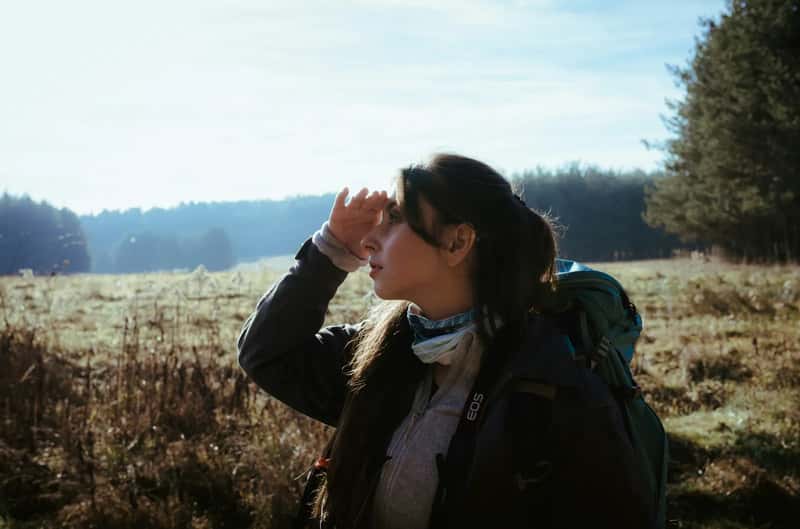
The brain has never fully updated its operating system.
Beneath the part that books flights and reads menus in foreign languages, there is a much older architecture.
Neuroscientifically speaking, uncertainty activates the amygdala – the part of your brain responsible for processing fear. It doesn’t know you’re in a cobblestoned city in Portugal. It doesn’t know you have international roaming. It knows something has changed in the sensory field, and it files that change under one category: threat.
Your brain evolved to deal with uncertainty as a threat, and anxiety is the natural response to that.
This is not a personality flaw. It is not neediness. It is not insecurity dressed up as concern.
It is hardware.
Old, efficient, uninterested in context – hardware that kept your ancestors alive in situations where a missing companion meant something had gone very, very wrong in the forest.
You are not overreacting. You are operating exactly as designed. The design is just older than the airport.
2. The Prediction Machine
Your brain doesn’t experience the present. It predicts it.
Your brain is constantly making predictions about the world, and judging those predictions against what actually happens. The greater the prediction error, the greater the entropy.
A partner who wanders off is a prediction error.
You had a model: two people, same sidewalk, same direction. Then the model broke. The brain doesn’t pause to consider benign explanations. Our survival depends on our ability to make predictions, and a primary goal of the brain is to predict where and how we can avoid threats and encounter rewards. Because the brain seeks to make accurate predictions, it has an aversion to uncertainty.
The gap between your expectation and reality registers as danger.
Not inconvenience. Danger.
This is why the irritability arrives before the rational thought. The rational thought – they’re fine, they always do this – is always late to the scene.
3. The Amygdala Doesn’t Wait for Evidence
It fires first and asks questions never.
The amygdala does not know you are in a safe city. It does not know your partner simply found a gelato shop. It knows one thing: the situation is no longer predictable. And unpredictable, to the amygdala, means dangerous.
This matters.
Because by the time your prefrontal cortex – the slow, reasonable part – arrives to talk things down, the aberrant and excessive anticipatory processes involved in anxiety include increased attention to, intense emotional responses to, and inflated estimation of uncertain threat, which engage multiple brain regions including the temporal gyrus, emotional circuit such as the amygdala, insula, and medial prefrontal cortex.
The whole system is already online.
Already scanning. Already misreading the room.
The sharp word you say when they reappear isn’t about them. It’s the exhaust fumes of a threat response that had nowhere else to go.
4. The Cortisol Flood
Here is what happens in the body while you’re pretending to look at a map.
When the amygdala gets fired up, it triggers the hypothalamus to release stress hormones like cortisol and adrenaline. Adrenaline makes the heart beat faster, causes blood pressure to go up and gives you more energy. Cortisol, the primary stress hormone, increases sugar in the bloodstream and enhances the brain’s use of glucose.
Your body is now ready for a fight you don’t need to have.
When the brain perceives a threat, the sympathetic nervous system is activated to initiate what is often referred to as a “fight or flight” response. Cortisol is released, a hormone that increases blood sugar and suppresses the immune system so energy can be redirected to address the perceived threat.
You are flooded. Physically flooded.
Your hands may tighten. Your jaw may set. You scan exits without realizing you’re scanning exits. And when your partner strolls back, gelato in hand, delighted – the energy has to go somewhere.
It becomes irritability. It becomes a clipped tone. It becomes a fight about nothing that is actually about something biological and very old.
5. The Collective Safety Myth (And Why It Isn’t One)
Here is the part that gets personal.
I remember standing in the medina in Marrakech, watching my partner fold into the crowd like smoke. Gone in under four seconds. And what I felt – before I felt anything rational – was something close to abandonment. Not the civilized kind. The cellular kind. The kind that has no language but has a very clear physiological signature.
I was embarrassed by it at the time. I am less embarrassed now.
Because attachment theory explains how humans form strong emotional bonds with key individuals, starting in childhood, to help manage stress, fear, and uncertainty. We are wired, from the beginning, to seek safety in proximity. Attachment theory is an evolutionary, biologically based theory explaining a predisposition to engage in proximity to important others for safety and survival.
Your travel partner isn’t just a person who splits the hotel room. They are, neurologically speaking, your anchor point in an unfamiliar environment.
When they disappear, your nervous system doesn’t think: they’ll be back. It thinks: the anchor is gone.
6. The Hypervigilance Tax
Travel is expensive in more ways than the obvious ones.
Studies have shown that the brain prefers predictability because it reduces cognitive load. When things are certain, your brain can switch to autopilot. But when you don’t know what’s coming next, your brain can stay hypervigilant, scanning for threats that may or may not exist. This state of heightened alertness is mentally exhausting and physically draining.
In a foreign city, almost nothing is on autopilot.
The signs are unreadable. The traffic moves wrong. The currency is slightly wrong. The food smells different. The social cues are different. Your nervous system is running continuous threat-assessment in the background – and you’re paying for it, in cognitive currency, all day long.
So when your partner wanders off, they aren’t just wandering off. They are removing a variable your exhausted nervous system was relying on to feel stable.
States of sustained anticipation of potential threat can also impair some cognitive functions such as working memory and attention control in healthy individuals.
That’s why you feel slow and thick-headed and unreasonably angry. You’re not unreasonable. You’re depleted.
7. The Uncertainty Gradient
Not all uncertainty is equal. The brain ranks it.
Research suggests that people often find uncertainty more stressful than knowing something bad is definitely going to happen. Think about it: knowing you’re going to have a tough day at work feels different than not knowing what’s waiting for you. Your brain hates the “what ifs” even more than the “oh nos.”
A known danger has an edge. You can assess it. You can make a plan.
Unknown danger is unbounded. Compared to fear, anxiety is more likely to be triggered by distal and unpredictable threat that continues until the state of uncertainty is resolved, which engages multiple sustained and diffuse anticipatory cognitive and emotional responses.
This is the gradient at work.
A partner who says “I’m going to wander for twenty minutes and meet you at the fountain” is a bounded uncertainty. Manageable. Almost fine. But a partner who simply dissolves into a side street with no timeline, no signal, no agreement – that is unbounded. That is the gradient at its steepest. And your nervous system treats the steepness as a measure of danger.
8. The Attachment Style You Packed Without Knowing
You brought more than luggage.
Attachment theory explains how humans form strong emotional bonds with key individuals, starting in childhood, to help manage stress, fear, and uncertainty. These bonds provide comfort and safety, shape how we see ourselves and others, and influence our relationships throughout life.
How you respond when your partner wanders off tells you something. Not about them. About the story your nervous system is still running from decades ago.
Due to the constant preoccupation with the stability of the relationship, anxiously attached individuals often experience heightened anxiety, particularly when faced with uncertainty or conflict. This distress is exacerbated by their difficulty in regulating emotions, as they tend to react strongly to perceived relational threats.
Travel is a pressure test. It strips the ambient comforts – your routines, your spaces, your familiar cues – and leaves you with only yourselves. The attachment pattern you manage perfectly well in your living room may feel considerably louder in the middle of a foreign square at dusk, when the light is wrong and the person you’re traveling with has been gone for six minutes.
Six minutes. That’s all it takes.
9. The Irritability Disguise
Anger is cleaner than fear.
That is the simplest and most important thing about why you snap when they return.
Anger is legible. Anxiety is not. The body, flooded with adrenaline and cortisol, needs an outlet. Fear feels vulnerable. Fear requires admission. Irritability, by contrast, redirects the energy outward. It has a target. It feels, briefly, like control.
But it is not irrationality. It is your survival system interpreting absence as danger.
The snap isn’t about the gelato. It isn’t about the wandering. It is the tail end of a physiological storm that passed through you while they were gone – and that had to land somewhere.
Understanding this – really understanding it, in the body, not just in the brain – changes the texture of the argument that follows.
Or, more quietly, prevents it.
10. The Geography of Being Found
There is a particular kind of traveler who insists they prefer to be alone.
Who says they’re better off solo. Who finds partner travel constraining, who bristles at itineraries, who disappears down alleys with cheerful abandon and cannot understand why the person waiting doesn’t feel the same freedom.
The evolutionary pressures to survive in the face of potential predation are so strong that a major function of the brain is to continuously process and scan the environment to enable rapid and successful defensive responding. In this regard, the central extended amygdala, as a threat detector and effector, is critical for survival. By continuously functioning in the background as a mechanism to rapidly and reliably respond to potential danger, the central extended amygdala enables organisms to feel secure in exploring new environments.
The wanderer is not wrong. But neither is the one left standing on the corner.
They are simply operating different nervous systems, with different baselines, in the same unfamiliar city. One brain is scanning for possibility. The other is scanning for threat. A bridge – something for the anxious nervous system to hold onto – transforms an open-ended absence into a bounded separation with a clear return point.
A text. A corner named. A time agreed.
Not a cage. A coordinate.
Something to give the amygdala permission to stand down.
The argument you’ve had a dozen times in a dozen cities isn’t about freedom versus control. It isn’t about independence or clinginess or trust. It is two nervous systems, both doing exactly what they were built to do, colliding in the beautiful, disorienting, relentlessly uncertain space of being somewhere new.
One system says: the unknown is the whole point. The other says: the unknown is the whole problem. Both systems are ancient. Both systems are yours. Neither one is pathology.
What changes things isn’t suppressing the alarm. It’s knowing it exists – naming it: “This is my attachment system activating. My nervous system is interpreting absence as danger. I am not actually in danger.” Not about dismissing your feelings. It’s about creating a tiny sliver of space between the trigger and your reaction. That sliver is everything. That sliver is where the relationship lives, in transit, between what the brain fears and what is actually true.
Somewhere, a corner is being turned. Somewhere, a partner is buying something they don’t need in a shop they couldn’t resist. Somewhere, a nervous system is quietly sounding an alarm about a person who will be back in four minutes, unbothered, happy, holding something strange and delicious. And the person waiting – the person always waiting, on corners, in airports, in the particular silence of an unfamiliar city – is learning, slowly, that being found has always been the point of going anywhere at all.