The restaurant is loud in a language you don’t speak.
You don’t mind that part.
What you mind is the silence that just fell between the two people across the table from you.
You are already calculating. Already triangulating. Already quietly rehearsing the joke that will dissolve it.
You are ten thousand miles from home, and the dinner table still feels exactly the same.
You built your identity around a function. Peacekeeper. Translator of moods. The one who holds the temperature of the room. Travel was supposed to dissolve that role. Foreign cities were supposed to offer you a clean slate. But the role followed you through customs, past the passport check, and straight to the reservation.
And so you carried it. You got on a plane and carried it. You sat at a table in a city built on ancient stone and you carried it still. You scanned the group. You measured the temperature. You made sure everyone was fine.
The Nervous System That Never Got the Memo
You learned to read rooms the way other children learned to read books.
A chair pushed back too hard. A pause that lasts one beat too long. The specific quality of someone’s silence after the waiter takes their order.
Research from the Journal of Family Psychology found that children who regularly intervened in parental conflicts showed elevated cortisol responses well into adulthood, even in low-stakes social situations – a pattern researchers called “chronic relational vigilance.”
Chronic. Relational. Vigilance.
That’s not a skill set. That’s a sentence.
The hypothalamic-pituitary-adrenal axis, which governs the stress response, becomes overactive in parentified children. Instead of relaxing into safety, the body stays in a heightened state of alert, ready to respond to crisis. This chronic activation can lead to long-term challenges with anxiety, emotional regulation, and even physical health.
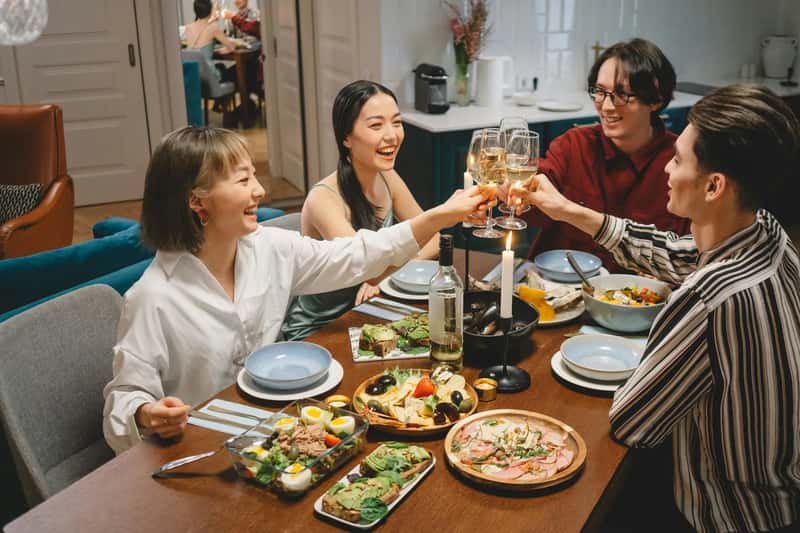
At a group dinner abroad, every ambient signal gets processed as data. The candle flickering. The clinking of glasses. The way someone’s smile didn’t quite reach their eyes. Your nervous system doesn’t know it’s on vacation. It’s still on shift.
The Room You Walk Into Before You Walk In
Before you even sit down, you’ve already run the simulation.
Who is sitting next to whom. Who hasn’t spoken in twenty minutes. Whether the energy between two people in the group has a charge to it that nobody else seems to notice.
The child who learns to read a room before they learn to read a chapter book isn’t developing a superpower. They’re developing a survival strategy. And survival strategies don’t retire when the danger passes.
So you pre-manage. You arrive at the table with contingency plans already drafted. You’ve already assigned yourself a conversational role. You’ve already decided which topics are safe and which are landmines.
The menu is in Italian. You don’t care about the menu.
Children who experienced parentification developed a sophisticated internal system designed for survival – becoming hypervigilant to the needs of others, developing an almost supernatural ability to read emotions and anticipate problems.
You pre-experience conflict so thoroughly that by the time you’re seated, you’ve already survived three versions of the dinner that never happened. That’s not preparation. That’s a haunting.
The Performance of Ease
Nobody at the table would guess.
You are charming. You are warm. You are the one who makes everyone feel included, who remembers that one person doesn’t eat shellfish, who smoothly redirects the conversation when it starts to drift toward something sharp.
You look like someone who is having a wonderful time abroad.
What clinical work consistently shows is that these individuals are often the most capable people in every room they enter – and the most disconnected from their own inner experience.
The performance of ease is exhausting because it is, in fact, a performance.
There is no muscle memory for simply being present at a table. Only the muscle memory of monitoring it. You were the cornerstone of your family, but your own foundation may feel shaky because you were never given the space to figure out who you really are outside of being the “emotional manager.”
Abroad, that dissonance sharpens. The backdrop is gorgeous. The self is still the same self.
The Translated Tension
There is a specific kind of dread that hits when tension enters a group dinner in a foreign place.
Maybe it’s a disagreement about where to go next. Maybe it’s an old grievance that surfaces under the particular pressure of traveling together. Maybe it’s nothing – just a collective tiredness that reads, to you, as something sinister.
The mediator’s entire childhood operating system was built on being between two angry people, never the target. They know what to do with other people’s conflict. When someone is angry at them specifically, they shut down, go blank, or leave.
You are a specialist in interpersonal conflict. A first responder. A translator of emotional static.
But you only know how to de-escalate from the center. Not how to sit in the discomfort. Not how to let something stay unresolved while you eat your pasta.
Preoccupation may be adaptive in the face of heightened family discord by increasing vigilance toward further threatening events – but in the long run, increased worry and preoccupation may promote anxious behaviors in broader settings beyond the family unit.
That’s the cruelest part. The vigilance that once protected you now follows you to the trattoria in Florence and makes it feel like a battlefield.
The Exit Strategy That Isn’t an Exit
Here is a thing I know from the inside.
I have left a group dinner in Rome – stood up, said I needed air, walked three blocks down a cobblestone street I didn’t know, stood under a streetlamp, and breathed. Two people at that table had been cold to each other all evening. Nothing dramatic. Nothing anyone else clocked. Just that particular frequency of unresolved tension that I’d been absorbing since the aperitivo.
I told myself it was the wine. It wasn’t the wine.
It isn’t avoidance in the way most people use the word. It’s a nervous system that was trained to be the referee suddenly being told it’s a player. The rules don’t apply anymore, and nobody taught them new ones.
Travel promised escape. And for a beautiful, flickering window of time – sometimes on a train, sometimes at a market stall, sometimes alone with a coffee – it delivers. But put a group around a table, and the old operating system boots back up without asking permission.
The Hunger Beneath the Hunger
Group dinners abroad should be simple pleasures. New food. New wine. New light hitting a new city skyline through a new window.
But the family mediator isn’t just hungry for the meal. They are hungry, in a way that is almost cellular, for safety.
Peace and safety are different things. Peace is the absence of conflict. Safety is the presence of honesty. Someone trained to prioritize the absence of conflict will sometimes stay in situations that are quietly harmful, because the situation is calm, and calm was always the goal.
So you engineer calm. You sacrifice your own appetite – literal or metaphorical – to manage the temperature of the evening. You eat your dinner with one eye always on the table. You never fully taste it.
Perhaps the most profound aspect of parentification is the particular grief it carries – the grief for the childhood you never had. For the carefree moments that were taken up with someone else’s needs.
Grief, it turns out, doesn’t need a passport. It travels light.
The Overfunctioning Tourist
Watch a former family mediator organize a group trip.
They will research every restaurant. They will have a backup restaurant. They will have accounted for the one person who needs gluten-free options and the other person who will be tired by 9 PM. They will absorb all the logistical anxiety so nobody else has to feel it.
They will call this “being a good planner.”
Parentified children often took on both emotional and physical caregiving duties – including being the go-to mediator for conflicts – and this pattern follows them into adult life.
Overfunctioning often feels both stressful and isolating. While you’re busy meeting everyone else’s needs, you probably feel unseen and unappreciated. It feels like no one even notices how much you do or the sacrifices you make.
In a foreign city, the overfunctioning intensifies. You cannot control the language barrier. You cannot control the weather, the late kitchen, the temperamental waiter. You compensate by controlling everything else. The itinerary. The seating arrangement. The emotional weather of the group.
You exhaust yourself keeping everyone else comfortable enough that the table never catches fire.
The Identity That Got Lost in Transit
Here is the quiet tragedy that travel throws into sharp relief.
You don’t know who you are when there is nothing to manage.
One of the most common things therapists see in adult parentified children is the realization that they don’t know who they are outside their role as a caregiver.
Abroad, in the moments between performances, it surfaces. Sitting alone at a café with no one who needs you. Standing in a museum in front of a painting. Watching a city wake up from a hotel window.
There is a self in there. Something quiet and unscheduled and not yet assigned to anyone’s emotional regulation.
Many who experienced parentification report struggles with identity formation and self-worth later in life – they may have been the cornerstone of their family, but their own foundation feels shaky because they were never given the space to figure out who they really are outside of being the “emotional manager.”
Travel cracks that open. The crack is uncomfortable and necessary. You glimpse yourself between the group dinners. In transit. Unclaimed.
The Silence You Don’t Know How to Sit In
Other people experience a lull in dinner conversation as a natural pause.
You experience it as a distress signal.
The mind, the reliance on thoughts, rumination, compulsive thinking, strategizing, future projections – these do not actually keep you safe and never have. The mind is like a computer, popping out thoughts that worked in the past, trying to keep you safe in the same ways that worked in childhood.
So into every silence, you insert yourself. A question. A story. A gentle, perfectly calibrated pivot to something warmer, lighter, safer.
The irony is that silence abroad is often the most beautiful part. The particular hush after a meal in a city that doesn’t know your name. The sound of a foreign street through an open window. These silences are not dangerous. They are gifts.
Calm situations can make you feel uneasy or on edge – because calm was never neutral. Calm was something you produced. Something you maintained through constant effort. Calm was the goal and the evidence that you’d done your job.
A silence that arrives on its own, with no intervention from you, doesn’t feel like peace. It feels like something you forgot to prevent.
The Weight You Carry to Every Table
This is the one that matters most.
You did not choose this role. You were given it before you had the language to refuse it, before you understood that refusing was even an option. You were a child in a system that needed a stabilizer, and you were the most emotionally perceptive person in the room, and so the role found you.
You learned to manage everyone else’s conflict instead of having a childhood. You got good at reading rooms and bad at reading yourself. You became indispensable to a system that never once asked what it was taking from you.
The parent was often unable to see that their child was taking responsibility for maintaining the peace in the family, for protecting one parent from the other, for being their friend and therapist, for mediating between the parents and the outside world
Your body has been keeping score of every crisis you managed, every emotion you absorbed, every need you suppressed.
That score doesn’t reset at the border.
Somewhere between the bread basket and the second glass of wine, there is a version of you that simply exists at the table. Not managing it. Not scanning it. Not already drafting the conversational pivot for the tension that hasn’t arrived yet. Just present. Tasting the food. Looking out the window at the unfamiliar street. Letting the silence be someone else’s problem – or nobody’s problem – for one long, unguarded moment.
That version is not a fantasy. It is not a person you have to become from scratch. It is a person who was always there, underneath the function. The role was the costume. The travel, at its most honest, keeps almost giving you permission to take it off. Airports at 5 AM. Trains between cities. The half-hour before the group wakes up and the performance begins again. In those margins, something real breathes.
The table abroad was never really the problem. The table was just the place where you remembered what it cost to be the one who kept everything from falling apart – and began, slowly, to wonder what it might feel like to just let something fall.