The cabin door seals shut.
You are already watching.
You’ve been watching since the gate.
Most passengers see a flight attendant. You see a mood. A posture. A micro-expression that lives somewhere between the jaw and the eye socket. You read it the way other people read headlines – automatically, without effort, without choice.
This is not a travel quirk. This is not personality.
This is the nervous system doing what it was trained to do in a house where the weather could change in seconds – where the wrong footstep, the wrong word, the wrong silence could detonate a room. You learned early. You learned fast. You learned to read the air before it moved.
There’s an identity gap that opens the moment you board a plane. On one side: the composed adult traveler with a boarding pass and a carry-on. On the other: the child who never fully stopped scanning. The gap between those two people is not distance. It is survival.
1. The Shoulder Read
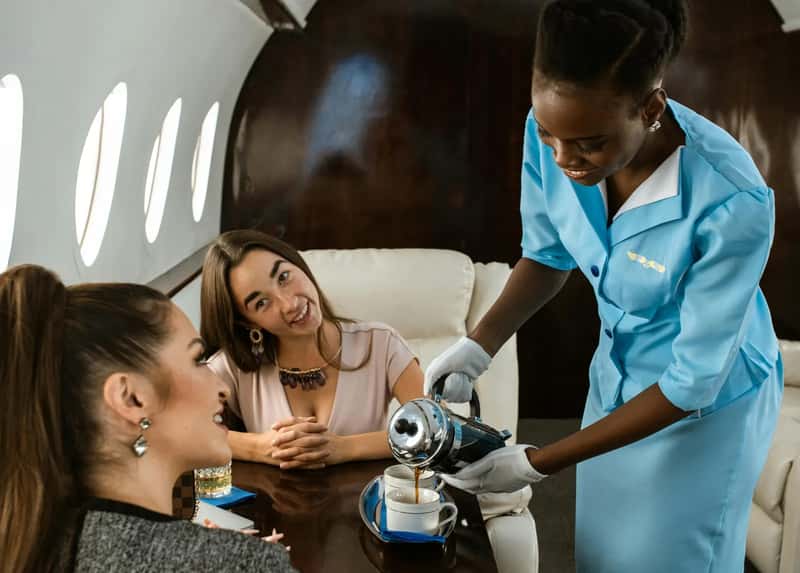
You notice shoulders before you notice faces.
Tight, raised, pulled inward – that’s tension being held. It means something is being managed. A passenger complaint. A difficult colleague in the galley. A mechanical issue no one is announcing yet.
The child raised in an unpredictable environment – a parent sometimes in a good mood, then out of nowhere enraged – learned to pick up on very subtle clues, because knowing what state someone was in helped keep them safe. You carry that skill onto every aircraft you board.
Shoulders at rest, rolled back, slightly dropped – you exhale. Not consciously. Just automatically. The threat assessment completed in under a second.
Most passengers don’t register shoulders at all. You have catalogued them since childhood. Your body was the instrument. The flight attendant is just the latest subject.
You are not paranoid. You are profoundly, expensively trained.
The shoulder read is the first chapter of a much longer story your nervous system tells you every single time you board.
2. The Smile Audit
You know the difference between a real smile and a performed one.
You have known since you were small. The performed smile is the one that lives only at the mouth. The muscles around the eyes stay flat. The timing is just slightly off – applied a half-beat too late, removed a half-beat too soon.
It is common for a person who’s hypervigilant to watch the people around them diligently for slight changes in behavior, tone, cadence, body language, written communication, or even sentence structure. On a plane, this looks like a passenger who seems to be gazing pleasantly ahead.
In reality, you are conducting a forensic audit of every smile that passes you in the aisle.
A strained smile on a flight attendant doesn’t necessarily mean danger. You know this intellectually. But the body does not run on intellect. It runs on pattern. And the pattern it learned was: performed warmth precedes volatility.
You watch anyway. Old habits wear very deep grooves.
3. The Walk Tempo
Fast is a signal. Not of efficiency.
Of suppression.
You notice when the pace in the aisle changes. When someone who was moving at a measured, professional clip suddenly accelerates – toward the front, toward the phone, toward a hushed conversation near the galley curtain.
This hyper-awareness often manifests as emotional reactivity after trauma, where minor stimuli are interpreted as threats. Loud noises, sudden movements, or even subtle shifts in tone can trigger a sense of danger.
A shift in walk tempo is a subtle movement cue. For most, it registers nowhere. For you, it registers everywhere – in the chest first, then in the jaw, then in the compulsive need to locate the nearest exit row.
You counted the rows on the way in. Of course you did.
Fast walking, in your childhood architecture, meant someone was about to explode or someone was trying to escape an explosion. The cabin is quiet. But your body has already filed the information.
4. The Eye Contact Calculation
Too much eye contact means something. Too little means something different but equally important.
You run this calculation without being asked.
A flight attendant who moves through the aisle without meeting anyone’s gaze is managing something internal. Something that is consuming the bandwidth that would normally go toward passengers. You’ve felt that energy before – in a house where an adult’s face was technically present but entirely absent.
If you constantly scan conversations for hidden meaning, feel a rush of anxiety before conflict even begins, or read other people’s moods as a matter of survival, you may be experiencing emotional hypervigilance.
Avoidant eye contact in your lexicon means: do not provoke. Do not ask for anything. Be small.
Over-extended eye contact, the kind that is slightly too deliberate and slightly too sustained, means: I am working hard to appear fine. You know that one too. You perfected it yourself, at the age of nine, sitting across from a parent who needed everything to look normal.
5. The Voice Frequency Shift
I remember the exact pitch my mother’s voice took on before a scene. Not loud. Never loud at first. Lower, actually. Flattened. Like affect being drained from the sound before the storm came.
I learned to live in the half-second between that flat tone and whatever came next.
On a plane, I notice the moment a flight attendant’s voice drops. When the announcement cadence changes. When the cheerful lilt of the service voice gets pulled back into something clipped and professional and tight.
Unlike general anxiety, which often focuses on performance, health, or future outcomes, emotional hypervigilance is centered on relational threat. The brain becomes hyper-aware of social cues, tone, facial expressions, and subtle shifts in connection.
A voice frequency shift is invisible data to most travelers. To those of us who grew up in high-conflict homes, it is a five-alarm signal. The body has already begun to prepare. For what, exactly, it cannot say. Only that something is coming.
It usually isn’t. But the body doesn’t wait for confirmation.
6. The Galley Glance
You watch the galley the way other people watch the weather.
When a flight attendant disappears behind that curtain and doesn’t come back out for longer than feels normal, you begin to track the time. You are not anxious about turbulence. You are anxious about the unknown.
Hypervigilance causes people to constantly scan their surroundings for threats of harm, even when they’re safe. Some people describe it as feeling “on edge” or “on guard” all the time.
The galley, in your threat-mapping system, is the back room. Every high-conflict household had a back room – a space where the real conversations happened, where tension was being negotiated, where moods were being decided.
You watched the doorway then. You watch the galley curtain now.
The mechanism is identical. The setting has simply moved thirty-five thousand feet above the earth.
7. The Colleague Dynamic Scan
You watch the crew interact with each other.
Not intrusively. You’ve learned to do this with your peripheral vision, with the practiced invisibility of someone who grew up reading rooms without being caught doing it.
Hypervigilance can make safe situations, people and places feel threatening, as hypervigilance can make people acutely aware of subtle details normally ignored – body language, a person’s voice and tone, their mood, their expressions – all things which are continually assessed.
When two crew members exchange a look that has weight to it – a compressed, sideways glance that communicates more than words – your system catalogues it immediately.
You know what it means when adults communicate silently in front of a child. You know what it means when the calm face contradicts the tense hands. Alliances, tensions, and hierarchies – you decoded them by necessity long before you had the vocabulary to name them.
You still decode them. Everywhere you go.
8. The Announcement Micro-Pause
Standard PA announcements follow a rhythm. You know that rhythm.
Any deviation from it registers as significant. A mid-sentence hesitation. An unusual pause before the word “momentarily.” A breath taken in the wrong place – held a beat too long, released a beat too quickly.
You may feel as though you are living in a heightened state of high alert where everything feels loaded with meaning. A delayed response, a change in tone, or a neutral expression may be interpreted as potential danger, even when no threat exists.
This is what it cost you, growing up with a high-conflict parent – the inability to hear language without simultaneously analyzing it. Every sentence became a potential carrier of concealed information.
The announcement ends. Nothing follows. The plane flies on, uneventfully, through six hundred miles of undramatic sky.
You exhale again. The audit concludes. Until the next one begins.
9. The Uniform Posture Code
Posture tells the truth when the face has been trained to lie.
You were taught this without anyone teaching you. You observed it, the way children observe everything when their survival depends on observation. A body angled slightly away from you means disengagement. A body squared up to you, with weight shifted forward – that means engagement. Not always positive engagement.
Childhood trauma often affects adulthood psychology in ways people miss because it disguises itself as character traits you might even take pride in. Hypervigilance becomes “being responsible” or “detail-oriented.”
What reads to the outside world as attentiveness – your careful posture reads, your quiet scanning – feels, internally, like exhaustion wearing a respectable mask.
The flight attendant stands at attention, hands clasped, uniform pressed. You are reading the geometry of that stance. The angle of the wrists. The distribution of weight across both feet. Whether the chin is up by choice or by effort.
You are, as you have always been, fluent in a language most people don’t know exists.
10. The Turbulence-Reaction Mirror
You don’t watch the turbulence. You watch the crew react to the turbulence.
This is, in fact, widely considered the rational approach to flight anxiety – watch the flight attendants; if they’re calm, you’re fine. But for you, this behavior goes far deeper than rational reassurance-seeking.
In the context of childhood trauma, hypervigilance develops as a survival mechanism. For children in unstable or harmful environments, being attuned to danger may help them avoid harm.
You learned to outsource your internal safety readings to a more powerful other. In childhood, that other was a parent – whose face told you whether the moment was safe. You watched for a flinch, a stiffening of the jaw, a tightening of the eyes.
Now it’s the lead flight attendant in seat 1F. Their face is your barometer. Their stillness is your permission to breathe.
The pattern is ancient. The setting is pressurized aluminum. The need is exactly the same.
11. The Exit Strategy
This is the heaviest one. And it isn’t just about the aircraft.
You have already identified the exits. Not because you’re afraid of a crash, specifically. But because you are a person who has spent a lifetime locating exits – in rooms, in conversations, in relationships, in the architecture of other people’s moods.
Hypervigilance involves a constant state of high alert, leading to an intense and obsessive awareness of one’s surroundings and frequent scanning for threats or escape routes.
You were never just scanning for danger as a child. You were pre-mapping the route out of it. Where the door was. How many seconds to reach it. Whether the hallway was clear. This was not childhood anxiety. This was tactical childhood survival.
The flight attendant at the forward door is doing her pre-flight safety check. She doesn’t know she is being watched with the intensity of someone who once needed to know exactly how far away freedom was. She doesn’t need to know. This is your interior architecture, not hers.
You watch her hands on the door handle. Steady. Practiced. Certain.
You note the exit row. Seat 14F. Four rows back, left side.
You allow yourself to settle, just slightly, into your seat.
This is not an overreaction. It is the nervous system responding as though emotional safety were as vital as physical survival – which, for many survivors of trauma, is true. Emotional harm once carried real consequences, and the body learned to protect you by staying vigilant. The body kept the score on every domestic flight, every international departure, every red-eye where the cabin went dark and you stayed lit.
There is something quietly remarkable about what you do in those aisles and cabins. Brain changes can arise as a result of adaptation – children and their brains adapt to cope and survive in dangerous and unpredictable environments. The plasticity of the brain allows us to learn and find new ways to cope in such conditions. You are not broken. You are adapted. Ruthlessly, intelligently, expensively adapted. The cost just never got disclosed on the ticket.
The flight attendant smiles at no one in particular and dims the cabin lights. You have already read her. You have already cleared her. And now, at altitude, in the manufactured dark of cruise altitude, you permit yourself – just barely, just briefly – to stop watching.
Not because the world has become safe.
But because, for once, nothing in this particular air space requires you to save yourself from it.