The gate is already boarding.
You are already ready.
You were ready before you got here.
You were ready before you even packed.
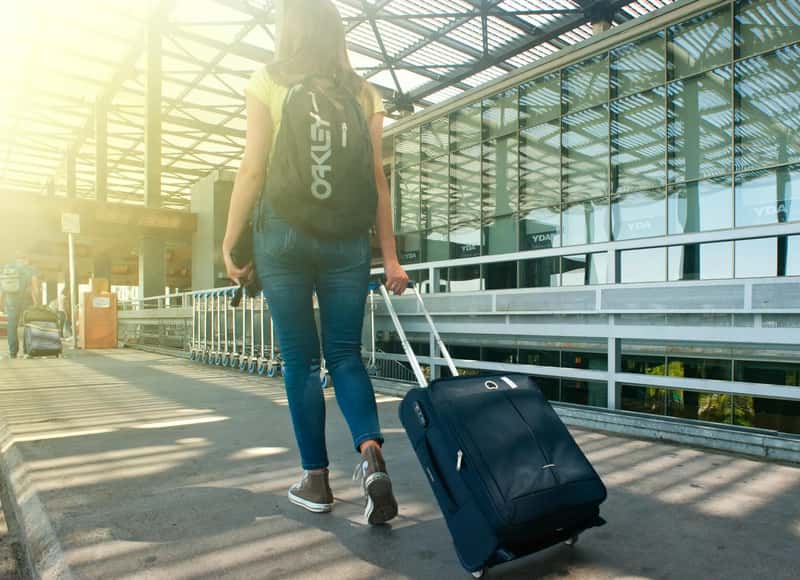
There is a specific kind of person who stands at the departure board with a single bag on their shoulder and feels something that is not pride, not practicality, not smugness. It is something closer to relief. A low, quiet hum of relief – the kind you feel when you realize the door is still open and no one has locked it behind you.
The carry-on-only traveler has been mythologized as efficient, minimalist, intentional. And sure. Fine. Those things are true. But they are the surface story. The one we tell ourselves when the deeper story feels too raw to say out loud. The deeper story is this: the bag stays small because the self needs to stay mobile. Not mobile in the frequent-flyer sense. Mobile in the existential sense. Mobile in the I-need-to-know-I-can-disappear-if-I-have-to sense.
The Control Variable
Here is what no packing guide will ever tell you.
The decision to keep your bag in the overhead bin – above you, where you can see it – is not about avoiding baggage fees.
It is about keeping one variable under your control when everything else feels like it belongs to someone else.
You eliminate loss, theft, and damage in one simple decision. That’s the practical argument. But underneath it is a psychological one that hits harder. When you hand your bag to a stranger at a counter, you are handing over a piece of your agency. You are saying: I trust this system. I trust that what I need will be returned to me. And for a certain kind of person – the kind who has learned, slowly and painfully, that systems do not always give back what they take – that is not a trade they are willing to make.
The bag is a proxy. The bag is always a proxy.
Control the bag. Control the exit. Control, at minimum, the feeling of having one.
The Autonomy Architecture
There is a word in psychology that doesn’t get used enough in conversations about travel. Differentiation.
Differentiation is aiming for a balance between attachment and autonomy – and the challenge of differentiation is to live in, and thrive in, the inherent tension between those two processes.
The carry-on-only traveler has resolved this tension – or thinks they have – by quietly building their entire mobility architecture around the autonomy end of the dial.
They do not ask permission to leave. They do not need to wait at the carousel. They do not require anyone’s timeline to align with their own.
When we travel solo, we are free to decide how much time we spend in one place and do not need to worry about another person and their needs. This is the sentence the carry-on-only traveler has tattooed somewhere invisible on their psyche. They have restructured their physical world – the weight on their back, the contents of their bag – to match the internal architecture they built years ago, long before they ever stepped into an airport.
This is not a travel preference. It is a blueprint.
The Dismissive Sovereign
Let’s say it plainly.
Many people who refuse to check a bag share a fingerprint with a specific psychological pattern.
Dismissive avoidants have built their identity around independence. They genuinely believe they don’t need emotional closeness to feel fulfilled, and they’re not pretending. Self-sufficiency isn’t just a preference for them; it’s a core value.
This does not mean every carry-on traveler is avoidantly attached. But the overlap is worth sitting with. The person who has designed their life so that no one, and no circumstance, has leverage over their departure – that person has usually built those walls for a reason.
At some point as children, people with an avoidant attachment style did not have all their needs met either physically or emotionally, so they learnt not to rely on people. At an unconscious level, they assume they’ll be rejected physically or emotionally, so they protect themselves.
The bag stays light. The timeline stays flexible. The heart stays, carefully, just far enough from reach.
The Exit Strategy
Spend enough time in airports and you begin to recognize a specific body language.
It belongs to the person who is already looking for the door – not because they want to leave, but because they need to know where it is.
This is not anxiety in the clinical sense. This is a calibration. A constant, low-grade scanning of the environment for the fastest path back to themselves.
Some avoidant individuals may have rigid rules and let others know that certain things – their job, freedom, or family of origin – are higher priorities. They may set in stone conditions at the start of a relationship, saying things like, “I will never give up my freedom for anything or anyone.”
The exit strategy is not dramatic. It rarely announces itself.
It just looks like a carry-on. It just looks like someone who “travels light.”
It is someone who has never stopped scanning for the door.
The Weight of Someone Else’s Hands on Your Things
I want to tell you something I have never said out loud in an article before.
I once stood at a check-in counter, bag in hand, and felt a physical sensation of wrongness when the agent reached for my bag. Not irritation. Not inconvenience. Something that read, to my nervous system, as danger. The bag went down the belt and disappeared and I stood there, suddenly 40 pounds lighter, feeling not free but exposed. Like I had handed away a piece of the story I needed in order to know how this ended.
I got the bag back, of course. But for three hours in the air, I kept glancing at the space under the seat in front of me. Reaching for something that wasn’t there. It took me two more years and a therapist to understand that what I had been reaching for had nothing to do with the bag at all.
All the contents inside your suitcase inform how you travel down your own path – how you approach your job, how you problem-solve, how you make friends and keep them. They influence how you view people who are different from you, and they especially impact how you show up in a relationship.
The bag was never just a bag. It was never just about packing light.
The Identity Inventory
Here is the question that no one asks at the check-in counter.
Who are you when everything you own is within arm’s reach? And who are you when it isn’t?
The carry-on-only traveler creates lists and factors in everything – intentionally and decisively packing only what they need. But look closer at that word. Need. Not want. Not enjoy. Not comfort. Need.
The inventory is not of clothing and toiletries. The inventory is of self.
What does this person actually require to function? What can they leave behind without losing something essential about who they are? The ruthlessness of the packing process mirrors the ruthlessness of the identity editing that happens in these people’s interior lives.
Traveling alone means you have plenty of time to focus on one very important relationship – the one with yourself. You learn to trust yourself more as you navigate through some new challenges.
The carry-on is an identity inventory. Conducted at altitude. Every single trip.
The Temporary Lease
The carry-on traveler does not fully move in anywhere.
Not into hotel rooms. Not into relationships. Not into versions of themselves that feel permanent and load-bearing.
This mechanism gives an unconscious fear of losing oneself – even one’s identity – in the relationship. And so the commitment stays carry-on-sized. Enough to function. Light enough to lift.
This is the temporary lease on life. The month-to-month arrangement with circumstances, with cities, with people. It is not pathological, necessarily. It can produce extraordinary art, extraordinary presence, extraordinary experiences. But it is also, at its most honest, a strategy for never being caught too far from the exit to use it.
The hotel room is never home. The neighborhood is never permanent. Even the relationships – the good ones, the real ones – are kept at a specific psychic distance. Just close enough to feel them. Just far enough to leave.
The bag reinforces the lease. Every time. Every trip.
The Lean Mythology
Our culture has made this pattern aspirational.
We celebrate the minimalist. The person who fits their entire existence into forty liters and a passport. We build Instagram aesthetics around it. We write entire books about it. We call it freedom and mean it as a compliment.
But freedom and escape are not the same thing.
A 2015 report by the International Journal of Tourism Research found that internal feelings of freedom, escape, and bravery were the strongest motivators for solo travelers. Another study found that transformative experience, freedom, and flexibility were key motivators, while anticipated self-discovery inspired the potential solo traveler.
Notice how freedom and escape sit right next to each other in the data. Adjacent. Almost interchangeable.
The lean mythology tells us that less stuff means more life. And sometimes that is true. But sometimes less stuff means less stake. Less commitment. Less to lose. And we have dressed that particular fear up in a very flattering wardrobe and called it a lifestyle.
The Self-Reliance Engine
There is something genuinely beautiful inside this pattern, even when the pattern is driven by fear.
Self-reliance isn’t about stubborn independence. It’s about a steady inner voice that says, “I can figure this out.”
The carry-on-only traveler has that voice. Loud and reliable. They have trained it through a thousand small acts of self-sufficiency. They figured out the transit system alone. They navigated the language barrier alone. They ate at the bar alone and liked it.
You can take pride in being self-sufficient and in building lifelong skills, such as problem solving and decision making.
This is real. This is earned. Do not diminish it.
But the question worth asking – gently, without judgment – is whether the self-reliance engine was built as a strength or as a defense. Whether it was chosen or inherited. Whether it is still serving the person running it, or whether the person running it is now serving it.
The engine does not always know when to rest.
The Softest Landing
Here is what lives at the bottom of this.
The carry-on-only traveler is not trying to be impressive. They are not trying to make a statement. They are not even, if we are being completely honest with ourselves, primarily trying to save time.
They are trying to preserve the option. The open door. The answer that has always worked when everything else stopped working: I can leave.
Common avoidant beliefs include expecting rejection if you express your emotional needs, or believing that intimacy inevitably leads to pain. And so the bag stays small. And so the overhead bin stays close. And so the exit aisle gets chosen, every time, not for legroom but for proximity to the door.
Some people have learnt to believe that love means indebtedness that could come at a cost of their own freedom. This usually operates at a very unconscious level, so the main outlets they experience it as can be irritation, anxiety, feeling trapped, and a need for space. The bag is the solution to a problem that was never, really, about the bag.
There is something worth honoring in the person who has spent years keeping themselves light enough to move. Something worth honoring and something worth questioning. Not because the lightness is wrong, but because sometimes the bravest thing is not to be able to leave in an instant – it is to stay. To unpack. To put something heavy down in a room that feels like yours and let yourself, slowly, believe that the door does not need to be open for you to be safe inside.
The overhead bin closes.
The plane lifts.
And somewhere in seat 14A, a person with one small bag looks out the window at the city getting smaller below them, and feels – just for a moment – exactly like themselves.
The question they haven’t asked yet is whether they’d feel the same way if they stayed.