The drawer won’t close all the way.
You know the one.
It’s full of metal. Edges. Weight without purpose.
Zlotys from a city you almost stayed in. Dirham from a souk that smelled like cardamom and diesel. Coins you cannot spend anywhere on earth anymore, pressed against coins that could still buy you a coffee if you ever went back.
You won’t go back. That’s not the point.
Here is what nobody tells you about constant movement: the more you travel, the more your identity begins to exist in the spaces between places. Not quite from here. Not quite from there. The person you are at home feels like a costume, and the person you are abroad feels like a secret. The gap between those two selves is where most frequent travelers quietly live – and quietly drown.
1. The Weight of Evidence
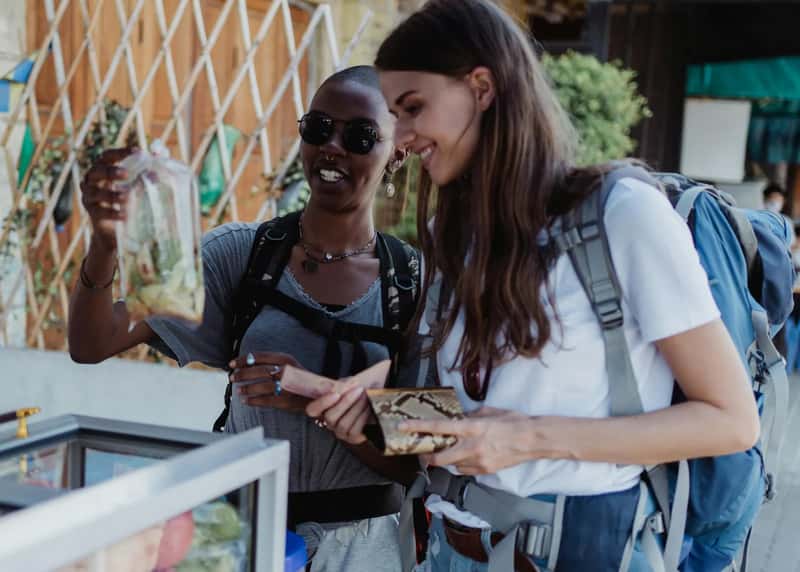
Pick up a coin. Any coin from that drawer.
Feel it. Really feel it.
Psychologists call objects like this “external memory cues” – physical items that trigger vivid, sensory memories. The heft of that small disc in your palm is not sentimental weakness. It is neuroscience. Your hand remembers the market stall before your brain finds the file.
The coin is evidence. Evidence that you were there. Evidence that you stood in a specific square, under a specific sky, and handed this piece of metal to a specific stranger in exchange for something now forgotten. What you remember is not the transaction. You remember the feeling of being someone the people at home have never met.
When we travel or experience something new, our brains are hardwired to seek out tangible reminders of those experiences. Souvenirs serve as anchors, helping us reconnect with the memories and emotions of a particular journey.
The coin is your anchor. You are still, quietly, drifting.
2. The Temporary Identity
Every city gives you a different name.
Not literally. But the version of you that orders coffee in Lisbon is not the version that orders it at home. The traveler-self is looser. Braver. Less haunted by the ordinary responsibilities that calcify the domestic-self over time.
Our sense of who we are is significantly tied to our personal stories and experiences. Holidays can present opportunities to be versions of ourselves that don’t get to shine during our “normal” lives. We can be more relaxed, more adventurous, more gregarious.
The foreign coin commemorates that other person. Not the you that pays bills. The you that once shared a train compartment with a stranger and spoke, haltingly, about life in a language that was neither of yours.
Keeping the coin is keeping that version alive on life support.
You are not ready to let it die. That says more about who you are at home than where you’ve been.
3. The Proof of Departure
We live in a world that has made memory digital, disposable, and deeply unreliable.
We live in a digital world, and while photos and videos are important, they can feel fleeting. Files get lost, hard drives crash, and social media timelines bury old posts. Tangible keepsakes, on the other hand, last. You can hold them, display them, and pass them down.
A photograph on a phone is proof of a moment. A coin from that same moment is proof of a life actually lived. There is a difference. The photograph is for the audience. The coin is for you.
It’s the difference between performing a memory and owning one.
The traveler who keeps every foreign coin is quietly, stubbornly refusing to let experience become content. That refusal is a form of psychological resistance. It is also, in its own dark way, beautiful.
4. The Exit Strategy
Some people collect coins consciously. Most don’t.
The coin ends up in a pocket. Then in a jacket lining. Then in a dish by the door. Then in the drawer. This is not hoarding. This is a story told in increments, without editorial control.
Currency collecting transforms routine travel transactions into meaningful souvenirs. Each bill and coin represents a moment in time, a place you’ve visited, and an experience you’ve had.
But there’s a darker truth underneath the nostalgia. The coin also represents an exit. A door that was once open. The possibility of being elsewhere – of being anyone – that still exists, technically, if you were willing to get on the plane.
Frequent travelers keep coins because somewhere in the reptile brain, they believe the coin is a ticket. Not a currency. A ticket. To the version of life where they haven’t settled. Where the next city is still possible. Where the drawer is still full of futures, not just pasts.
5. The Narrative Object
I have a coin from a country that no longer uses that coin.
The currency changed. The government changed. The borders were redrawn in ways I still don’t fully understand. But I was there when this piece of metal was still legal tender, when a woman sold me a paper cup of tea from a stall barely wide enough to turn around in, and the coin she pressed back into my hand was warm from her pocket.
I kept it because throwing it away felt like an act of violence against the moment.
Souvenirs or mementos are not only representational but also carry a symbolic meaning – apart from keeping as a display object, there is a personal story with an emotional value.
The coin is not the story. The coin is the proof that the story happened. Without the physical object, the doubt creeps in. Did I actually go? Was it as vivid as I remember? Did I change, or did I just think I did?
The coin answers back: yes. You were there. It was real.
6. The Symbolic Consumption
Economists would tell you a foreign coin is worthless once you’re home. Psychologists would tell you something different entirely.
One aspect of souvenir psychology is the concept of “symbolic consumption.” People buy souvenirs not just for their functional use but also for the symbolic meanings they represent.
The coin you can no longer spend is worth more than the coin you can. The moment it became economically inert, it became psychologically loaded.
This is not irrational. This is deeply human. We are meaning-making machines. We need our experiences to leave a mark on the physical world, because the internal mark – the shift in our thinking, the expansion of our empathy, the new tolerance for ambiguity – is invisible to everyone else.
The coin is the external version of an internal transformation. It is the physical proof that when we step into another culture, we encounter different ways of thinking, different problem-solving strategies, and different values that can turn our worldview upside down. This exposure fundamentally reshapes our understanding of reality.
The coin sits in your drawer and silently broadcasts: I was changed here.
7. The Identity Archive
Open that drawer again.
What you’re looking at is not a random collection of foreign metal. You are looking at an autobiography. An unchronicled, unedited, unsentimental record of every version of yourself that ever stepped off a plane into the uncertain air of somewhere new.
Collections have a special place in human psychology. Collecting stamps, coins, or souvenirs from different cities brings a sense of order and continuity. But it also brings something darker: accountability. The collection forces you to admit how many times you left. How many times you came back. How many times you were a different person in between.
Souvenirs can become symbols that represent these alternative identities and our relationships with a particular time, place, or culture. That miniature Eiffel Tower – or that worn coin – can come to represent not just the memory of an exciting trip, but also the memory of alternative versions of ourselves.
The drawer is a mirror. Most people keep it closed for a reason.
8. The Validation Circuit
There is a psychological need, rarely spoken aloud, that sits beneath every collected coin.
The need to know that it happened.
According to psychologist Dr. Susan Krauss Whitbourne, souvenirs help us solidify life experiences. Every time you glance at that fridge magnet – or hold that coin – you’re reminding your brain: this trip was important. It meant something.
In an age of curated identity, where every experience is half-performed for an audience, the private act of keeping a foreign coin is quietly radical. Nobody asked you to keep it. Nobody will ever see it. The algorithm will not reward you for the drawer full of evidence.
You kept it for yourself. That is a vanishingly rare act for a generation trained to document for applause.
The coin is the thing that exists outside the performance. It is proof to yourself, by yourself, of yourself.
9. The Unspent Self
Here is the cruelest truth about the foreign coin in your drawer.
It couldn’t be spent. Not because the exchange rate was wrong, or because the kiosk was closed. Because spending it meant the trip was over. Spending it was an act of finality – a declaration that the journey had fully converted into the past tense.
For many, the real ache is not about comparison – it’s the ache of deferral. The “someday” mindset is the quiet belief that happiness will arrive once we can afford that trip, get that visa, or post that reel.
The unspent coin is the physical form of an unspent self. The you who was going to stay longer. Learn the language. Come back in winter. The you who had a second chapter in mind that the first chapter somehow never permitted.
Every unspent coin is an unmade decision, preserved in metal, waiting to be reconsidered. It will not be reconsidered. But the waiting is its own kind of comfort.
10. The Weight of Return
This is the heaviest one.
The coin you kept was not kept in joy. Not entirely. It was kept in the complicated, uncomfortable moment of return – when the customs line moved forward, when the familiar skyline appeared through the airplane window, when the person waiting for you at arrivals smiled and said “welcome home” and you smiled back and said nothing about how “home” suddenly felt like the foreign country.
Loss of identity is a common challenge faced by those who return to their roots after deep travel, and it can significantly impact mental health. This can result in feelings of isolation, loneliness, and disconnection.
The coin went into your pocket on the way out of the terminal. Not into your wallet. Your pocket. Because wallets are for currencies you intend to use. Pockets are for things you intend to hold.
Tourists are not only searching for the “Other” – they are also on a quest for self-identity, and travel is a vessel for self-discovery. But the vessel always docks. The quest always pauses. And you are left standing in your kitchen, foreign coin in hand, trying to remember who you were before you left, and whether that person is still worth returning to.
The keeping is not nostalgia. The keeping is negotiation. Between the self that left and the self that came back. Between the world that opened and the world that closed. Between the evidence of a life fully inhabited and the quiet, persistent fear that the most alive you have ever been is already behind you.
That drawer is not a collection. It is a case file. Evidence that something happened to you – not to a character in a travel essay, not to a version of you posed for photographs at the right angle with the right light – but to you, in the mess and the heat and the disorientation of actually being somewhere else.
Close it gently.
The coins are still warm.