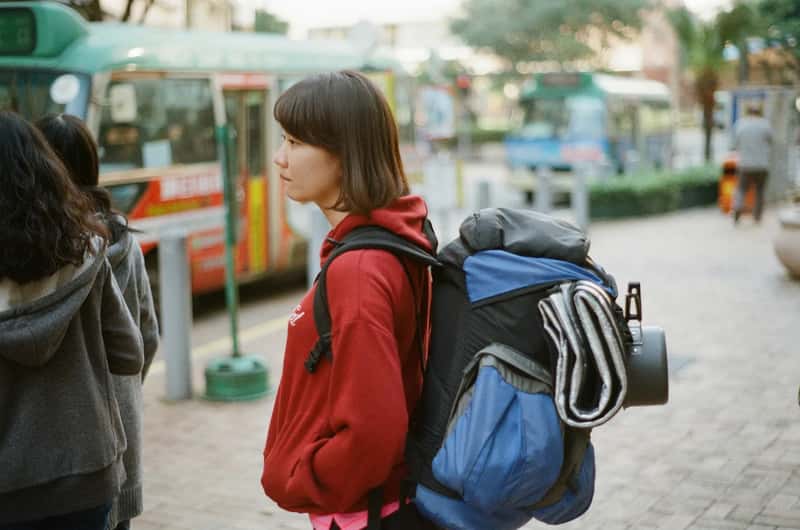
You arrive in a new city and the strap is cutting into your shoulder.
You already passed three people who spoke English.
You did not stop.
You never stop.
There is a version of you that exists only in motion – always competent, always composed, always carrying the full weight of every mile alone. That version is not free. It is performing freedom, and it is exhausted from the audition. The traveler who cannot ask for directions is the same person who cannot ask for softness, for patience, for love. The bag is just the most honest symbol of everything else they refuse to set down.
The Armor You Packed Before You Left Home
Before the first flight. Before the first hostel. Before the first foreign city swallowed you whole – you were already carrying it.
Hyper-independence is when your nervous system learns that needing anyone equals danger, usually from past experiences – whether it was growing up in chaos, emotional neglect, or being in an unhealthy relationship.
You did not invent this at the airport.
You brought it with you, folded neatly between the travel adapter and the backup charger.
It is an unconscious compulsion to over-function, overachieve, and over-give in efforts to protect yourself from being let down, rejected, or controlled again.
The cobblestones are just a new stage for an old performance.
The armor traveled with you. It always does. And the longer you wear it in foreign heat, the heavier it gets.
The Distance Between Confident and Closed
You look confident. The stride is long. The face is readable as someone who knows exactly where they are going.
But there is a difference between confidence and closure.
The outside may look composed and capable. Internally, though, there may be deep loneliness or emotional exhaustion.
You have mastered the art of looking unbothered in every time zone.
The currency changes. The cafes change. The language on the signs changes. Your expression does not.
Many people wear their independence like armor, believing that self-reliance equals strength. But armor, by design, does not let anything in. Not the warmth of a stranger’s help. Not the relief of a shared map. Not the quiet gift of being known.
The distance between confident and closed is exactly three miles with a heavy bag.
The Nervous System That Never Landed
You touched down. Customs cleared. Cab taken.
Your body has not landed yet.
Over time, the nervous system learns that control equals safety. Hyper-independence is about avoiding pain rather than avoiding connection.
This is the invisible immigration checkpoint that no passport controls. The one your nervous system enforces every time someone offers to help and your chest tightens instead of opens.
Hyper-independence actually rewires your brain. When you repeatedly choose isolation over connection, your nervous system begins to interpret help-seeking as dangerous. This creates a neurological feedback loop where your stress response activates when someone offers assistance.
You are not paranoid. You are not unfriendly.
You are operating on a very old operating system in a very new city, and the lag is killing you.
The Exit Strategy Disguised as Adventure
Let us name the thing that travel sometimes is.
Not exploration. Not curiosity. Not wanderlust.
Sometimes, it is a very elegant exit strategy.
Traumatic experiences can create specific triggers that bring up distressing emotions and memories. Hyper-independence may be a way to avoid these triggers by avoiding situations or people that could be retraumatizing. By maintaining a high level of independence, people can minimize their exposure to these triggers and protect themselves from further emotional pain.
Movement is the most socially acceptable form of avoidance we have invented.
Buy a ticket. Board a plane. Call it growth.
But the thing you were running from had a passport too. It met you at the baggage carousel. It has been sitting across from you at every solo dinner in every candlelit restaurant in every city you swore would finally be the one that changed everything.
The Weight of the Bag Is Not About the Bag
I have been the person on the three-mile walk. I know the math of it – how you calculate the distance, decide it’s manageable, and then spend forty-five minutes arguing with your own shoulder just to avoid a thirty-second exchange with a stranger.
The real calculation is never logistical. It is emotional.
When your emotions weren’t met with care, comfort, or attunement, you likely learned that relying on others wasn’t safe or effective. You adapted. You became the strong one, the one who doesn’t ask for anything. Because asking meant risking rejection, disappointment, or shame.
The bag is not the problem.
The problem is that somewhere along the way, you decided that needing help was a vulnerability you could not afford. And now you pay for that decision in blisters and sweat and the particular loneliness of choosing the long way around every single time.
The Perfectionism That Packs Itself
You researched the route. You downloaded the offline maps. You have contingency plans for your contingency plans.
This is not preparation. This is pre-emptive self-protection wearing the mask of competence.
Sometimes, hyper-independence is outwardly visible through perfectionistic behavior or general distrust of others. They may take on more than they can realistically handle, increasing the risk of burnout.
Perfectionism and hyper-independence are the same creature wearing different outfits.
One says, “I must do this flawlessly.” The other says, “I must do this alone.” Together, they whisper that any deviation – any moment of leaning – is a failure of character.
If you’ve learned that depending on others isn’t an option, you might try to control everything yourself. This can lead to perfectionism, overworking, and burnout – all of which fuel anxiety.
You are not meticulous. You are afraid. And fear, in the right light, looks a lot like competence.
The Loneliness You Call Freedom
There is a particular silence at a solo table in a foreign city.
You have romanticized it. The novel beside the wine glass. The notebook. The private ritual of eating alone in public.
But underneath the aesthetic, there is a word for it.
While hyper-independence may seem like a strength, over time it can take a quiet toll on both mental health and personal relationships. People who live in constant self-reliance often experience anxiety and burnout from carrying everything alone, and a sense of loneliness, even while telling themselves it’s just “freedom” or “peace.”
Freedom and loneliness are not opposites. They are neighbors. And in the geography of hyper-independence, the wall between them is thinner than you think.
Hyper-independence can create invisible walls between you and the people who care. You might feel disconnected, even in the presence of others, simply because you’re not used to letting anyone in.
The solo table is honest. The question is whether you are honest about why you chose it.
The Identity That Only Exists in Transit
There is a version of you that only shows up when no one knows your name.
Looser. Lighter. Almost warm.
The hyper-independent traveler is often addicted to this version – the self that gets to be a mystery, that owes no one an explanation, that has not yet disappointed anyone in this particular postcode.
You tell yourself you prefer doing it all alone, that you don’t need anyone. But deep down, it is a survival strategy built from pain – one that slowly convinces you that you’re safer solo, even if it leaves you feeling disconnected, unseen, and like you don’t belong anywhere.
The transit identity is seductive precisely because it is temporary.
Temporary means untested. Untested means safe.
But you cannot build a life in a departure lounge, and you cannot heal inside a persona that only works when no one is watching long enough to see the cracks.
The Cost That Never Appears on a Boarding Pass
There are fees for this kind of travel that no airline charges.
They come out of a different account.
When you refuse help, every responsibility, every problem, and every decision falls on you. This creates chronic stress, which leads to exhaustion, tension, and racing thoughts – classic symptoms of anxiety.
The chronic fatigue is real. Not the tired-from-travel kind. The deeper kind.
This heightened responsibility increases stress hormones such as cortisol, contributing to anxiety, exhaustion, and burnout. Many describe feeling “on edge” even when no obvious danger is present.
You arrive at every destination already depleted. You leave every destination having spent more of yourself than the journey required. And somewhere, quietly, you wonder why the places never quite restore you the way you hoped they would.
The place was never the problem. The cost was always the invisible one – the one you paid in the currency of never letting anyone carry anything.
The Slow, Terrifying Act of Setting the Bag Down
This is the heaviest point. Not because it is complicated. But because it is simple, and simple things – when you have been avoiding them for years – feel like standing at the edge of something very tall.
Healing from hyper-independence does not mean giving up your independence or becoming dependent on someone else. It means expanding one’s capacity for connection and learning to support the idea that vulnerability can coexist with strength. This process aims to become “inter-dependent” – the ability to both give and receive care.
That is the revolution. Not therapy. Not a ten-step plan. Not a different city.
The revolution is the moment you stop walking and ask someone where the street is.
Hyper-independence isn’t just your personality. It’s something you learned to keep yourself safe. And just like it was learned, it can also be unlearned.
The local points left. You say thank you. Nothing catastrophic happens. No one takes anything from you. The world does not register your vulnerability as weakness, because the world was never watching as carefully as the fear told you it was.
Here is what no travel writer tells you: the most radical thing you can do in a foreign city is ask for help. Not because it solves the logistical problem – though it does. But because it tells your nervous system something it has spent decades refusing to believe. That the ask is survivable. That the answer might even be kind.
The hyper-independent traveler moves through the world like someone who has been told, in no uncertain terms, that they are on their own. And so they walk. And walk. And walk. Three miles becomes five. Five becomes a way of life. The city blurs past them, full of hands they never reached for, full of voices they never let answer.
The bag is still there, where you left it on the floor. You’ve been standing at the window for a while now, looking at nothing in particular. That might be the most honest thing you’ve done all day.