The gate is called.
You are already catastrophizing.
Thirty thousand feet hasn’t happened yet and you’re already mapping the exits, reading the flight attendant’s face for tells, counting the seconds between engine sounds.
The plane is fine. You are not.
There’s a version of you that exists only in transit – half-present, half-braced for impact. A you that doesn’t know how to simply sit inside a good thing without anticipating its collapse. The airport, the boarding pass, the hum of the fuselage – they don’t create the dread. They just strip away the noise you use at home to drown it out. What’s left is the truth: you have been trained, somewhere along the way, to treat safety as suspect.
1. The Permanent Standby
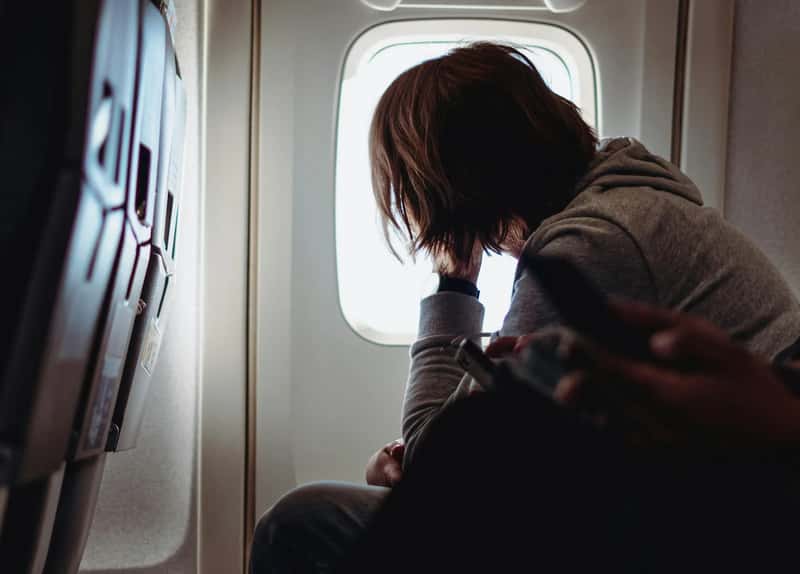
Hypervigilance is the result of an overactive threat-detection system in the brain. With it, you feel anxious or on edge and constantly worry about potential harm, even when you’re safe.
On a plane, this system doesn’t get a break. It gets a stage.
You sit down and the scanning begins immediately. The overhead bin. The passenger three rows up shifting in their seat. The slight variation in the engine pitch during climb. Your brain is doing what it was trained to do: locate the danger before it locates you.
The problem is that this was never about flying.
Beyond overt trauma, growing up or living in consistently unpredictable environments can foster hypervigilance. If your caregivers were inconsistent, if your home life was unstable, or if you faced constant uncertainty, your nervous system learned to be on high alert to predict and prepare for the next shift in your surroundings.
The plane is just the room where you finally run out of distractions. The standby light has been blinking your whole life.
2. The Catastrophe Rehearsal
You don’t just think about what could go wrong. You script it.
Full production. Cast, setting, tragic resolution. Before the wheels leave the tarmac, your mind has already run three distinct scenarios involving engine failure, turbulence over the Atlantic, and a pilot who sounds just slightly too calm on the intercom.
Anxiety manifests as a future-oriented mood state – a complex cognitive, affective, physiological, and behavioral response system associated with preparation for anticipated events perceived as threatening. Pathological anxiety is triggered when there is an overestimation of perceived threat or an erroneous danger appraisal that leads to excessive and inappropriate responses.
The rehearsal feels like preparation. It is not. It is punishment.
You are punishing yourself for daring to be somewhere good. You are pre-suffering. Because somewhere in the architecture of how you were formed, suffering first felt safer than being blindsided by joy and then losing it.
The catastrophe rehearsal is not about the plane. It is about every time the good thing ended without warning.
3. The Control Inventory
You chose the seat with the best exit access.
You read the safety card. Twice. You know where the life vests are. You have already identified which flight attendant looks most competent. You brought your own snacks because the airline’s food is one variable you can eliminate.
Planning for every possible problem – checking traffic repeatedly, leaving extremely early, having backup plans for your backup plans – is a real-world example of hypervigilant behavior.
This is what the interior of a controlling mind looks like at altitude. It isn’t arrogance. It is terror in a very organized suit.
The Control Inventory is the behavior of someone who once lost everything because they weren’t paying close enough attention – or was told they weren’t. So now you pay attention to everything. You think that if you just cover enough variables, the universe will hold.
It won’t. And some part of you already knows that. Which is why the inventory never actually ends.
4. The Body Betrayal
Your heart rate goes up at the boarding announcement.
Not during turbulence. Not at takeoff. At the boarding announcement. Before anything has even happened, your body has already started the alarm sequence.
The body stays in a state of “readiness,” even when there’s no real threat – rapid heartbeat, sweating, trembling.
This is the physical language of a nervous system that no longer trusts the present moment to stay safe.
Worry primes the nervous system to look for signs of threat, increasing sensitivity and awareness in spaces that would typically be considered safe.
Your palms are wet. Your jaw is clenched. Your shoulders are somewhere near your ears. And you’re still on the jet bridge.
The body keeps score, yes. But it also keeps anticipating. It is running drills for a disaster that statistically will not arrive. The real story isn’t in the plane. It’s in the body that never learned it was allowed to stop bracing.
5. The Exit Strategy
I once sat in row 22, aisle seat, on a red-eye from New York to London. I had already identified three exit rows, mentally rehearsed brace position, and decided that if we went down over the ocean, I would use my inflatable vest and swim toward the blinking light. I was completely serious. I was also completely exhausted.
I wasn’t preparing. I was performing control in a situation where I had none. And the performance was costing me the entire flight – seven hours of Europe I never arrived for mentally because I was too busy not dying in my imagination.
Emotional hypervigilance keeps your nervous system braced for impact, even when no danger is present. While it may have once helped you stay safe, over time it can make connection exhausting, rest difficult, and trust feel risky.
The exit strategy isn’t about the door at the back of the plane. It’s about having one foot out of every good thing, always. So when it ends – and you are certain it will end – you can say you saw it coming. You were almost out already. You were never fully there to lose.
6. The Noise Audit
That sound. What was that sound?
Every click of the landing gear retracting. Every change in the engine’s register. Every PA system crackle that precedes a routine announcement. You catalog them all. You build a mental baseline and then spend the flight checking for deviations.
In a hypervigilant state, the brain’s threat-detection circuits are over-tuned, interpreting ambiguous or benign stimuli – a door creaking, footsteps – as possible threats.
On a plane, there are approximately eleven thousand sounds per hour that mean nothing. Your brain will assign significance to at least forty of them.
People with flying anxiety may become hyper-aware of their surroundings, constantly scanning for signs of danger or discomfort.
The Noise Audit is the auditory version of a childhood spent listening through walls. Footsteps on the stairs. The particular silence that meant something was wrong. Voices dropping. You learned early that sound carried information about survival. You never got the memo that the flight deck is fine and the captain just dimmed the cabin lights for landing.
7. The Borrowed Calm
You watch the flight attendant. Obsessively.
If she looks relaxed, you exhale for approximately four seconds before checking again. If she frowns at something – anything, a spilled drink, a passenger’s tray table – you register it as a possible indicator of structural failure.
If you constantly scan conversations for hidden meaning, feel a rush of anxiety before conflict even begins, or read other people’s moods as a matter of survival, you may be experiencing emotional hypervigilance.
This is borrowed calm. You cannot generate it yourself right now, so you try to download it from someone else’s face.
Maybe you’re constantly scanning for shifts in tone. Maybe calm doesn’t feel peaceful – it feels suspicious. Maybe part of you is always waiting for the other shoe to drop.
The flight attendant is paid to look unruffled. You know this. You still keep checking. Because somewhere in your history, someone else’s calm face was the only early-warning system you had. You learned to read rooms instead of reading books. That skill doesn’t disappear at thirty thousand feet. It just runs out of reliable data.
8. The Impostor Altitude
Everyone else looks fine.
The man in 14C is already asleep. The woman across the aisle is eating warm nuts and watching a film and laughing, actually laughing, as if the aircraft isn’t a metal tube held aloft by physics she doesn’t personally understand.
You feel alien. Wrong. Like you missed some internal update that taught everyone else how to simply be inside a moving thing without auditing it for failure.
Many people with hypervigilance appear high-functioning, insightful, and emotionally aware on the outside – while feeling anxious, guarded, or chronically unsettled on the inside.
This is the Impostor Altitude. The gap between the face you put on and the storm running underneath it.
The tendency to catastrophize may make it hard to let one’s guard down and enjoy happy moments. When life is going really well, a person living with hypervigilance may find themselves anxious, waiting for the next shoe to drop.
You are not broken. You are not weak. You are operating with a nervous system that was shaped in environments where relaxing was a liability. The man in 14C is asleep because no one ever taught him that safety is temporary. You were taught differently. That lesson cost you something.
Reframing hypervigilance as an adaptation means we stop asking what is wrong with the person. Instead, we ask what happened to the person. That shift is not small. That shift is the beginning of everything.
You are not afraid of flying. You are afraid of losing the good thing. Of being at altitude – in life, in love, in any moment of lightness – and having it taken without warning. The plane is just the cleanest metaphor your nervous system could find for that terror. No land beneath you. No exits you can actually reach. Just the physics of trust, holding you up.
And here is what no one tells you: the people who seem at ease up there haven’t solved the problem of impermanence. They’ve just, somewhere along the way, decided to stop solving it mid-flight. They let the engine noise be engine noise. They let the turbulence be weather. They let the landing be a landing and not a reprieve from a punishment they expected all along.
You can learn that too. Not by forcing your body into calm. Not by reading statistics about airline safety, though the statistics are staggering in your favor. But by slowly, painstakingly, teaching your nervous system what your mind already suspects: that the good thing lasting is not an anomaly to be investigated. It is, quietly, simply, the most ordinary miracle there is.