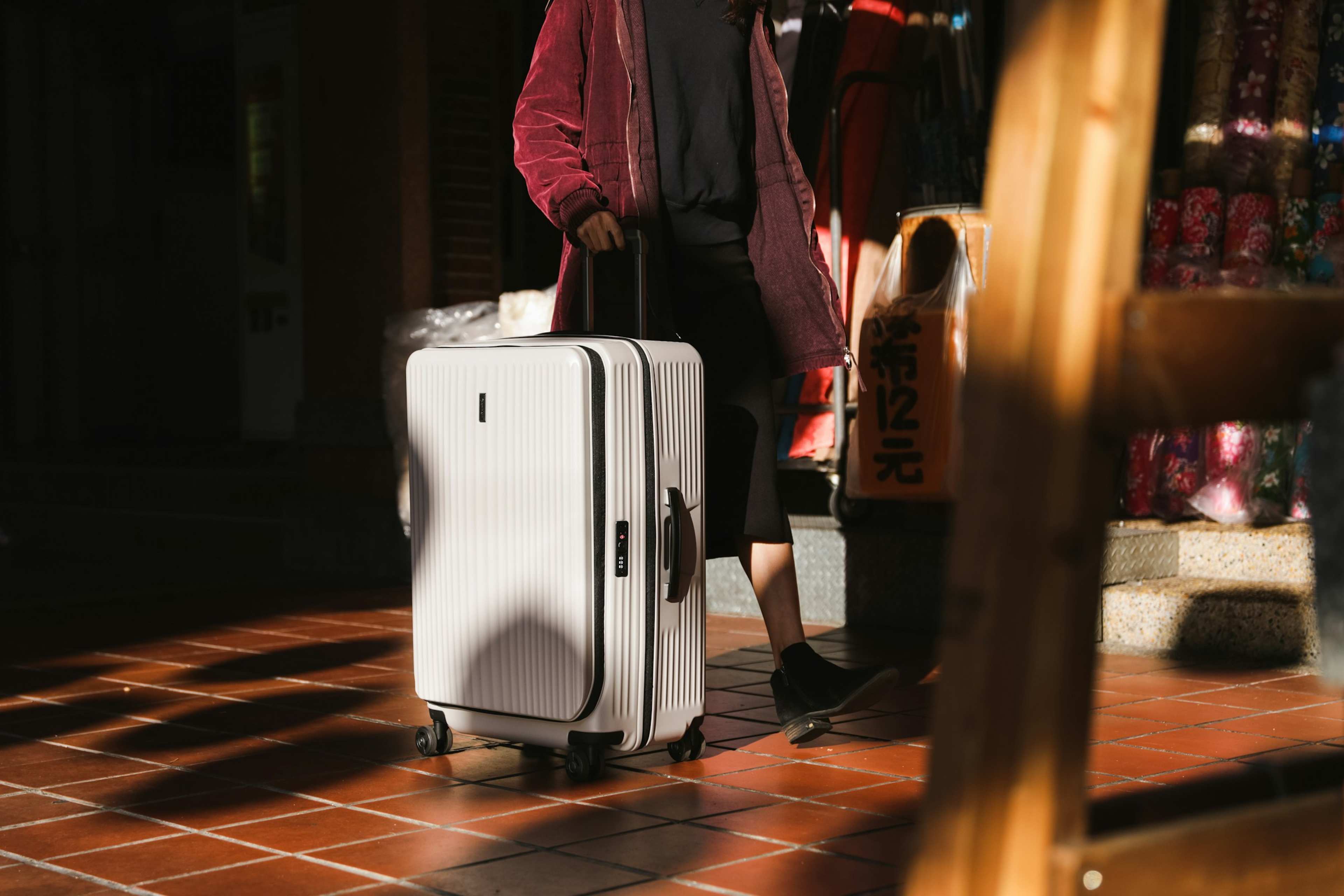
The market opens at dawn.
You are already there, camera down, linen shirt on, pretending you belong.
You don’t speak the language. But you order the coffee anyway – slowly, carefully – as if the ritual itself might restructure something broken inside you.
You’ve been doing this for three cities now. Maybe four.
There’s a word for the gap between who you perform yourself to be in a foreign alley and who you actually are in your own kitchen at midnight. It’s not wanderlust. It’s not freedom. It’s the space between the identity you’ve constructed for the road and the one you’ve quietly abandoned back home.
There is a version of travel that is genuinely transformative. It opens the architecture of your thinking. It introduces you to the uncomfortable fact that your way of doing things is not the only way, or even necessarily a good way. It returns you home altered, quieter, more honest about what you want.
The Temporary Identity

Every new city offers the same intoxicating gift: a blank slate.
No one here knows your history. No one knows about the career pivot that didn’t work out, the relationship that quietly collapsed, or the version of yourself you promised to become by thirty.
Here, you are simply “the traveler.”
Sociologist Karen Stein writes that travel and vacations are a means to reshift and reorganize identities – a way to reexamine our priorities and devote attention to identities we’ve had to push into the background. That is a generous reading. The darker one: some of us aren’t reorganizing. We’re hiding.
The temporary identity is seductive precisely because it is temporary. It asks nothing of you. It carries no mortgage, no recurring disappointment, no awkward family dinner where someone asks how the “big dream” is going.
You get to be whoever you want to be for exactly as long as your visa allows.
Then you land. The carousel spins. And you are, once again, undeniably yourself.
The Exit Strategy
Watch how quickly the flights get booked.
Like other escapist behaviors, when something stressful occurs, a habitual pattern sets in – which might be immediately looking up flights and planning trips.
The job review goes poorly. You’re on Skyscanner within the hour.
The relationship reaches a difficult conversation neither of you is ready for. You’re suddenly very interested in the cheapest route to Lisbon.
If escapism is defined as a desire or behavior to ignore, evade, or avoid reality, then there will be many instances when traveling is a way to run away from underlying problems one doesn’t want to address – and this is common because travel is, for the most part, a way to be free of the burdens of life.
The exit strategy is not a travel plan. It is an emotional reflex dressed in linen and good intentions.
And the cruelest part? It works. For a while. The distance feels like progress. The motion feels like momentum. Until you stop moving and realize you’ve been standing still the entire time.
The Dopamine Architecture
Your brain doesn’t distinguish between a breakthrough and a booking confirmation.
Both feel like forward motion. Both flood the same reward pathways. As one psychologist puts it, travel “can be a way to delay or completely avoid doing things we don’t want to do” – and “it’s easy to get hooked on travel because it stimulates the pleasure centers in the brain.”
That stimulation is real. It is not imaginary or weak or something to be ashamed of.
But it is borrowed time.
The allure of new horizons can temporarily mask discomfort, but it rarely addresses the root cause of what one is running from.
Every new destination is a hit. Every return home is the comedown. To cope with post-travel depression, travelers often resort to constantly planning their next vacation to do away with the drudgery of everyday life and routine. The cycle has a name. It just doesn’t have a departure gate.
You are not exploring the world. You are self-medicating with geography.
The “Local” Costume
Let’s talk about the costume specifically.
The farmers’ market tote. The phrase learned from a YouTube video. The deliberate avoidance of tourist infrastructure. The pride – and it is pride – in knowing which café the locals use and which ones are “ruined.”
This is performance. Beautiful, harmless, deeply human performance.
But ask yourself what you are performing and for whom.
For some, the thrill of discovering unfamiliar cultures becomes a defining aspect of their identity, driving them to prioritize travel above all else – behavior that can stem from a desire to escape mundane routines or seek validation through social media.
The “local” costume is a way of saying: I am not a tourist. I am not a stranger. I belong somewhere, even if that somewhere is not my actual home.
It is an identity worn like a disguise. Comfortable precisely because it can be shed at the airport on the way back.
The harder question is not whether you can live like a local somewhere else. It’s why living like yourself at home feels so unbearable.
The Mirror You Can’t Pack
I remember sitting in a rented apartment in Porto, convinced I had finally figured something out.
The light was different there. The pace was slower. I cooked. I walked. I felt, briefly, like a person I actually respected.
Then I opened my laptop and the same emails were waiting. The same unfinished document. The same unanswered question about what, exactly, I was building.
The city had changed. The mirror had not.
If no new place seems to settle the agitation or claustrophobia one feels, either there or when returning home, then there may be deeper issues at play.
That sentence landed like a slow punch.
Because I had been to eight countries in two years looking for a feeling that was apparently not available for purchase anywhere on earth. The mirror you can’t pack is the one that shows you who you are when no one is watching, when the itinerary is over, when the last Instagram post is uploaded and the quiet rolls back in like a tide.
That mirror follows you everywhere. It always has.
The Unresolved Issues Back Home
Here is what the travel content never shows you.
The inbox that grew while you were away. The friendship that quietly expired because you were always “somewhere.” The creative project that never made it past the planning stage because planning the next trip was easier and more immediately satisfying.
Being intensely interested in one activity to the point that a person begins to neglect other aspects of their life – including work, relationships, and even their own basic needs – is where passion becomes unhealthy.
The unresolved architecture back home doesn’t crumble while you’re away. It quietly calcifies.
The relationship that needed a real conversation gets another six months of polite distance. The career question that required brutal honesty gets another year of deferral.
Consider the case of individuals who plan trips back-to-back, often at the slightest hint of dissatisfaction with their current reality – for them, travel becomes a form of emotional anesthesia, numbing the pain of unresolved conflicts or unfulfilled aspirations.
Anesthesia is not a solution. It is a postponement with an expensive itinerary.
The Social Proof Machine
There is a reason the algorithm rewards movement.
Motion reads as ambition. Novelty reads as depth. A photograph in front of a centuries-old door in a city you visited for four days reads, somehow, as a personality.
The jet-set lifestyle paraded on social media seems like pure bliss – and for many, this type of travel-fueled glamour appeals to the intrinsic human need for change, but for others, it could be a marker for mental health issues.
The social proof machine is not neutral. It actively rewards the person who is always elsewhere. It has no mechanism for valuing the person quietly doing the slow, unglamorous work of building something real in one place.
Your followers will double-tap the cobblestone street. They will not double-tap the therapy session. They will not validate the Tuesday night when you finally had the conversation you’d been avoiding for two years.
The algorithm optimizes for departure. It has no interest in arrival.
The Identity Gap
The gap is specific. It lives between who you are when everything is temporary and who you are when everything is permanent.
Social psychologist Michael Brein, who specializes in travel and intercultural communication, notes that “travel can certainly appeal to people who don’t want to come face to face with difficult situations” – and that “since you’re very independent when traveling, and not having to deal with interpersonal difficulties or troubled relationships back home, that’s part of the draw.”
In the gap, you are likeable. Easygoing. Curious. Brave.
Back home, you are complicated. You have history. You have patterns. You have a way of shutting down in November that you’ve never fully explained to anyone, including yourself.
The identity gap is not a flaw. It is information.
It is telling you, in the only language it knows, that the version of you that exists abroad is not impossible at home. It is simply inconvenient. It requires work that moving doesn’t require. It requires presence that transit makes impossible.
The gap is not the destination. Closing it is.
The Return That Reveals Everything
Pay close attention to the moment you land.
Not the romance of departure. Not the ritual of the foreign morning. The return. The specific, unforgiving quality of your own front door after three weeks away.
Post-travel depression is real. Anyone who has returned from a trip knows what it is – the conversation about how amazing and life-changing long-term travel is rarely addresses the idea that coming home is harder than leaving.
That difficulty is data.
If coming home feels like a defeat, then home is telling you something. Not that you should leave again. That you have unfinished business with the place and the life you actually inhabit.
This behavior often stems from the desire to escape stress, monotony, or unresolved emotional turmoil – and while occasional travel can rejuvenate the mind, frequent reliance on it to avoid confronting personal issues may signal a deeper problem.
The return reveals everything the departure conceals. Most people book the next flight before it has time to speak.
The Bravest Trip You’ll Ever Take
Here is the thing no travel account will post.
The most demanding journey is not the one that requires a passport. It is not the fourteen-hour layover, the uncomfortable bus, the unfamiliar currency, or the language you can’t quite crack. Those discomforts are finite. They have an end date. They are, in the most honest sense, safe.
Joseph Troiani, a professor of psychology at Adler University, notes that travel can turn into a compulsive behavior for people who are looking to escape reality or use it as an avoidance strategy.
The bravest trip is the one where you stay.
Where you sit in the apartment you’ve been trying to escape and you look, really look, at what it is you’ve been running from. Where you have the conversation. Where you start the thing. Where you grieve the version of your life that didn’t happen instead of perpetually rebooting in a new time zone.
By recognizing the difference between escaping and exploring, individuals can transform their wanderlust into a force for personal development rather than a means of avoidance.
That distinction is everything. Exploring moves toward something. Escaping moves away from something. Both can look identical on a map. Only one of them actually takes you anywhere.
The bravest trip has no itinerary. No curated café. No linen costume. It is just you, in your own city, your own language, your own recurring and unresolved life – choosing, finally, to be present for it.
That travel is earned. It is the travel of someone who has done enough interior work to recognize when they are genuinely curious versus when they are genuinely afraid. It does not require a local market or a perfectly curated neighborhood. It requires only that you bring yourself fully – including the parts you’d rather leave behind at check-in.
The city you keep running to is not the point. The city was never the point. Somewhere between the departure lounge and the cobblestone street and the carefully ordered coffee, you already know this. You’ve known it for a while. The question is not where you go next – it’s whether you are brave enough to finally go home.