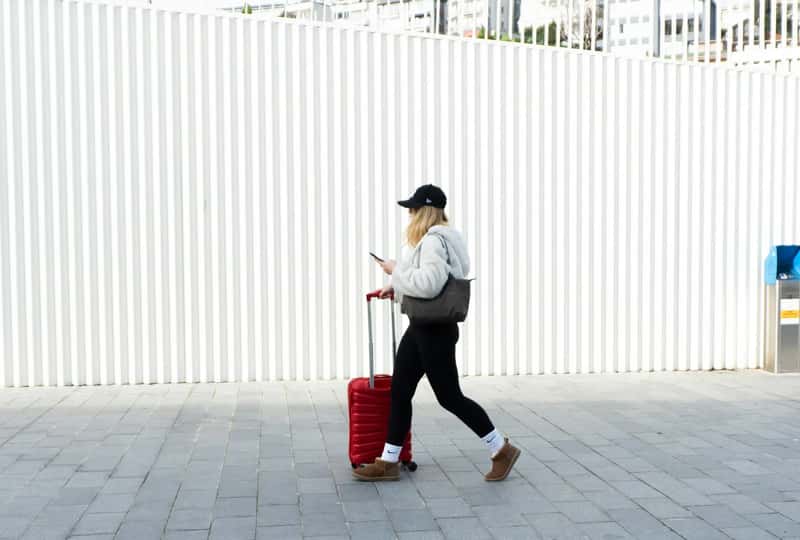
You packed in forty minutes.
One bag. No checked luggage. No apologies.
The gate agent looked at your carry-on and you felt something close to pride.
That feeling – quiet, private, almost smug – is worth examining. Because it wasn’t about the bag. It was never about the bag. It was about the person standing next to the bag, trying to prove something to a world that keeps insisting you need more, want more, buy more, carry more. The suitcase is just the prop. The performance started long before you got to the airport.
There is a gap – a clean, cold, specific gap – between who the minimalist traveler presents themselves to be and who they quietly are when the terminal empties out at 2 AM and there is no one left to impress. The enlightened wanderer. The untethered soul. The person who has “figured it out.” But underneath the packing cubes and the capsule wardrobe, the emptiness of returning from travelling is not simple nostalgia – it may be a sign that the identity expanded during transit cannot fully be embraced back in your original context. The gap is real. The gap is you.
The Temporary Identity
Here is the first uncomfortable truth about minimalist travel.
The less you carry, the more you become.
In transit, stripped of the artifacts that signal your role – your commuter mug, your desk plant, your neighborhood coffee shop loyalty card – you become someone refreshingly undefined. During solo travel, you are free from all kinds of expectations. The self is relational, formed by relations with others. Who we are is not only who we decide we are, but how others formulate that conception. Strip those others away, and suddenly the self feels infinite. Unbounded. Possible.
The minimalist traveler mistakes this vacancy for freedom.
They mistake the absence of mirrors for the presence of truth.
They pack light because a lighter bag means a lighter identity – one that hasn’t yet hardened into the shape other people expect. The single-bag philosophy isn’t about practicality. It’s about keeping the self deliberately provisional. Temporary identities don’t have to answer for themselves.
The Control Ritual
Count the items in your bag. Go on.
You know the number. You always know the number.
That knowing is a ritual of control dressed up as a philosophy of freedom. Research on minimalism identifies its core behavioral representations as clutter removal, cautious shopping, longevity, and self-sufficiency. Self-sufficiency. That word carries more psychological weight than any packing list ever could. Because self-sufficiency is not really about how many shirts you bring. It’s about how desperately you need to believe that you are enough – without the backup plan, without the safety net, without the extra pair of shoes.
The airport becomes a theater of competence.
You move through security with a practiced calm. You know exactly where everything is. You waste no motion. You need no help. This is not accidental. When travelling solo, travelers remove themselves from the continual negotiation of group dynamics. They have control of decisions and actions – what to eat, what to do, when to rest. This control removes perceived obligation and makes preferences resurface that might have become obscured by social obligation.
The minimalist bag is the most visible expression of that control. It is a portable argument. And you are always making it.
The Scarcity Performance
Somewhere, a travel influencer is photographing their single tote bag against a European cobblestone street.
The caption will say something about freedom.
It will not mention the performance embedded in every pixel. Because minimalist travel, at its most aestheticized, is a form of conspicuous scarcity – the deliberate, public display of having chosen less. It is consumerism wearing a different costume. Instead of showing what you own, you perform the virtue of what you have refused. At the most sophisticated level, exploring minimalism requires analyzing the socio-economic underpinnings of consumer culture and interrogating the Western bias in dominant minimalist narratives, understanding the potential for minimalism as a form of resistance against hyper-consumerism.
The resistance is real. But it has been monetized.
The capsule wardrobe now costs more than the wardrobe it replaced. The “one perfect bag” retails at four hundred dollars. The liberation from things has become its own category of thing.
You are not wrong to want less. You are only worth examining when “wanting less” becomes a brand.
The Exit Strategy
Ask yourself honestly: when did you start planning the next trip?
Was it on the flight home from the last one?
There is a particular kind of person who lives in a state of permanent pre-departure. The apartment is always slightly provisional – a mattress on a frame, a half-empty kitchen, a bookshelf that never quite gets filled. The minimalist aesthetic at home is not a design choice. It’s an exit strategy. Traveling provides the time and space to reflect on thoughts and emotions. It provides the opportunity to take a step back from daily life and really think about what you want. If you’re feeling lost or unsure about your path in life, traveling can help you gain clarity and perspective.
But what happens when the clarity only arrives in motion?
What happens when stillness feels like a malfunction?
The minimalist traveler has trained themselves to associate lightness with aliveness. A full apartment starts to feel like a trap. A long-term lease reads like a sentence. The exit strategy disguised as a lifestyle is still, at its core, an exit.
The Weight You Actually Carry
I once stood in a budget terminal in Lisbon with a single backpack and felt, for approximately eleven minutes, like I had solved something.
Then the gate changed. The coffee was bad. The man across from me was crying quietly into his phone. And I sat there, unburdened by luggage and absolutely crushed by the realization that I had carried the same interior weather to every airport on three continents.
The bag was light. Everything else was not.
When one travels alone – into fear, isolation, and uncertainty – the traveler is able to trust their own abilities. They can become more resilient, self-sufficient, and closer in harmony with their personal identity. This is the beautiful part. The true part. But it is only half the story. The other half is the part no packing guide will ever address: solo travel dramatically reshapes identity by shedding attachments and inner roles, and each independent decision in travel conveys something about personal preferences. Those preferences include the preference for avoidance. And even a one-bag traveler is carrying the full weight of that.
The Proof of Concept
The deeper architecture of minimalist travel is this: it is a proof-of-concept run.
You are testing the hypothesis that you can survive on less than the world insists you need.
You are daring the world to call your bluff. And when no one does – when you land, find the hostel, eat the strange food, navigate the wrong bus route and still arrive – there is a vindication that feels almost chemical. By facing and overcoming obstacles on your own, you develop mental toughness and the ability to cope with adversity. Whether it’s dealing with a missed flight, navigating a language barrier, or simply managing solitude, these difficulties teach patience, problem-solving, and emotional regulation. Solo travelers often report a heightened sense of accomplishment after tackling such challenges.
The accomplishment is real.
But examine what you needed to prove it. And to whom. The proof-of-concept has an audience even when no one is watching. That audience is the version of you that once believed you were not capable. The minimalist bag is a direct argument against that voice. Seven items in a carry-on, and you are winning a fight that started somewhere long before your first passport stamp.
The Relational Void
Here is what minimalist travel culture does not advertise.
Relationships are heavy.
They require reciprocity, presence, and staying. They require a kind of weight that cannot be compressed into a packing cube. And the minimalist traveler, fully optimized for transit, is often quietly terrified of the one thing they cannot fit in their bag: genuine, sustained connection. The self is relational, formed by our relations with others. Who we are is not only who we decide we are, but how others formulate that conception – and the sense of self emerges from the alignment between self-concept and others’ conception of us. Because of the relational nature of self, our sense of identity changes, evolves, and expands or shrinks over time.
Transit friendships are safe precisely because they end.
The hostel kitchen conversation. The stranger on the overnight train. The brief, luminous intimacy of people who will never see each other again. These are relationships pre-designed for lightness. They ask nothing of your permanence. For the minimalist traveler who struggles to stay, they are a perfect substitute for the heavier, messier, more demanding kind.
The Capsule Self
The capsule wardrobe has a psychological cousin: the capsule self.
It is the version of you that travels. Edited. Curated. Stripped of context.
Abroad, no one knows you were difficult in your twenties. No one knows about the relationship that ended badly or the job you left without a plan. Perhaps one of the most profound psychological benefits of travelling alone is the opportunity for self-discovery. When you’re free from the expectations and distractions of familiar environments and social circles, you have the space to reflect on your true desires, values, and goals. Solo travel offers time for introspection, helping you gain clarity about who you are.
But the capsule self is still a selection.
You have chosen which parts of yourself to pack and which parts to leave on the closet floor at home. The minimalist traveler is not carrying less of themselves. They are carrying the edited highlights. The full version – complicated, inconsistent, historically accountable – is still there, waiting in the apartment with the half-empty bookshelf, wondering when you’re coming back.
The Identity Gap in Plain Light
The gap between who we are in transit and who we are at home is not a failure.
It is information.
Identity change can begin outside conscious awareness and be difficult for individuals to recognize or verbalize – which is exactly why the minimalist traveler keeps moving. Motion is a very efficient way of staying ahead of the recognition. If you are always arriving somewhere new, you never have to stand still long enough to notice the distance between the person you are in the airport and the person you are in your own kitchen at 7 PM on a Tuesday.
That distance is the real carry-on.
Research participants pursuing a minimalistic lifestyle identified “minimalism as enabling them to become more aware of their values and aligning their actions accordingly.” The key word is aligning. The minimalist bag, at its most honest, is not a statement about needing less. It is a question about alignment. About whether the life you are living on the ground matches the life you feel when you are moving through it at thirty thousand feet.
The Stillness You’ve Been Outrunning
This is the heaviest point. Which is why it comes last.
The minimalist traveler’s greatest fear is not a delayed flight or a lost reservation. It is the weekend with nowhere to go. The clear calendar. The open Saturday that requires no itinerary, no gate number, no reason to pack anything at all. Because in that stillness, without the identity of the traveler to inhabit, without the proof-of-concept to run, without the bag to point to – the question arrives, quiet and insistent: who are you when you are not going anywhere?
Even local explorations can provide the psychological distance needed to gain perspective on your life and identity. The key lies not in the distance traveled but in the mental space created for self-discovery. This is the sentence the minimalist travel community never puts on its mood boards. Because it dismantles the central argument. The work – the real identity work – does not require a boarding pass.
The essence of psychological minimalism is living with intention by clearing away the mental and emotional clutter that distracts from what truly matters. Psychological minimalism is the practice of simplifying your inner world. Not your luggage. Your inner world.
The most radical form of packing light is deciding to stop running from the self that is already there, already full, already enough – sitting in the apartment with the half-empty bookshelf, unbothered by the weight of staying.
The bravest trip you will ever take is the one where you unpack everything and sit quietly with what remains.