Everyone is laughing.
The wine is open. The golden hour light is doing everything right.
And you’re behind the camera.
Again.
There is a specific kind of person at every gathering – the one who documents everything and appears in nothing. They know every angle of the table, every candid expression, every stolen moment between other people. Their camera roll is a masterclass in intimacy. Their own face? Absent. Curated out. Quietly erased from the record of a life they were technically present for.
This isn’t just a personality quirk. It’s a negotiated identity. A gap between who you show up as – the cheerful archivist, the generous documentarian – and who you actually are when the lens comes down: someone who has decided, at some quiet level, that observation is safer than participation.
1. The Observer’s Armor
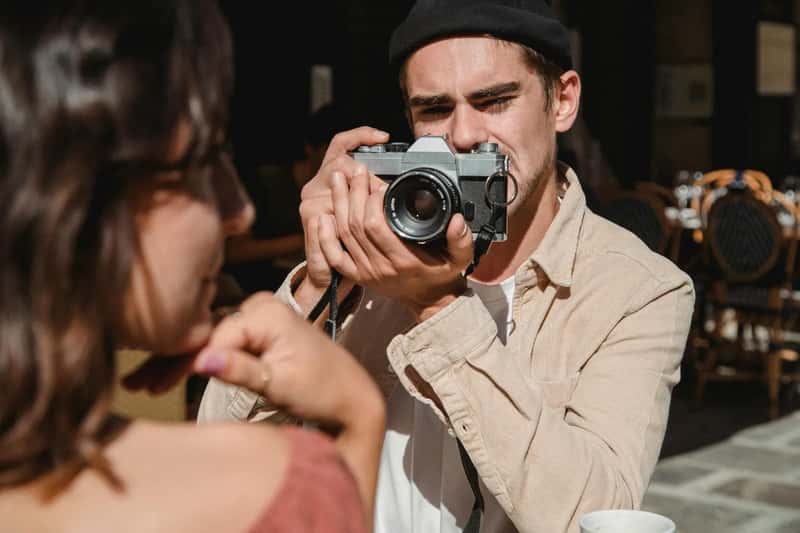
The camera is not just a device. It is a role.
The moment you pick it up, you become the photographer. And the photographer has a job. They have purpose, direction, a reason to be slightly apart from the crowd.
That separation feels like function. It feels like contribution.
But underneath the usefulness is something older. Being photographed requires surrendering control over one’s image and how others will perceive and judge that representation – and that loss of control triggers primitive psychological defense mechanisms that evolved to protect individuals from social rejection. The person behind the lens never has to surrender anything. They give, they capture, they preserve. They never have to be seen.
The armor is elegant. It looks like generosity. It functions like a wall.
And the quietest walls are always the most load-bearing.
2. The Permanent Grade
A photograph is a verdict.
It says: this is who you were, in this light, at this angle, at this particular moment in time.
There is no context. No footnote explaining your tired eyes or the argument you had that morning or the fact that you laughed half a second before the shutter clicked.
A photo can feel like a permanent grade. Even if nobody says a word, a picture can invite commentary in a way regular life doesn’t. Someone might zoom in, compare, post it, and tag you. Suddenly, your face is part of a public moment you didn’t fully agree to.
The person who always holds the camera never receives that verdict. They author it. They decide who looks good, who gets cropped, what the story is.
Control over the image is control over the narrative. And some people need that control because the alternative – being interpreted by someone else – feels genuinely unbearable.
That’s not vanity. That’s survival instinct wearing a lens cap.
3. The Hawthorne Self
Here is something psychology has known for a long time.
We change when we are watched.
The Hawthorne Effect states that people will modify their behavior when they know they are under observation. Studies conducted from 1924 to 1932 discovered that workers were more productive when under observation, and the concept has since been adopted to understand how individuals behave when being evaluated.
Now apply that to a dinner table. A beach trip. A birthday party.
The person behind the camera is never the one being evaluated. They are the one doing the evaluating. You are being observed without the ability to observe back, which can heighten self-consciousness and even change your behavior. The photographer inverts that dynamic entirely. They watch. They are not watched back.
It is a masterful psychological position. And the person who takes all the photos has, consciously or not, claimed it.
4. The Familiarity Trap
You do not recognize yourself in photographs.
That’s not a complaint. It’s a clinical reality.
Most of us are more used to seeing ourselves in the mirror than in photographs, which flips how we appear. This mismatch can feel strange. Plus, we tend to be our worst critics, noticing things no one else would.
The person who avoids the frame has, over years, reinforced a very specific self-image – the one in the mirror, the one they control, the one that doesn’t get posted without consent.
Every photograph feels like a lie. A distortion. A bad translation of something they know to be more nuanced.
So they stay behind the lens. Where the world looks like what they need it to look like.
Where they are the one doing the translating.
5. The First-Person Parenthesis
I have a memory from a trip I took years ago. A group of eight people. A coastline I will never forget.
I took forty-three photographs that weekend. I know this because I checked.
I am in exactly two of them – both taken by someone who grabbed my camera when I wasn’t looking. In both, I look slightly startled. Off-guard. Not performing anything. Just present.
Those two photographs are the only evidence that I was actually there. The other forty-one are my ghost. My absence made visible through what I chose to document instead.
It took me a long time to understand that staying behind the camera wasn’t modesty. It was distance. The question of why people do or do not appear in photographs is really a question about how comfortable they are with being seen – not just by strangers, but in the broader sense of allowing other people access to who they actually are. I wasn’t ready for access. So I shot around myself instead.
6. The Performance Problem
There is a cruel paradox at the center of this behavior.
The person who avoids being photographed often does so because they cannot perform naturalness on command.
The expectation to “look natural” while being consciously observed and documented creates a paradox that triggers performance anxiety. This performance pressure intensifies when photography serves important purposes – family documentation, milestone celebration. The higher the stakes, the greater the pressure, which ironically makes natural expression more difficult to achieve.
So they opt out entirely. They become the one who makes everyone else look natural.
They are, by all accounts, excellent at this. Their friends have beautiful photographs. Warm ones. Real ones.
The photographer has trained themselves to see authenticity in others. They have not yet learned to extend that same generosity inward.
7. The Inner Observer Who Never Rests
The friend who takes all the photos is almost always the most perceptive person in the room.
They notice the shift in someone’s posture. The way the light changes. The moment just before the laugh breaks open.
The people who struggle most with photos aren’t the ones who crave attention. They’re the ones who notice everything, including themselves. This doesn’t mean they’re insecure. It might just mean their inner observer never takes a day off.
That inner observer is a gift and a prison simultaneously.
It makes you extraordinary at reading rooms. It makes you exhausting to inhabit.
Because the same eye that catches every nuance in someone else also tracks every perceived flaw in yourself. The camera is a way of redirecting that ruthless gaze outward. Away from the one place it cannot be turned off.
8. The Visibility Equation
Being seen is a risk calculation.
Most people do not articulate it this way. But the math runs quietly in the background every time a camera appears.
The second group stays invisible for an entirely different reason. Something about being seen feels uncomfortable, exposing, or unsafe. Maybe they are not satisfied with how they look. Maybe their life does not feel like it measures up to what they see on everyone else’s feed.
The person behind the camera has done this math and reached a conclusion: the cost of being seen is higher than the reward.
That conclusion usually formed early. A careless comment. A photograph that got used against them. A moment when their image became someone else’s punchline.
Sometimes this discomfort started early. A teasing comment, being bullied, or someone criticizing how they looked.
The camera became a shield before they even knew they were holding one.
9. The Invisible Archivist
Here is the quiet tragedy of this role.
You build the archive. You preserve the memory. You make sure everyone else has proof that they lived, that they were happy, that they were loved in this specific light on this specific afternoon.
And decades from now, someone will scroll back through all of it.
They will find you in the metadata. In the file name. In the fact that the photo exists at all.
But not in the frame.
People who avoid photos often prefer to experience moments fully rather than document them. They trust their internal memory more than external proof. That may be true. But there is another truth running parallel to it: the internal memory is the only one you’ll have. Because you gave the external record to everyone else.
You documented a life. You just forgot to include yourself in it.
10. The Unshielded Moment
Here is what no one tells you about the lens.
It does not actually protect you.
It delays the reckoning. It redirects the gaze. It gives you something to do with your hands and your eyes and your nervous system when being present starts to feel like too much.
But the moment always comes. The camera runs out of battery. Someone grabs it from you, laughing. The group insists. The light is too good and everyone knows it and even you know it.
Maybe being visible has felt risky at some point in their history, and invisibility became a form of self-protection that outlasted the original threat.
That is the thing about armor built in childhood or in old grief or in one bad afternoon where someone laughed at the wrong picture. It keeps fitting long after the wound has closed. It becomes the shape of you. And you call it personality. You call it preference. You call it just being the photographer.
But what you are, underneath all of it, is someone who deserves to be in the frame. Not performing. Not posed. Not looking natural on command. Just there. Present. Documented. Proof that you showed up to your own life.
The camera is a remarkable tool for distance. It turns the unbearable intimacy of a moment into something you can hold at arm’s length, study through glass, frame and control and choose when to release. It makes the overwhelming world into a composition problem. And composition problems have solutions.
But life is not a composition problem. Life is the chaotic, unlit, slightly-out-of-focus thing that happens when you put the camera down. It is the moment that exists before you raise the lens. The laugh that no one captured. The conversation that will never be a photograph. The version of you that only other people can see, that lives in their memory and not in any archive you have ever curated.
Somewhere, right now, there is a dinner table with golden hour light and an open bottle of something good. Everyone is there. And you can be in the photograph this time. Not because you have resolved every anxiety or healed every old wound or suddenly become someone who loves cameras. But because the light is right, and the people are real, and you were actually there. Let someone else hold the lens. Just for this one. Let yourself be found in the frame of a life you have spent so long quietly, carefully, beautifully documenting for everyone else.