Lavenham is a tiny village in eastern England—Suffolk, to be precise—where houses lean slightly forward, timber beams trace irregular lines, and every street seems to invite you to slow down.
During one of my summers spent wandering through rural England, I allowed myself the luxury of seeking silence, far from overtourism, in this part of the country. I discovered that peace comes at a price: perseverance. Lavenham isn’t close to anything—you have to go there on purpose. London is far, Norwich too, and the train doesn’t reach the village. If you suffer from FOMO, this probably isn’t the place for you. But if you want to understand what England is truly made of—its history, its landscape, and even walk through the places that shaped two of its greatest painters—you’re exactly where you should be. I loved it.

A Prosperous Past that Stopped Time
In the Middle Ages, Lavenham was anything but marginal. Thanks to the wool trade, between the 15th and 16th centuries it became one of the wealthiest villages in England. The large timber-framed houses, still clearly recognizable today, tell the story of that prosperity. When the wool market declined, Lavenham came to a halt. There were no major rebuilds, no radical transformations. And that is exactly what makes it special today: a place that never had to reinvent itself, only to keep existing.
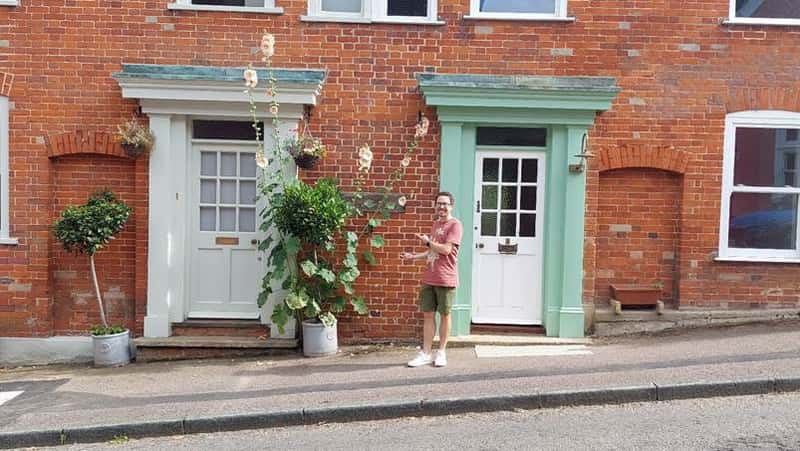
The leaning houses are the first thing that catches your eye. They are everywhere in the village, and not a scenic effect, but the result of timber that has warped over centuries. Restored without being straightened, they retain an imperfect balance that makes the village unique. Many façades are painted in soft tones — dusty pink, cream, pale blue — and are often crossed by climbing flowers that wind their way up the wood and around the windows. It’s worth slowing down to notice the details: wrought-iron signs, old doors, hidden courtyards, and windows that are never quite the same.
A Living Village, not a Museum

Despite its postcard-perfect appearance, Lavenham is not an open-air museum. The houses are lived in, the shops are independent, and pubs and tea rooms are part of everyday village life—places to linger, not just stop by, and an easy way to slip into the town’s cozy, unforced atmosphere. Film and TV lovers may recognize Lavenham from a few well-known productions: some scenes from Harry Potter and the Deathly Hallows were filmed here, as well as some scenes from Barry Lindon.
Yes, there are two places that matter most to the village’s history: Market Place, once the heart of Lavenham’s wool trade and public life, and the Guildhall of Corpus Christi, built in the early 16th century as a symbol of the town’s wealth and civic pride. Both are essential for understanding how Lavenham came to be what it is today. What makes Lavenham truly work, though, is how effortless it feels to wander without a plan. There is nothing to “do” in the strict sense, no attraction that demands a scheduled visit. You step into a café filled with books, stay longer than expected, and simply watch.
Bury St Edmunds: Abbey and Gardens

Just a few miles from Lavenham lies Bury St Edmunds, a more structured town yet equally tied to the history of Suffolk, which also benefited greatly from the prosperity of the wool trade. I visited it in combination with Lavenham. Its heart is dominated by the evocative remains of the medieval abbey, once one of the most important monastic complexes in England and now set within beautifully maintained gardens that are open and easy to wander through.
Bury St Edmunds moves at a different pace from Lavenham: more urban, more lively, but still measured. Independent cafés, markets, bookshops, and historic pubs make it an ideal complement to visits to the surrounding rural villages, offering a well-balanced mix of historic heritage and contemporary everyday life.
Norfolk and Eastern England: A Quiet Kind of Beauty, Seen Through Two Masters
Lavenham sits within the broader context of eastern England, between Norfolk and Suffolk, a region less celebrated than other parts of the country but remarkably consistent in character. The landscape is open and gentle: cultivated fields, rural villages, slow-moving rivers, and a wide, natural coastline facing the North Sea. It is an area with a strong agricultural tradition, historically tied to wool and grain, and deeply connected to water through canals, estuaries, and wetlands such as the Norfolk Broads. Tourism exists here, but it is never intrusive, following a slower rhythm made of walking paths, cycling routes, small villages, and long stretches of silence—England for those who seek authenticity rather than icons.
The wool towns of eastern England also gave the country two of its most important painters, John Constable and Thomas Gainsborough, both born in Suffolk. The landscapes that surrounded them from an early age became the foundation of their artistic vision: rolling fields, quiet rivers, country lanes, and cultivated countryside as central subjects rather than simple backdrops. Through their Georgian-era works, they shaped how generations would imagine the English countryside, capturing a balance between nature and human presence, labor and calm. The landscapes are still there: walking through villages like Lavenham and the surrounding landscape today, it’s easy to recognize the same atmosphere.
Practical Information
Lavenham is located in Suffolk, in eastern England, about two hours from London.
How to get there
- By train: from London Liverpool Street to Sudbury (about 1.5 hours), then bus or taxi (15 minutes).
- By car: about a two-hour drive from London. A great option if you plan to explore nearby villages.
When to visit
- Spring and early fall are ideal for weather and crowd levels.
- Summer is busier, especially on weekends.
- Winter is very atmospheric, with fewer visitors but shorter days.
How much time to allow
- 2-3 hours are enough for the village itself.
- A full day if combined with other Suffolk villages.
Don’t miss
- Market Place and Guildhall of Corpus Christi
- A break in a tea room or a historic pub
Who it’s for
- Lovers of historic villages
- Slow travelers
- Photographers
- Anyone looking for silence, detail, and authenticity