Most long-distance drivers think fuel-stop strategy ends the moment the low-fuel light blinks on. They’re leaving serious money on the table – and quietly wearing out their own cars.
Veteran cross-country drivers run on a completely different playbook, built around timing, tank levels, and a handful of counterintuitive habits most people never think about. The gap between a driver who spends $60 a tank and one who spends $90 on the exact same route usually comes down to just a few repeatable moves – and rule #1 alone might be the biggest one on this list.
#17 – Never Treat the Low-Fuel Warning as Your Cue to Stop
Most casual drivers see the fuel warning light as their cue to fill up. Long-distance veterans see it as a failure – because it means they waited too long.
Mechanics broadly agree that letting your fuel level drop below a quarter tank isn’t good for the vehicle, and it can cost far more than a routine fill-up. Modern fuel pumps usually sit inside the tank, where gasoline keeps them cool and lubricated – running low lets them overheat and wear out faster.
There’s also a moisture problem nobody talks about. Low fuel levels leave more air space in the tank, and if that humid air condenses, water forms inside the system – causing rough running, rust, and damaged fuel components.
Most road-trip veterans refuel at the half-tank mark, not the quarter mark. A half tank in most cars is good for 150 to 200 miles or more, and that buffer is your insurance policy on unfamiliar roads.
But the fill-up rule is only the beginning. There’s a mistake almost every driver makes every single week – and it costs them before they even leave the driveway.
#16 – Stop Filling Up on the Wrong Day of the Week
Here’s one that separates road warriors from regular drivers: fuel prices follow a weekly cycle, and most people fill up on exactly the wrong days.
GasBuddy, after analyzing daily statewide fuel prices over the past year, found that Sunday is the most consistently affordable day to buy gas in most U.S. states. Wednesday through Friday, on the other hand, tends to run more expensive.
Friday is the worst offender. Stations anticipate weekend travel and raise prices accordingly, sometimes jumping 10 to 20 cents per gallon between Thursday morning and Friday afternoon.
“Gas prices don’t just move based on global oil markets – they also follow a weekly rhythm.”
Patrick De Haan, Head of Petroleum Analysis, GasBuddy
Monday and Tuesday mornings are usually the cheapest, running 3 to 5 cents lower than weekend peaks. That may sound small, but prices can swing 30 to 50 cents a gallon within a single week – a $5 to $10 difference per tank.
The day-of-week trick is powerful on its own. But experienced drivers stack it with something even more specific – and most people have never heard of it.
#15 – Fill Up in the Morning, Not the Afternoon
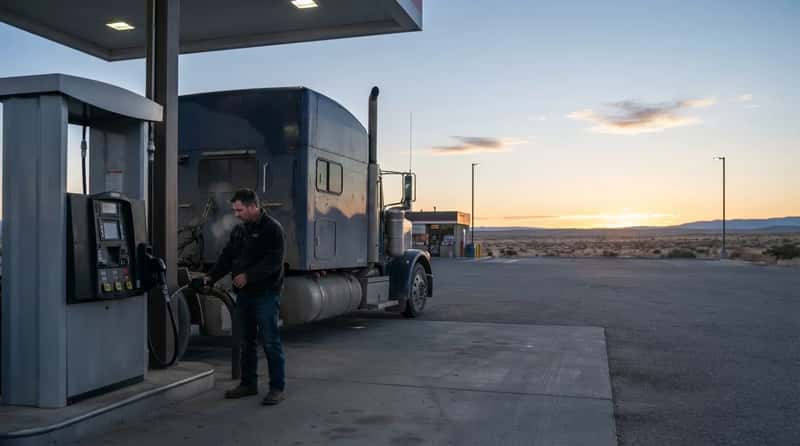
The time of day you fill up matters more than most drivers realize, and it’s rooted in basic physics.
Early morning is generally the best time to buy gas – not because prices swing hourly, but because cooler temperatures mean denser fuel. Gasoline is sold by volume, so cooler fuel packs slightly more energy per gallon than fuel expanded by afternoon heat.
Over a long trip with multiple fill-ups, those fractions add up. Some drivers also report stations nudging prices down right before the morning rush, meaning an early fill-up can save both money and the time you’d otherwise burn waiting in line.
The compounding effect of day-of-week timing plus morning fill-ups is real. But none of it matters if you’re pulling into the first station you see off the highway exit – which brings us to rule #14.
#14 – Never Buy Gas at the First Exit Station
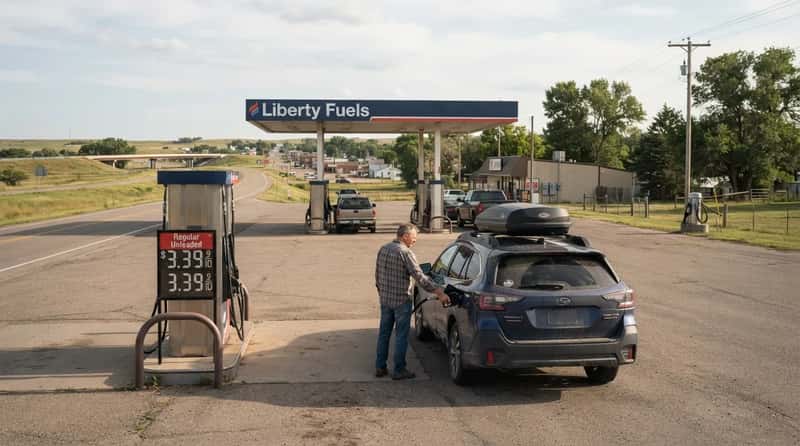
This is one of the cardinal sins of road-trip fueling. That station sitting right off the interstate exit is betting on your laziness – and it usually wins.
Stations with easy on-ramp access often charge a premium simply for being convenient. A short detour into the nearest town, even a mile or two off the highway, frequently turns up noticeably lower prices.
Gas stations actively watch their competitors as drivers get more price-aware. Along routes near suburbs or towns somewhat removed from bigger cities, local competition tends to keep prices honest.
The rule is simple: if you have enough fuel to take the detour, always take it. And one free tool makes finding those cheaper stations completely effortless.
#13 – Use a Gas Price App Before Every Single Stop
Veteran long-haul drivers never guess where the cheapest fuel is. They know before they arrive.
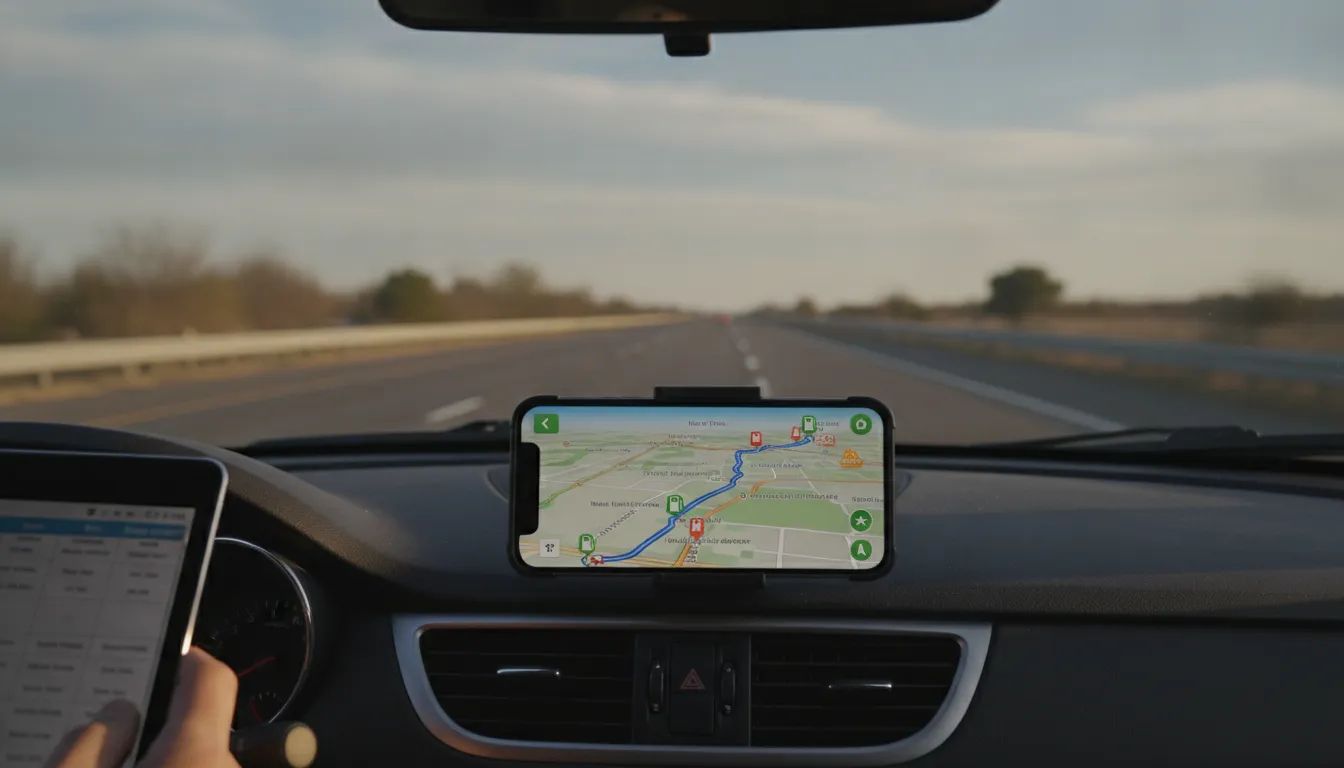
Apps like GasBuddy and Waze let you compare recent, user-reported prices within a set radius of your location or destination. The data is crowdsourced from drivers and station owners, so the more people contributing in your area, the more accurate it gets.
GasBuddy, Gas Guru, and the AAA mobile app can all point you to the lowest price nearby and give you directions to get there. Most drivers only open these apps once they’re almost empty.
Smart drivers check 20 to 30 miles ahead, so the stop is deliberate instead of desperate. That brings us to a rule almost no one follows correctly.
#12 – Pay Cash When You Can
This one feels old-fashioned, but the savings are real and immediate.
Many stations offer lower prices for cash customers, with the gap ranging from a few cents to more than 10 cents per gallon – especially in states with higher fuel taxes. Over a 400-mile trip with three fill-ups, that difference is noticeable.
The cash discount is one of the most underused fuel hacks in road-trip driving. It costs nothing beyond pulling out a different form of payment, and many experienced drivers keep a small cash reserve just for fuel stops.
The next rule, though, is where most drivers unknowingly bleed the most money – not at the pump, but on the road between stops.
#11 – Use Cruise Control on Every Highway Stretch
Long-distance drivers who skip cruise control are paying a hidden tax on every mile – and most of them don’t even realize it.
When your speed dips and surges, you burn more fuel than you need to. Tests have shown that varying speed between 75 and 85 km/h every 18 seconds can increase fuel use by 20%.
On the highway, cruise control is a genuine efficiency tool, not just a comfort feature. The human foot is an imprecise instrument – it drifts unconsciously, and that drift burns money.
One nuance: small variations can actually help when gravity does the work for you. Let your speed drop naturally on the uphill, then regain it coasting down the other side – a trick even experienced drivers often miss, and one that pairs perfectly with the next habit.
#10 – Check Tire Pressure Before Every Long-Haul Departure
Skipping this takes 30 seconds – and quietly costs you miles per gallon all day long.
Driving on tires under-inflated by just 8 PSI can increase fuel consumption by up to 4% and cut tire life by more than 10,000 kilometers. That’s a measurable, avoidable loss that stacks up across every mile of a long drive.
Properly inflated tires last longer, improve gas mileage, and are simply safer. Keeping them at the right pressure can boost fuel economy by 0.6% on average, and up to 3%.
Find the correct pressure on the tire information placard, usually on the driver’s doorpost – don’t guess or eyeball it. A $5 gauge pays for itself on the very first trip.
Next is a rule that sounds obvious, but the specific number behind it will surprise most drivers.
#9 – Don’t Let Your Car Idle at Fuel Stops
Veterans pull in, fuel up, and leave. They don’t sit in a running car checking their phones while the engine burns fuel for nothing.
Fast Facts
- Idling burns 0.25 to 0.5 gallons of fuel per hour, going nowhere.
- A typical 3-liter engine wastes more than a cup of gas every 10 minutes at idle.
- Both the U.S. Department of Energy and the Vehicle Certification Agency confirm the waste.
- Rule of thumb: shut the engine off past 60 seconds, unless you’re stuck in traffic.
That’s a full cup of gas gone just because someone sat in a parking lot. On a multi-day trip with frequent stops, idle time is one of the most controllable fuel leaks a driver has – and the next mistake is even more dramatic.
#8 – Never Drive Aggressively Between Stops
Every jackrabbit start and hard brake is a small fire you’re lighting under your own fuel tank.
Aggressive driving can lower gas mileage by as much as 33% on the highway and 5% in the city. That’s not a rounding error – that’s the difference between one fuel stop and two on a long stretch of road.
Rapid acceleration, hard braking, and excessive speeding all force the engine to burn fuel it doesn’t need to burn, especially in stop-and-go traffic. Lifting off the gas early when approaching a light or slow-moving traffic keeps you in the throttle’s sweet spot the whole way.
Smoother really does mean cheaper – and so does something most drivers never think to check before they even leave the house.
#7 – Lighten Your Load Before You Leave
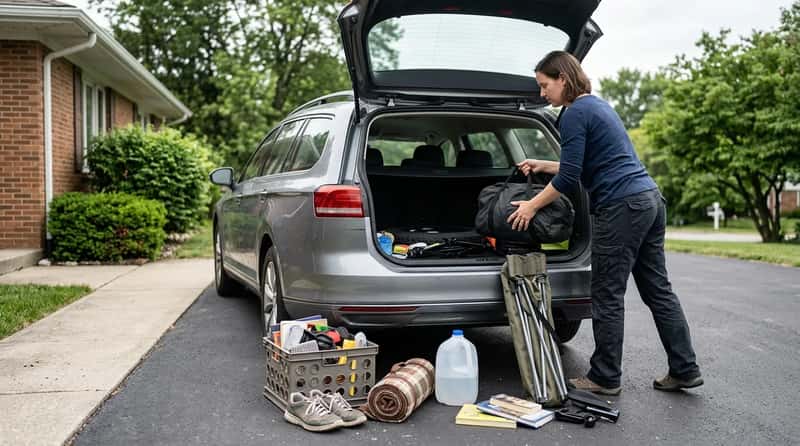
Every road tripper has done it: thrown everything they own into the car “just in case.” That habit is costing fuel on every single mile.
At a Glance
- An extra 45 kg (about 100 lbs) in the trunk can lower fuel mileage by roughly 1%.
- Every unneeded pound makes the engine work harder on every mile of the trip.
- A quick pre-trip cargo sweep costs nothing and takes minutes.
We’ve all turned the trunk into a storage unit at some point, but extra weight is a quiet fuel killer. Before any long-distance departure, do a ruthless sweep of the cargo area: the old gym bag, the spare toolbox, the half-empty water jugs.
If it’s not needed for this specific trip, it stays home. And wait until you see what rule #6 reveals about your route choice.
#6 – Plan Your Route Around Fuel Stations, Not Just Destinations
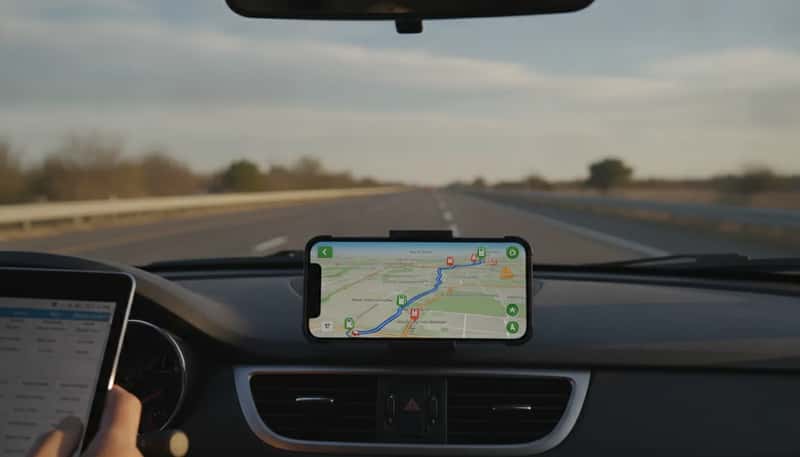
Most GPS apps optimize for time or distance. Neither of those metrics cares what you pay at the pump – but you should.
It’s tempting to always tap the “fastest” button, but the quickest path isn’t always the cheapest one. Reducing unnecessary stops, avoiding steep hills, and minimizing time stuck in traffic can save more than shaving a few minutes off arrival time ever will.
For long trips, mapping rest stops, fuel stations, and efficient highways in advance leads to smoother travel and better fuel management overall. Strategic planning cuts both travel time and fuel costs at once.
Map your fuel stops the same way you map your overnight stops. Know where the cheap stations are, know your backup if one is closed, and never get caught improvising on an unfamiliar road with a dropping gauge – because the next rule is even easier to overlook.
#5 – Keep Your Gas Cap Tight, Every Single Time
This sounds almost too simple to include. It isn’t.
About 17% of vehicles on the road have gas caps that are damaged, loose, or missing entirely – causing an estimated 147 million gallons of gas to vaporize into thin air every year. A loose cap alone can cause a 2.0 mpg drop in fuel efficiency.
That’s a staggering amount of fuel lost to something that takes one second to fix. It’s not just about vapor loss, either – a missing or damaged cap can trigger a check engine light, and an unexplained warning light is the last thing you want mid-road-trip.
Long-distance drivers make this a non-negotiable habit. Cap clicks, then you drive – always, no exceptions.
#4 – Know Your State’s Fuel Tax Before You Cross the Border
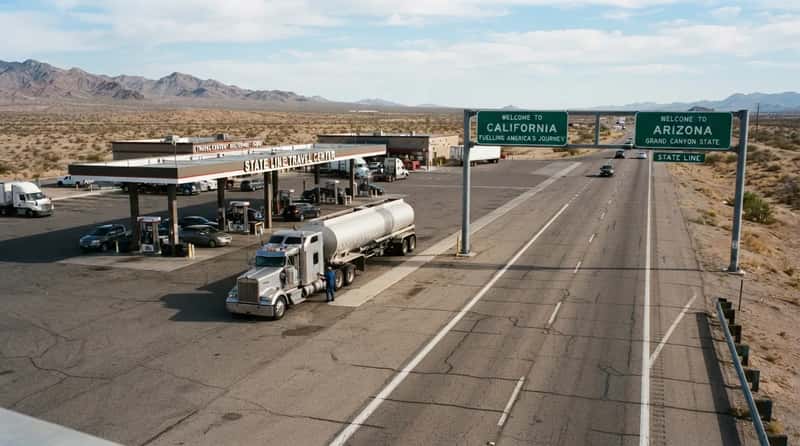
This is the insider move most drivers only discover by accident – usually right after they’ve already crossed the state line and overpaid.
State fuel taxes vary enormously, and that variation matters when you’re deciding where to fill up. California, Illinois, Washington, and Pennsylvania rank among the most expensive states, while Alaska, New Mexico, and Arizona tend to run cheaper.
Quick Compare
| Highest State Gas Taxes | Lowest State Gas Taxes |
|---|---|
| California – about 71¢/gal | Alaska – about 9¢/gal |
| Illinois – about 66¢/gal | New Mexico – about 19¢/gal |
| Washington – about 59¢/gal | Arizona – about 19¢/gal |
Keep an eye on stations near state lines – they often compete aggressively for cross-border drivers. If you’re heading into a state with noticeably higher fuel taxes, top off on the cheaper side while your tank is low; the savings can be substantial.
It’s one of the most underrated habits of experienced cross-country drivers, and it costs nothing but a little pre-trip research.
#3 – Don’t Top Off Your Tank at the Pump
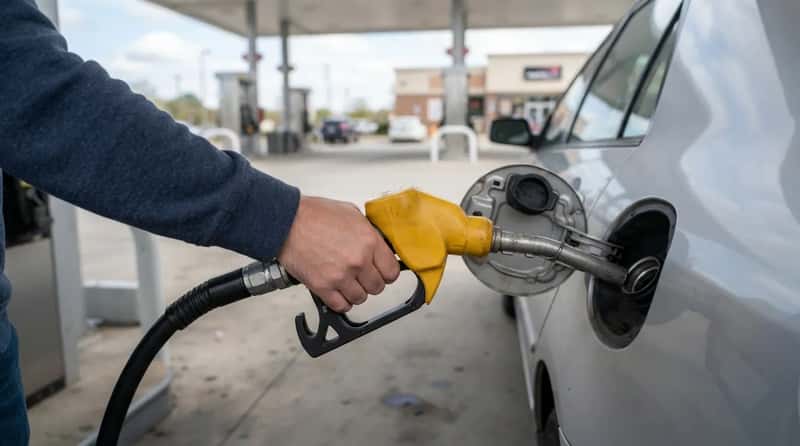
The instinct to squeeze in every last drop makes total sense. It’s also wrong, and it can genuinely damage your car.
Modern vehicles use a charcoal canister in the emissions system to capture fuel vapors, and topping off forces liquid fuel into that canister. Liquid fuel destroys it, and replacing it is an expensive, entirely avoidable repair.
When the pump clicks off automatically, that’s your signal to stop. The extra half-liter you’d force in isn’t worth risking a $300-plus repair bill down the road.
Veteran road-trippers know: the click is the finish line, not a suggestion.
#2 – Use the Correct Motor Oil Grade for Your Engine
This one hides in plain sight, and most drivers never think of it as a fuel-stop decision. It absolutely is one.
Using the manufacturer’s recommended oil grade can improve fuel economy by 1% to 2%. Check your owner’s manual to confirm what your engine actually calls for.
That might not sound dramatic, but across a 600-mile highway haul, the wrong viscosity creates constant internal friction that quietly burns fuel the entire drive. The wrong oil is essentially a slow leak in your fuel economy that never stops running.
Before any serious trip, verify your oil grade and check the level – if you’re due for a change, do it before you leave. A $30 oil change beats paying for it in extra fuel stops down the highway.
#1 – Learn to Read Traffic and Coast, Not Brake
Every seasoned long-haul driver eventually develops this skill. It’s the single habit that separates drivers who consistently hit their best fuel economy from everyone else.
Look far enough ahead to see what’s coming, and keep a comfortable following distance from the vehicle in front of you. That distance isn’t just a safety rule – it’s a fuel strategy, because it buys you the time to lift off the throttle early and coast instead of stomping the brake.
Accelerating gradually, braking gently, and anticipating traffic flow all reduce unnecessary fuel burn. Every time a skilled driver coasts to a red light instead of braking hard, they preserve kinetic energy that would otherwise turn into wasted heat.
Multiply that across hundreds of miles and dozens of traffic lights, and you’re looking at a real gap in fuel spend – without changing where you stop, what day you fill up, or how fast you drive. This is the one rule that costs nothing to adopt, pays back on every mile, and most drivers never learn it.
The Bottom Line
Long-distance drivers who stretch every tank aren’t lucky. They’re deliberate.
They fill up on Sundays or Monday mornings, detour a mile off the highway for cheaper fuel, check apps before they’re desperate, and never let the tank drop below a quarter. They keep tires inflated, caps tight, loads light, and they coast instead of braking.
None of these rules are complicated, but stacking even half of them on your next trip will show up at the pump. Every single one is free to start today – the only question is how many you were already breaking without knowing it.
Bonus: The Fuel-Rewards Stacking Trick Long-Haul Drivers Never Share
Most drivers ignore grocery-store fuel rewards programs because they only think about the pump price, not the loyalty side of the equation.
Chains like Kroger, Safeway, and Albertsons let you earn fuel points on everyday purchases, then redeem them for real cents-off-per-gallon at partner stations – often 10 to 100 cents off, sometimes more during promotions.
- Sign up for the store’s free loyalty/fuel rewards card before your trip – it takes two minutes online.
- Buy gift cards for hotels, restaurants, or gas itself through the grocery chain’s gift-card rack; many programs award bonus fuel points (sometimes 4x) specifically on gift-card purchases.
- Stack those points before you leave, then redeem them all at once at a partner station near your route – most programs cap savings around 35 gallons per fill-up.
- Check the app or receipt for point expiration dates, since most rewards expire at the end of the following month.
Combine this with the half-tank rule and Monday-morning fill-ups, and it’s realistic to shave well over a dollar a gallon off your biggest fill-ups of the trip.
It takes about ten minutes of setup before you ever leave the driveway – and it works every single time you fill up, not just once.