From March 13 through August 23, Palazzo Strozzi hosts a landmark exhibition named “Rothko in Florence” dedicated to Mark Rothko, drawing visitors from across Europe and well beyond. Flights and trains are filling with travelers whose itineraries revolve around a single destination, while many Italians approach it with precision—arriving in the morning, stepping into the exhibition, and returning home by evening with the distinct impression of having experienced something rare. Living here, I had no excuse to miss it: the historic center is just a short walk away, and with it, the chance to encounter some of the Maestro’s most iconic works up close.
Rothko’s special relationship with Florence adds an additional layer of resonance, and this was the starting point of the exhibition’s curation. He visited the city multiple times, studying its architecture with a depth that would later inform his work. The exhibition traces this connection with intelligence and clarity, revealing how the measured stability of Florentine spaces translates into the structural balance of his paintings. Moving through the rooms feels akin to inhabiting a sequence of interiors, each calibrated to hold silence, proportion, and a particular emotional gravity.
A Chronological Journey Through Rothko’s Evolution
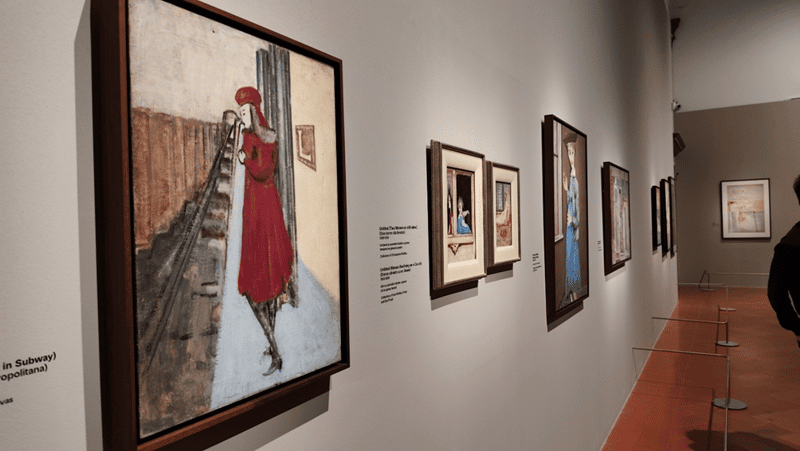
The exhibition unfolds with a deliberate chronological structure, allowing visitors to follow Rothko’s evolution from early figurative compositions – among which his only self portrait – to the immersive color fields that define his mature work. This progression is handled with a curatorial precision that mirrors the artist’s own discipline, guiding the viewer without unnecessary dramatization. Each room builds on the previous one, creating a sense of continuity that rewards careful observation.
What distinguishes this show is the exceptional provenance of many of the works. Several paintings come from private collections and from Rothko’s family, offering access to pieces that are rarely exhibited publicly. This lends the exhibition a distinctive intimacy, as though one is encountering chapters of an artistic journey that are usually kept out of view. The result is both rigorous and personal, expanding the understanding of Rothko beyond his most iconic works.
Florence as Architectural Influence

Rothko’s engagement with Florence emerges most clearly in his response to the Biblioteca Laurenziana, Michelangelo’s masterwork of spatial tension and compositional control. The library’s vestibule compresses and releases space with a calculated rhythm, guiding the body and the gaze simultaneously. This architectural sensibility finds a parallel in Rothko’s canvases, where color and proportion create a similar balance between containment and expansion.
Standing before these paintings, one senses an underlying structure that goes beyond abstraction. The color fields are anchored, their edges breathing within a framework that definitely feels architectural. The compositions stabilize the viewer’s perception, offering a quiet but persistent sense of order. Florence, with its disciplined geometry and material presence, provided Rothko with a framework that he translated into a language of color and light.
Palazzo Strozzi and a Program of Cultural Excellence
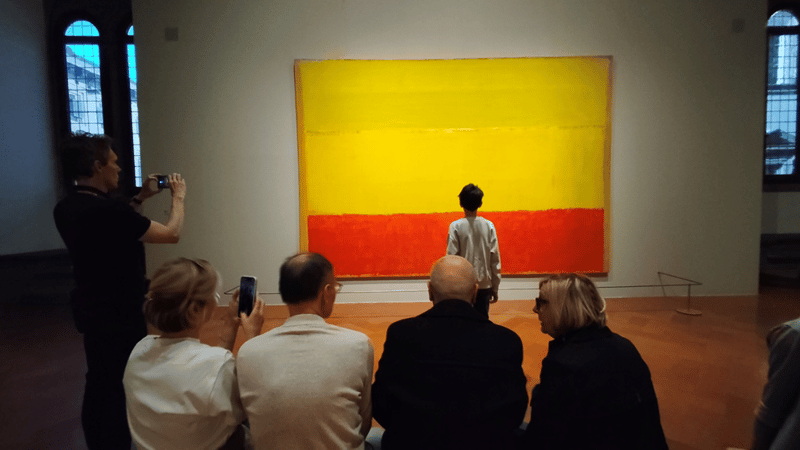
This exhibition represents another chapter in the ambitious and consistently high-caliber program of Palazzo Strozzi, widely recognized as one of Italy’s leading cultural institutions. Under the direction of the widely respected artistic director Arturo Galansino, the foundation has developed a reputation for presenting exhibitions that combine scholarly depth with broad international appeal. Rothko’s show fits seamlessly into this trajectory, reinforcing the institution’s ability to engage with both historical legacy and contemporary discourse.
The Renaissance architecture of the palazzo provides a compelling counterpoint to Rothko’s work. Its clarity of proportion and material solidity create a setting that enhances the paintings’ spatial presence without overwhelming them. The exhibition design respects this balance, allowing the dialogue between art and architecture to unfold naturally. The result is an experience that feels both grounded in Florence’s cultural heritage and fully attuned to a global audience.
A European Destination Worth the Journey

The exhibition has quickly established itself as a significant cultural destination, attracting a steady flow of international visitors. Conversations in the galleries reveal a shared sense of purpose: many have traveled specifically to see this show, often structuring entire trips around it. At the same time, the efficiency of Italy’s rail network makes it accessible as a day trip, encouraging visitors from cities like Milan, Rome, and Bologna to engage with the exhibition in a focused and intentional way.
This dual dynamic—international pilgrimage and local accessibility—creates a distinctive atmosphere. The audience is diverse yet united by a clear interest, and the experience takes on a certain intensity as a result. Florence gains a renewed sense of immediacy, positioning itself not only as a custodian of the past but as an active participant in contemporary cultural conversations.
Practical Details and the Experience Beyond the Galleries
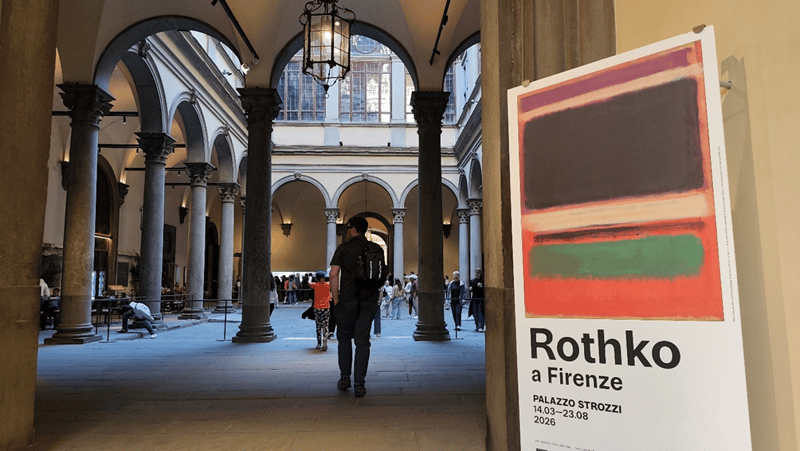
Palazzo Strozzi is located in the historic center of Florence, approximately a 10-minute walk from Santa Maria Novella train station. The route passes through some of the city’s most vibrant streets, making the approach part of the experience. High-speed train connections from major Italian cities make same-day visits entirely feasible, while the compact nature of Florence ensures that the exhibition is easily integrated into even a short stay. Booking in advance is strongly advised, since this will allow you to skip the queue and gain immediate access.
The visit extends naturally into the museum shop, which maintains the high standards associated with Palazzo Strozzi’s programming. The selection is carefully curated, with exhibition catalogues, design objects, and publications that reflect the intellectual and aesthetic scope of the show.