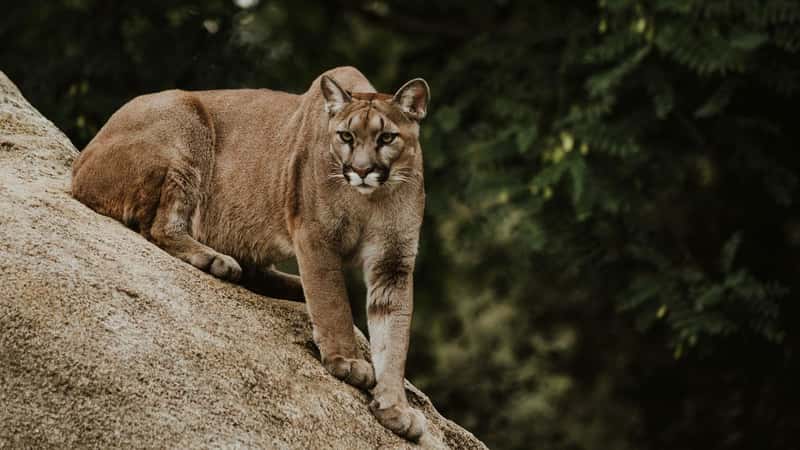
Mountain lions have outsized impact on small preserves – Image for illustrative purposes only (Image credits: Unsplash)
Stanford, California – Trail cameras placed across Stanford University’s Jasper Ridge Biological Preserve recorded a clear shift in wildlife patterns after mountain lions began appearing more regularly. Between 2015 and 2020, researchers noted fewer deer moving through the area once the large predators established a presence. The change set off a chain of effects that allowed certain plants to recover.
Camera Data Reveal a Clear Pattern
The preserve sits south of San Francisco and covers a relatively small area. Despite its size, the site connects to larger wildlands in the Santa Cruz Mountains. Cameras captured consistent mountain lion visits during the study period, and deer activity dropped sharply in response.
Researchers tracked the decline in ungulate movement across multiple camera stations. The reduction was not uniform across all species, yet the overall drop in browsing pressure stood out in the footage. Plants that deer typically eat or crush showed signs of increased growth once the pressure eased.
Plants Respond to Reduced Browsing
With fewer deer present, vegetation that had been heavily used began to rebound. The study documented this recovery through repeated camera observations rather than direct plant counts alone. The pattern matched expectations for a trophic cascade, in which the top predator influences lower levels of the food web.
Staff at the preserve noted that the changes occurred within the existing boundaries of the protected land. No large-scale habitat restoration was required. The presence of the predators alone appeared sufficient to alter the balance among deer and plants.
Small Sites Can Still Deliver Large Effects
Chinmay Sonawane, the study’s lead author and a doctoral student at Stanford, pointed out that small preserves have often been viewed as having limited value. The findings suggest otherwise when those sites link to bigger wilderness areas. “In the past, small preserves like Jasper Ridge have often been dismissed for holding very little ecological value, but this study shows that when these small preserves are connected to large wilderness like the Santa Cruz Mountains, you can still see magnificent ecological phenomena like trophic cascades,” Sonawane said in a university release.
The work appeared in the journal Ecology and Evolution. It adds to evidence that even modest protected areas can support meaningful ecological processes if movement corridors remain open.
Implications for Future Management
Land managers may now weigh the benefits of maintaining connections between small preserves and surrounding wildlands. The Jasper Ridge results indicate that predator access can produce measurable vegetation responses without additional intervention. Continued monitoring would help determine how long such effects persist and whether similar patterns appear elsewhere.
The study also underscores the value of long-term camera networks for detecting subtle shifts that might otherwise go unnoticed. Further research could test whether the same dynamics hold in other regions with comparable predator-prey relationships.