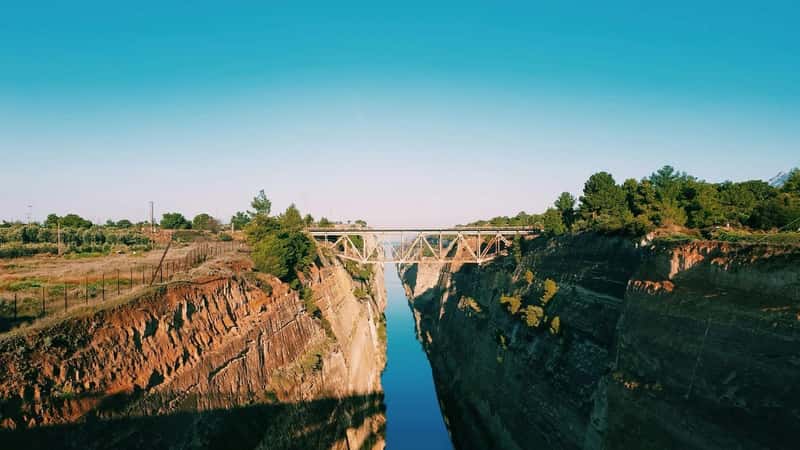
Greece Trip: Day 3. Corinth Canal, Mycenae & Nafplio – Image for illustrative purposes only (Image credits: Unsplash)
Many American travelers head straight for the islands or Athens landmarks when planning a Greece trip. Yet routes that include Nafplio, Mycenae, and the Corinth Canal deliver distinct historical and engineering interest with fewer visitors. These sites sit within easy reach of the capital and offer a measured alternative to more saturated destinations.
The Corinth Canal as an Engineering Landmark
Travelers departing Athens often reach the Corinth Canal as an early stop on a southern route. The waterway cuts through the narrow isthmus that separates the Peloponnese from the mainland. Its limited width prevents passage by many contemporary vessels, which has shifted its primary role from commercial shipping to a point of interest for visitors. The canal’s scale and setting provide a clear view of 19th-century construction efforts. Observers can stand at the edges and note the sheer rock walls that frame the channel below. This perspective underscores why the site now functions mainly as a tourist draw rather than an active trade route.
Mycenae and Nafplio in Context
Further along the same corridor lie Mycenae and Nafplio. Mycenae supplies direct access to Bronze Age remains that predate classical Greek periods by centuries. Nafplio, by contrast, presents a compact coastal town with preserved architecture from later eras. Together the locations illustrate successive layers of Greek history within a compact geographic area. Visitors can move between an ancient citadel and a later harbor settlement without extensive travel time. This sequence gives a concise overview of regional development that many longer island itineraries do not emphasize.
Practical Timing and Access for U.S. Travelers
The corridor works well as a single-day extension from Athens or as part of a broader Peloponnese loop. Road connections are straightforward, and the sites remain open year-round with standard operating hours. Summer months bring warmer temperatures and longer daylight, while shoulder seasons reduce both heat and group sizes at the canal viewpoints and archaeological areas. Travelers benefit from advance planning around ferry or cruise schedules that sometimes bypass the canal entirely. Those who allocate time here typically encounter shorter lines and more space for unhurried viewing. Local operators offer short boat passages through the canal when conditions allow, adding a direct experience of the channel’s dimensions.
Why These Stops Matter for Broader Itineraries
Including Nafplio, Mycenae, and the Corinth Canal shifts the balance of a Greece visit toward inland and engineering heritage rather than solely coastal scenery. The combination supplies tangible examples of how geography and history intersect in one region. For visitors seeking substance beyond the most photographed islands, the route supplies measurable variety without added complexity. The practical outcome is a clearer sense of Greece’s layered past within a manageable timeframe. Travelers who incorporate these stops often return with a more complete picture of the country’s development across eras.