The ground is cold beneath your boots.
The air smells like old stone and something older.
You paid to be here.
You chose this.
There’s a name for what you’re doing – and it isn’t morbid. It isn’t broken. It is, in fact, one of the most fundamentally human things a person can do: stand at the edge of death and look it in the face while knowing, with quiet relief, that you can leave.
This is the identity gap. The distance between who we perform ourselves to be in the daylight – productive, optimistic, death-denying – and who we are in the quiet hours, when we wonder how much time we actually have left. The gap between our curated lives and the raw, unspoken awareness that all of it ends.
Dark tourism doesn’t widen that gap. It bridges it.
If you feel more alive standing in a place built for the dead than scrolling through a highlight reel of someone else’s vacation, you aren’t disturbed. You’re just existing in the gap.
The Controlled Descent
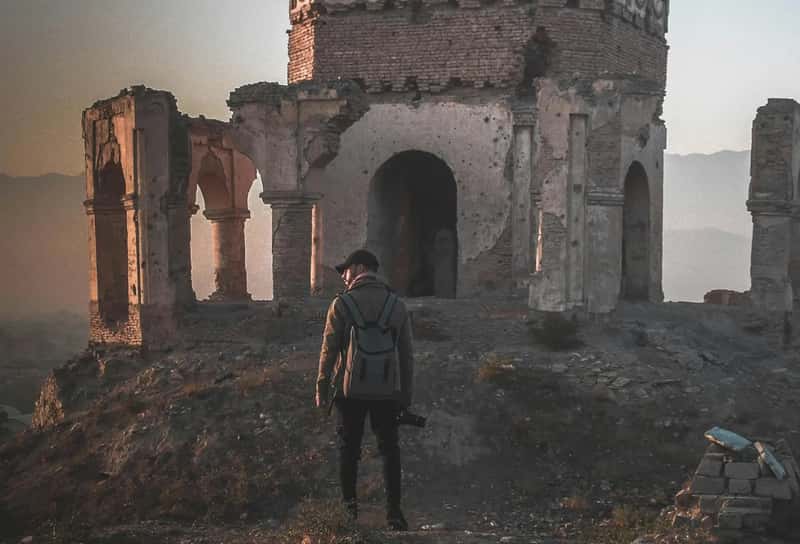
If dark tourism could be considered a contemporary mechanism for confronting death, allowing consumers to reflect on death, mortality, and one’s own identity, it is essential to understand the different ways this confrontation works.
The operative word is controlled.
You book the ticket. You buy the entry pass. You read the placard. You leave when you want to.
That architecture of permission is the entire psychological engine. The dark tourist doesn’t stumble into mortality – they schedule it. They rope off the terror into a defined window, walk through it with their eyes open, and return to the hotel by dinner.
This is not avoidance. This is rehearsal.
The psyche needs practice dying – needs to sit with the idea before the idea sits with you uninvited. Dark tourism offers a stage. A script. A way to hold the unspeakable thing without being consumed by it.
The exit sign glows green. And that glow is everything.
The Mortality Salience Engine
While dark tourism research has increasingly emphasized mortality salience’s role in exploring dark tourists’ experiences, little is known regarding the triggers and effects of that salience.
Mortality salience. It’s a clinical phrase for a raw human ache.
It’s what happens when the brain, confronted with evidence of death, suddenly recalibrates. Priorities shift. The petty falls away. The essential rises. For a suspended moment, you see your life in stark relief – what you’ve built, what you’ve wasted, who you’ve loved carelessly.
Research has found a positive relationship between mortality salience and the identified triggers and effects in dark tourism contexts.
The concentration camp. The battlefield. The ruins of a city swallowed by disaster. These aren’t just exhibits. They are salience machines – spaces engineered by history to remind the body that it is temporary.
And the body, when reminded, pays attention.
The dark tourist seeks that attention. Craves the clarity it produces. Finds more truth in one hour at a site of tragedy than in a month of ordinary life.
The Terror Management Theory
Biran and Buda address this domain using Terror Management Theory, which highlights a psychological framework for understanding consumer behaviour and how consuming helps people cope with their anxieties of dying by boosting their cultural worldviews and self-esteem.
Terror management. The phrase itself is almost beautiful.
We are all, every day, managing terror. We just don’t call it that. We call it productivity. We call it ambition. We call it scrolling. We fill the hours with enough noise that the fundamental fear – the one that has no name we like to say out loud – stays below the threshold of awareness.
Dark tourism, paradoxically, lowers the noise. It drags the terror into the light, places it on a plinth, and makes you stand in front of it.
And then something unexpected happens.
The terror gets smaller. Not gone. Never gone. But smaller. Manageable. Named. You’ve looked at it and you haven’t collapsed. The worldview holds. The self survives the encounter. That is, in itself, a profound piece of psychological work.
The Safe Distance Paradox
Dark tourism highlights the persistent human desire to confront mortality and chaos from a safe distance.
This is the paradox that trips people up. They assume proximity to death is the same as recklessness. It isn’t.
The safe distance is the mechanism. It is the thing that makes the whole encounter bearable, and therefore useful. Stand too far from death and you learn nothing – you remain numb, protected, sealed in the amber of denial. Stand too close and the encounter becomes trauma, not education.
Dark tourism calibrates the distance.
It places glass between you and the archive of atrocity. It routes you through corridors built to deliver emotional impact without psychological rupture. This psychological phenomenon is rooted in a desire to see what is normally hidden or forbidden, coupled with a safe distance that allows observers to confront uncomfortable truths without personal risk.
The glass is the whole point. The glass is what makes the lesson possible.
The Identity Audit
I will tell you something I don’t usually tell people.
The first time I stood inside a former prison – cold walls, low light, the smell of rust and old concrete – I didn’t feel sad. Not at first. I felt clarified. As if the proximity to something irrevocably real had burned off the static that I carry everywhere else. For approximately forty minutes, I knew exactly who I was and what actually mattered to me.
That is the identity audit.
Dark tourism is a new mediating institution that allows the Self to construct contemporary ontological meanings of mortality and to contemplate both life and death through consumption of the Significant Other Dead.
The dead become mirrors. You look at what happened to them and you see, suddenly, the outline of your own life. Its edges. Its limits. Its possibilities. You leave knowing something about yourself that no productivity app, no therapy session, and certainly no beach holiday could have surfaced.
Not everyone has words for this. But almost everyone who does it, feels it.
The Sequestered Death Problem
It is within the ‘forbidden/invisible death’ that a present/absent death paradox is evident – death comes to us all, yet dying is removed to institutionalised realms. Death is universal, but modern dying is not. We have become socially divorced from the realities of secular deathbeds as mortality of the Self is sequestered under a professional gaze.
We have outsourced dying.
The hospital. The hospice. The funeral home. We have built an entire infrastructure to ensure that death happens somewhere else, managed by someone else, away from the daily field of vision. The result is a culture profoundly unequipped to process what it cannot avoid.
Dark tourism is, in part, a corrective.
We may mediate our own sense of mortality and ontological security through the fatality of others, where visibility of death in dark tourism helps fuel a new cultural fascination with death.
The fascination is not pathology. It is catch-up. It is the psyche doing the work that polite society told it not to do. Meeting the thing it was never given permission to meet.
The Curiosity That Isn’t Morbid
People who know what dark tourism is show more curiosity, need to learn and understand, and need to see morbid things – and they have visited more Holocaust museums, sites of human tragedy and natural disasters, concentration camps, and prisons.
Curiosity. That clean, underestimated word.
It sits at the center of dark tourism motivation with none of the drama the label implies. The dark tourist is not, in most cases, a thrill-seeker strapping in for emotional violence. They are a curious person. A person who finds that the standard tourism itinerary – the cathedrals, the cuisines, the coastlines – leaves something unanswered.
That something is the hard question. The one that goes: what does it mean that we are alive, and that we will not always be?
Dark tourists are psychologically moved by the need to be in contact with authentic experiences by looking at the other’s death as if it were their own death.
That isn’t morbidity. That’s empathy running at full frequency. That’s a person fully, deliberately, awake.
The Authenticity Hunger
One of the motivations that drive dark tourists is the possibility of re-creating the same emotions victims experienced, followed by the authenticity issue.
Authenticity is the currency of the serious traveler.
And it is in desperately short supply. Modern tourism has been smoothed to a polish so high it reflects nothing true. The curated experience. The Instagram backdrop. The itinerary designed to produce pleasurable content rather than genuine encounter.
Dark tourism refuses that bargain.
You cannot filter a killing field. You cannot caption a gas chamber into something comfortable. The site demands that you be present in your full, unguarded humanity. No performance survives it.
That demand is the very thing that draws the authentic traveler in. They are hungry for something that cannot be staged. And death, whatever else it may be, is stubbornly, irreducibly real.
The Spectacular Death Mentality
Deathscapes have become spectacular and, as part of a ‘spectacularization of death’, dark tourism mediates visual signifiers of our own mortality and brings us into a new death mentality.
We live in an age where death is everywhere and nowhere simultaneously.
It is on the news. In the crime drama. In the disaster documentary playing on the hotel television at 11 PM. But it is abstract, performed, mediated to the point of numbness. Extraordinary deaths of strangers, delivered in high definition, processed with the same emotional weight as a weather forecast.
Dark tourism at Ground Zero mediates the tragic departing of the 9/11 dead, where the deceased are turned into memorialised spectacles and an outlet for cultural and religious fears. It shows us death that we dread – an untimely and violent ‘bad death’ – rather than a ‘good death’ inherent in romanticised notions of dying.
The spectacular death mentality isn’t detachment. It is an invitation. An invitation, for those willing to accept it, to step out of the screen and into the silence.
The Return
The implicit fear of death in one’s mind is mediated by confronting the life-death issue through visiting dark tourism sites.
This is the point the critics miss. Dark tourism is not about dwelling in death. It is about returning from it changed.
The dark tourist arrives. Stands in the cold. Looks at the evidence. Feels the weight of it move through their body. And then – this is the crucial part – they turn around and walk back toward the living. Back toward the light. Back toward whatever ordinary Tuesday is waiting for them.
But they go back different.
Dark tourism consumption plays a mediating role between life and death in contemporary society. The word mediation is key. Not destination. Not immersion. Mediation – a passing through, a brokering of meaning between two impossible poles.
The dark tourist doesn’t want to stay in the dark. They want to carry a small piece of it home. Not as a souvenir. As a compass.
There is something we do not say in polite conversation about travel. We do not say: I went there to practice dying. I went there to rehearse the end, to hold it in my hands for an hour, to understand it well enough that it frightens me a little less on the ordinary nights.
We say: I went for the history. I went to understand. I went to pay respects. All of these are true. All of them are also translations of the same deeper sentence – the one that admits, quietly, that the awareness of death is not a shadow over a life, but the thing that makes a life worth examining at all.
The dark tourist understands this intuitively, even if they never frame it that way. They book the flight not toward doom but toward clarity. They stand in the ruins not to mourn but to measure. They return not haunted but, in some quiet and difficult way, more whole.
You already know this, don’t you. You’ve felt it – that particular stillness that comes from standing somewhere that death has been, somewhere that refused to let you be small or distracted or half-present. You walked out the other side with your pulse in your ears and the particular, irreplaceable sensation of being, for once, completely awake.
That feeling has a name now. Use it without apology.