You book the flight at midnight.
Not because a deal appeared. Because you couldn’t sleep.
Again.
There is a version of you that functions – that answers emails, maintains eye contact, keeps the apartment tidy. And then there is the other one. The one running a low-grade fever no thermometer can read.
The Identity Gap lives in that second version. It is the distance between the self you perform in your living room and the self that emerges only when the environment becomes so extreme it demands your full, undivided presence. The ordinary life – the inbox, the lease renewal, the Tuesday – cannot close that gap. So you reach for the most inhospitable place on Earth. You reach for ice.
The Fever You Can’t Name
Modern anxiety is not loud. It doesn’t announce itself.
It hums.
It is the persistent background static of a life that looks fine from the outside – a career, a relationship, a functional routine – but feels, from the inside, like a room that is always slightly too warm. The environmental factors linked to some depressive and anxious symptoms are high heat and humidity, factors that can disrupt the body’s production of norepinephrine, dopamine, and serotonin – all brain chemicals associated with mood and body temperature regulation. But the heat we are talking about here is not meteorological. It is psychological. It is the combustion of unprocessed emotion, the thermal byproduct of a mind that never fully powers down. The Arctic, in this frame, is not a destination. It is a diagnosis. A self-prescribed course of treatment for a fever the clinic at home refuses to name.
The Biology of the Freeze
Cold is not merely symbolic.
It is biochemical intervention.
The body does not distinguish between a metaphor and a plunge into Arctic water. It only knows sensation. At the biochemical level, whole-body exposure to cold triggers a release of neurotransmitters such as serotonin, cortisol, dopamine, norepinephrine, and β-endorphin, which play a crucial role in emotion regulation, stress regulation, and reward processing. The anxious traveler standing on the frozen tundra, wind at minus forty, is not being dramatic. They are being recalibrated. Participants who underwent cold-water immersion reported feeling more active, alert, attentive, proud, and inspired, and less distressed and nervous afterward. The internal temperature drops. The fever breaks – if only briefly. And in that brief window, the person in the gap gets to feel like the person they pretend to be.
The Psychological Hibernation
There is a state researchers found in people who overwinter in Antarctica.
They called it psychological hibernation.
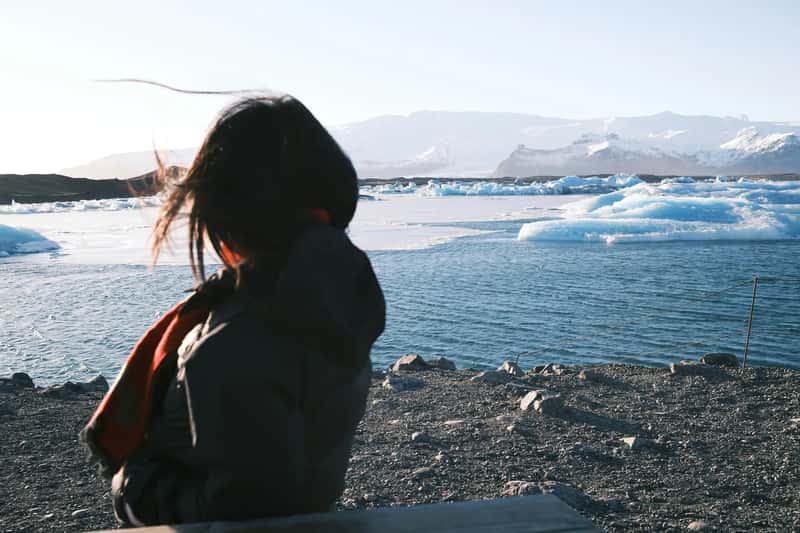
The state of seeking reduced stimulation and emotional flatness bears resemblance to what could be called “psychological hibernation” – a state that may be beneficial for coping with the harshness of prolonged exposure to stress in extreme environments. This is not a failure of the mind. It is an adaptation. A feature, not a bug. The anxious traveler who flies to Svalbard or Greenland or the frozen edge of Alaska is, consciously or not, seeking exactly this state. They want the noise to stop. They want the volume of their internal monologue, that relentless prosecutor reviewing every decision ever made, to simply go quiet. The cold does not solve anything. But it creates a temporary courtroom recess. And sometimes that is enough.
The Exit Strategy
Every extreme cold traveler has one.
They don’t call it that. They call it adventure. A bucket list item. A need for perspective.
But look closer. For some people with anxiety, their daily routines of work, family, or social life can be stressful and sometimes trigger their anxiety symptoms. Whether due to pressure from work or a difficult life situation, sometimes people can feel stuck in a routine that is not good for their mental health. The exit strategy is not the flight itinerary. It is the psychological permission structure that travel provides. The Arctic is particularly potent as an exit strategy because it is not merely unfamiliar – it is incompatible with the anxious self. The habits, the triggers, the cast of characters who sustain the anxiety – they cannot survive at minus forty. The cold kills what the therapy session couldn’t. At least temporarily. And the traveler knows this, even if they have never said it aloud.
The Last Chance and the Last Self
I understand this from the inside.
I once booked a trip to northern Norway not because the northern lights were on a list, but because I had run out of ways to explain to myself why I felt so relentlessly restless at home. The apartment was fine. The work was fine. I was not fine. I remember the specific cold of Tromsø in January – the way it hit the face like a clean hard fact, something utterly indifferent to my anxieties, my unread emails, my unresolved everything. For about four days, the fever broke. I stood on ice and felt something I could only describe as provisional peace. I also understand now that I was chasing something that was never going to stay.
People are planning trips to experience places or see species they may never have wanted to see until learning that the option to witness it could disappear in their lifetime. But “last chance tourism” is also a personal psychology. The endangered thing being visited is sometimes not just a glacier. It is a version of the self that still feels capable of awe. The traveler who races to the melting Arctic is grieving two losses simultaneously: the loss of the landscape, and the loss of their own capacity to feel anything at the ordinary temperature of daily life.
The Hardiness Paradox
Not everyone falls apart in the cold.
Some people grow harder. More themselves.
High-hardy subjects in polar environments have superior coping skills, are less influenced by environmental stress, show increased motivation during endurance activities, and have a more adaptive biological stress response. It could be assumed that explorers undertaking solo expeditions in polar environments would represent extremely hardy people. But hardiness is not a personality type you are born with. It is a state you arrive at through repeated confrontation with the thing you fear. The anxious traveler goes to the Arctic not because they are hardy. They go because they suspect – correctly – that hardiness lives on the other side of the exposure. Every cold morning faced without retreat is a small renegotiation of the self-concept. Every moment of discomfort endured is a deposit into an account that the anxious self has been drawing down for years.
The Identity Suspension
Your name means nothing in a blizzard.
Your job title means less.
Extreme environments feature three core characteristics: a hazardous physical surrounding, a demanding mission goal, and limited communications with loved ones at home. Those three features – hazard, mission, and disconnection – constitute a precise recipe for identity suspension. When survival requires the full bandwidth of the nervous system, the social self, the performed self, the self built from other people’s expectations, simply drops away. What remains is something older and quieter. Travelers who seek extreme cold are often seeking that residue. The stripped-down version of themselves that exists when the environment is too demanding to support any performance at all. The Identity Gap, for a few days, simply closes. Not because it was healed. Because the cold made pretense thermodynamically impossible.
The Cortisol Trade
Anxiety is, at its root, a cortisol problem.
A body running too hot. Too long. On the wrong fuel.
By reducing cortisol production in response to repeated cold exposure, participants might also release less cortisol in response to other stressors in everyday life, thus fostering a more resilient physiological state over time. The Arctic traveler is, without knowing the biochemistry, conducting a self-directed cortisol reset. Multiple studies have shown that repeated exposure to cold water can positively affect the physiological markers of stress: both cortisol release and subjective stress perception were reduced upon repeated exposure. The body learns, incrementally, that the danger it has been catastrophizing is survivable. That it can stand in a windstorm at the top of the world and not cease to exist. This is not metaphor. This is neuroscience. The person who comes back from Svalbard is genuinely, measurably different at the hormonal level – even if the inbox is exactly as they left it.
The Awe Transaction
Anxiety shrinks the world.
Awe explodes it.
Visitor impressions of polar environments include five “awe” elements that encompass spiritual connection, transformative experience, and a sense of feeling humbled. Awe is the precise antidote to anxiety because it makes the self feel appropriately small. The anxious mind is, paradoxically, a grandiose mind – one that believes its own catastrophic forecasts are uniquely important, uniquely unbearable. Stand beneath the Northern Lights and that grandiosity simply cannot sustain itself. What makes travel uniquely valuable is its paradoxical nature – it is both anxiety-provoking and anxiety-reducing. It stretches our comfort zones in ways daily life rarely does. The awe transaction is the exchange the Arctic traveler is actually seeking to make: give me something so enormous, so indifferent, so magnificent, that my personal catastrophe becomes briefly impossible to take seriously.
The Return, and the Fever’s Relapse
The flight home lands. The bags come off the carousel.
The fever is already climbing again.
This is the part nobody posts about. While frequent travel can boost your mood and positively impact your mental health, there are limits. The reduced stress and increased feelings of happiness after a vacation typically last less than one month. The cold was real. The relief was real. The recalibration happened. And then the apartment reassembled itself around the traveler like a familiar cage, and the low-grade hum returned, and the screen lit up with everything that had been carefully avoided. People who undergo these extreme experiences also gain positive, so-called salutogenic outcomes resulting from successfully coping with stress – including enhanced self-sufficiency, improved health, and personal growth. But growth is not immunity. The traveler who uses extreme cold to manage what cannot be managed at home is not broken. They are resourceful. They found a non-pharmacological solution to a pharmacological problem. The question is simply whether they will eventually turn the frost inward – and apply that same unflinching exposure to the things that are actually burning.
There is a particular kind of courage in flying to the edge of the world to feel something. It should not be underestimated. To choose discomfort deliberately – to stand in a landscape so vast and cold and indifferent that your internal weather becomes temporarily irrelevant – is not escapism. It is a form of honesty. An admission that the ordinary temperature of modern life has become unlivable. That the central heating of routine, comfort, and familiarity is not, in fact, keeping anything warm. Only numbing it.
What the Arctic offers is not a cure. It is a mirror held in extreme conditions – one that shows you the version of yourself that exists before the anxiety gets dressed for the day. The stripped-down, windburned, frostbitten self that stands in the silence of a polar morning and realizes, with a clarity that the living room never permits, that the fever was never about the place. It was always about what was left unaddressed inside it.
The ice will be there, melting slowly, for a few more seasons. The question worth sitting with – in the warmth of wherever you are reading this – is not when to book the next flight north, but what it is, precisely, that you are hoping the cold will finally put out.