The trailhead is empty at dawn.
The only sound is your own boot on gravel.
No one is texting you to fix anything.
No one needs translating.
For the first time in your life – possibly ever – the air does not carry a single unspoken demand.
There is a particular kind of adult who ends up on a mountain. Not the athlete. Not the adrenaline-seeker. The one who booked the cabin six months in advance and didn’t tell most people where they were going. The one who, when the pine trees closed in around the road, exhaled so slowly it almost sounded like weeping. They’re not running from anything obvious. They’re running toward a version of themselves that has never been allowed to exist – the version that doesn’t manage, soften, translate, or absorb. The version that simply is.
The Training Ground
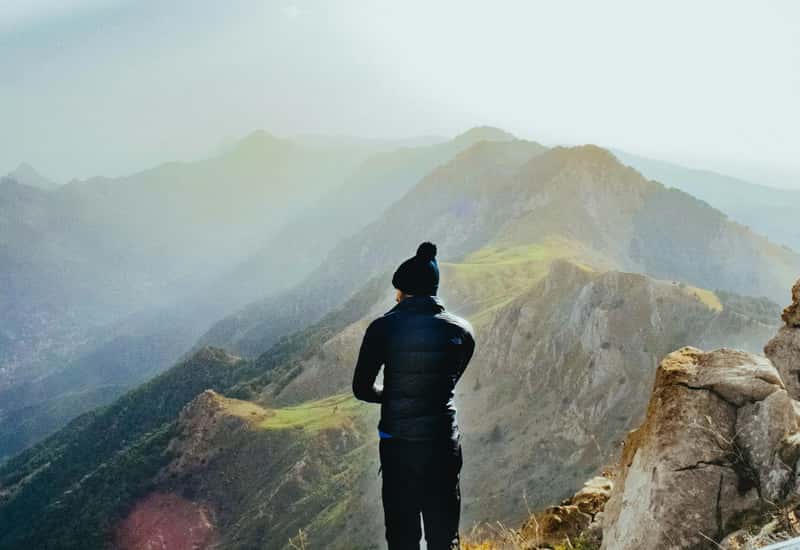
It started before you could name it.
A fork set down too hard at dinner. A particular silence after a door closed. People who grew up mediating learned to track micro-expressions the way other kids tracked baseball stats – a tightened jaw, a fork set down a little too hard, the pitch of a greeting when someone walks through the door.
You didn’t learn this in a classroom.
You learned it for survival.
Family systems theory has long documented how children adopt specific roles to maintain emotional balance within their households. The mediator role teaches a child that their job is to stabilize other people’s feelings, often at the expense of processing their own.
The mountain doesn’t need stabilizing.
That’s the whole point.
The mountain just sits there, enormous and indifferent, and for someone who has spent forty years making sure everything holds together – indifference feels like a gift. The training ground was the family dinner table. The graduation is a trailhead at 5 AM with no cell service.
The Hypervigilance Hangover
The radar doesn’t just switch off when you leave the house.
This hypervigilance was adaptive in childhood – it gave them a head start on defusing tension. In adulthood, it means they’re constantly scanning for emotional weather that isn’t theirs to manage.
A partner’s silence becomes a puzzle. A coworker’s short email becomes a crisis to avert. You’re perpetually on duty even when no one has assigned the shift.
The mountain breaks the pattern.
Not because it’s therapeutic in a clinical, cushioned sense. Because it is utterly, brutally neutral. The wind does not care if you’re upset. The ridge does not need you to hold it together. Silence provides an opportunity for introspection, allowing us to process thoughts and feelings without judgment – a practice that can lead to better emotional control and reduced anxiety.
For the former family mediator, this isn’t a luxury.
It’s the first honest environment they’ve ever been in.
The Debt Nobody Counted
Nobody sent you a bill. But the debt was real.
You became indispensable to a system that never once asked what it was taking from you. You were the emotional infrastructure. The load-bearing wall no one ever bothered to inspect. You absorbed, deflected, soothed, and rerouted – and the family kept spinning, kept functioning, kept calling it love.
But function is not the same as flourishing.
The healer or mediator takes on the role of peacemaker, attempting to resolve conflicts and mediate disputes – while well-intentioned, they may sacrifice their own emotional needs and well-being in the process.
What gets sacrificed doesn’t disappear. It migrates. It shows up as the adult who can’t sit still in a quiet house. Who fills every Sunday with tasks. Who panics slightly when there’s nothing to fix.
The mountain is where the debt stops accruing.
Up there, nobody is making withdrawals.
The Nervous System Geography
Your body knew before your brain did.
In one study, just fifteen minutes of solitude had an emotional “deactivation” effect – lowering high-arousal emotions, including excitement and anxiety, and increasing low-arousal feelings such as calmness. This effect did not happen when participants were with another person.
Think about what that means for someone whose nervous system has been running on high alert since childhood. The mountains aren’t just scenic. They’re physiologically corrective.
Research indicates that spending time in silence can stimulate brain growth by creating new cells in the hippocampus, the region associated with memory formation and emotions.
The former mediator’s nervous system is a machine built for crisis management. Every relationship, every room, every inbox has kept it running at capacity. Altitude doesn’t just change the air.
It changes the operating speed.
And for the first time, the machine is allowed to idle.
The Confession I Keep To Myself
I’ll tell you something I don’t say at dinner parties.
The first time I drove into the mountains alone – no itinerary, no one expecting check-in texts – I pulled off the road after twenty minutes and sat there in the parking lot of absolutely nothing. No dramatic view. Just trees and a gravel pullout and the engine ticking as it cooled.
I sat there for forty minutes.
Not because it was beautiful.
Because no one in the world, in that exact moment, needed anything from me.
I had spent the better part of three decades being the person who noticed when things were about to go wrong and quietly intervened before they did. I had gotten good at reading rooms and bad at reading myself. The mountains weren’t a revelation. They were a subtraction. Everything that had always been added to me – expectation, function, emotional labor – was simply gone. What was left was very small and very quiet and, I think, closer to actual me than anything I’d found indoors.
The Exit Strategy That Isn’t an Exit
People misread it.
They see someone booking solo cabin trips and assume it’s depression. Avoidance. Misanthropy dressed up as self-care. What they miss is the precision of the choice.
Spending time alone can be a healthy, positive choice, with no universal level of socialisation or solitude to aim for. Choosing solitude and using it intentionally for its benefits may be key to balancing solitude amid the demands of modern life.
The former mediator isn’t hiding. They’re recalibrating.
There’s a difference between running away and running toward. The mountains are not an exit strategy from life. They are a strategy for re-entering it as someone who has had five minutes – or five days – of not being needed.
What looks like withdrawal is actually recovery.
What looks like isolation is, in the most precise psychological sense, an act of profound self-authorship.
The Identity That Got Left Behind
When you spend your formative years as the family’s emotional ballast, your own identity development gets deferred.
Early life experiences, such as family discord, profoundly shape an individual’s psychological and behavioral patterns – these formative experiences not only shape an individual’s worldview and self-perception but also play a crucial role in determining coping strategies in adulthood.
The identity you built was built for others.
Competent. Calming. Available. These are not character flaws. They are adaptations. And adaptations, however elegant, are not the same as authenticity.
By taking the social pressure off, solitude can leave us free to be who we “are.”
On a mountain, without an audience, without a role to perform, the question becomes strangely urgent: Who are you when you’re not managing someone else’s feelings?
Most former mediators have never had adequate time to answer it.
The mountain, relentlessly patient, waits.
The Silence as a Second Language
You had to learn to tolerate it.
Silence in the family home was never neutral. It was loaded – the prelude to a fight, the aftermath of one, the particular held-breath quality of an evening where everyone was trying not to detonate anything. Silence meant incoming weather. You learned to fill it before it filled you.
Purposefully spending time alone plays an important role in the development of emotional regulation and perspective of self. Healthy self-care involves an individual self-reflecting on thoughts and feelings, and taking time for introspection of the motivation for their actions.
Mountain silence is a different dialect entirely.
It doesn’t precede anything. It doesn’t mean anything bad is coming. It just is. Learning to inhabit that – to stop bracing, to stop scanning, to let the quiet be just quiet – is essentially learning a second language. One with no grammar of threat. No vocabulary of emergency.
For the former mediator, fluency in this language is the whole journey.
The Body Keeps the Tab
Years of emotional labor have a physical address.
It lives in the shoulders. In the jaw. In the particular tightness across the chest that you’ve stopped noticing because it’s been there so long it feels like a natural feature of your anatomy.
Silence has been found to lower blood pressure and reduce stress by decreasing cortisol levels, promoting overall physical health.
The body, it turns out, is an honest accountant. It has been keeping the tab even when you weren’t. Every tense family dinner, every argument you diffused, every night you lay awake running interference in your mind – it all went somewhere.
Spending time alone reduces stress and anxiety, which can decrease our risk of mental disorders like depression.
The mountain is not a spa. It doesn’t pretend to be gentle. But it does something that no amount of massage or mindfulness app has managed to replicate: it removes the cause. Not just the symptom. The tension was never yours to carry. Up at elevation, the air thins, the Wi-Fi drops, and somehow, miraculously, so does the weight of everyone else’s emotional weather.
The Permission You Never Got to Give Yourself
This is the heaviest one.
Because the real thing the mountain offers isn’t scenery. It isn’t silence, strictly speaking. It isn’t even solitude. It’s permission. The thing that was never on offer in the family home, the thing that was quietly, systematically withheld every time a child stepped between two adults who should have managed their own conflict – the permission to simply exist without being useful.
The pattern isn’t selflessness. It’s a trained response: other people’s needs are urgent; mine can wait.
The mountain does not wait. The mountain does not need. The mountain is the first entity, in a long line of entities, that has made absolutely no claims on the person standing on it. And standing there, maybe for the first time, the former mediator gets to practice the most radical act of their adult life: doing nothing that benefits anyone but themselves.
One of the functions of solitude is that it helps us regulate our moods and, if we go all the way through the process, ultimately offers us emotional renewal. But for the child who grew up holding everyone else’s emotions before they’d developed a container for their own, renewal isn’t a weekend strategy. It’s a years-long archaeology. Digging through layers of other people’s crises to find, somewhere underneath, the raw unmediated self that never got a proper introduction.
The mountains keep no record of who you were at the dinner table. They don’t remember the version of you that kept the peace. They don’t need the translator, the buffer, the soft voice that knew exactly how to re-enter a room after a fight and make it feel like nothing had happened. Up there, the wind erases everything impartially – the good days and the bad ones, the things you held together and the things you quietly fell apart over at 2 AM when no one was watching.
What you’re left with, after the hiking boots are broken in and the silence has become familiar, is something very simple and very hard to name. It might be rest. It might be identity. It might just be the first extended period of your life where the only emotional weather you’re responsible for is your own.
Maybe that’s enough. Maybe that’s everything.