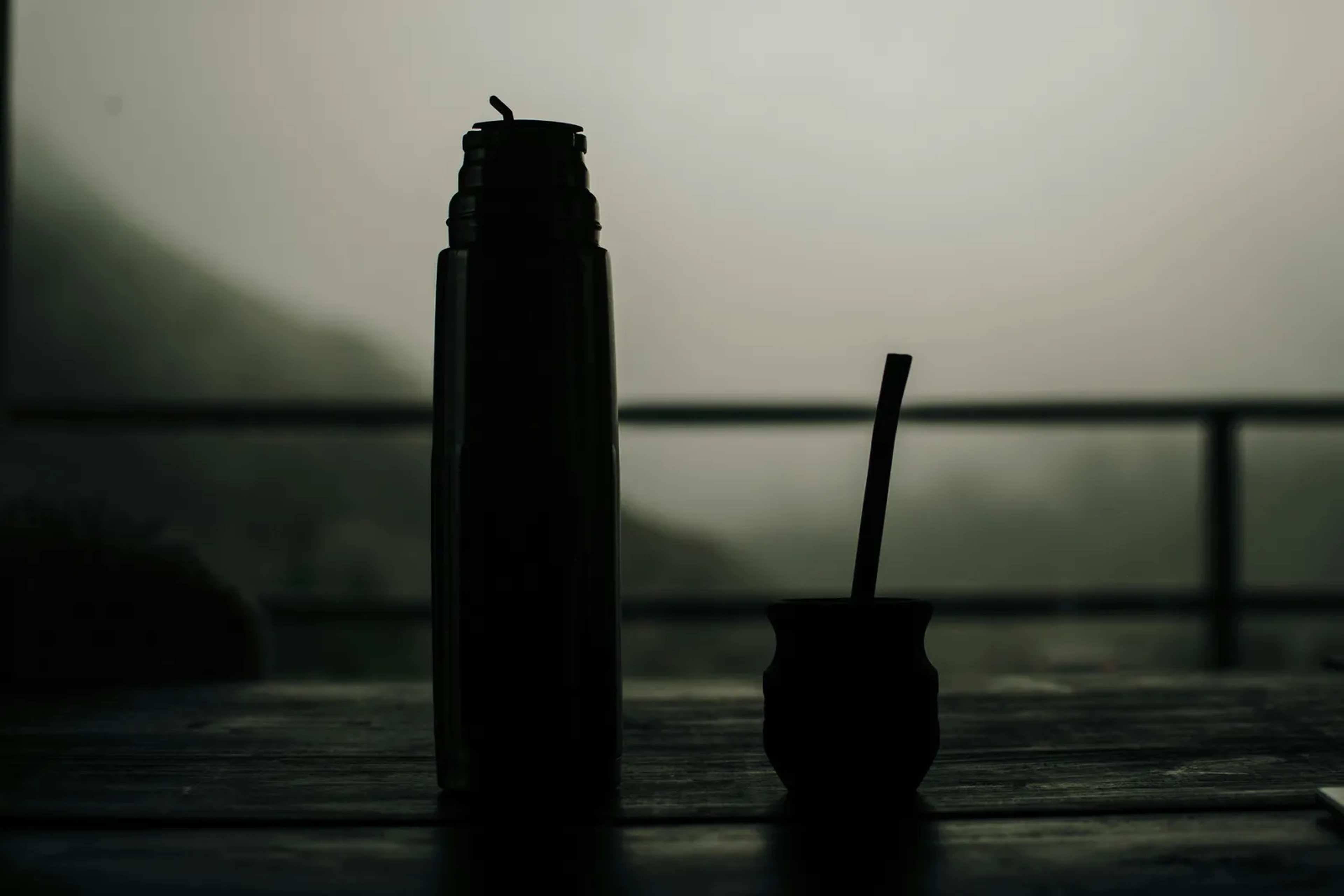
The espresso arrives. You don’t taste it.
You’re already cataloguing the room.
Counting exits. Reading shoulders. Deciding who looks wrong.
This is not paranoia. This is not personality. This is a nervous system doing exactly what it was trained to do – decades ago, in a house that never felt safe.
There is a particular kind of traveler who moves through the world with a map no one else can see. They book the window seat, then stare at the aisle. They arrive in beautiful cities and immediately locate the fire escape. They sit in a foreign cafe – somewhere in Lisbon, or Kyoto, or a backstreet in Buenos Aires – and without thinking, without deciding, they slide into the chair with the wall behind them and the door in full view. They look like they are relaxing. They are not relaxing. They are working. They have always been working.
1. The Threat Inventory

You walk in. You already know where the exits are.
You didn’t decide to look. Your eyes went there first, before your coffee order, before your coat was off.
In practical terms, this means constantly scanning your environment – checking exits when you walk into a restaurant, watching strangers’ hands, tracking movement in your peripheral vision, reading facial expressions for signs of hostility.
This is the Threat Inventory. A silent, automatic audit of every room you enter.
It didn’t begin in this cafe. It began in a kitchen, or a hallway, or a living room where the emotional temperature could shift without warning.
Hypervigilance is strongly linked to childhood trauma – and that has a lot to do with the fact that, as we grow up, our brain develops in a way that’s responsive to our environment.
The child who learned to read a room survived by doing so. The adult who can’t stop reading rooms is carrying that child everywhere they go.
Foreign cities don’t reset the inventory. They just give it new material to process.
The architecture changes. The scanning does not.
2. The Wall Protocol
It isn’t superstition. It isn’t quirk. It is engineering.
Many survivors of trauma report that they prefer to sit with their back to a wall, as opposed to a door or open space. Due to their constant state of hypervigilance, their nervous system keeps them “ready” for any perceived, even if illogical, threat.
The wall behind you is the only variable you can fully eliminate. With your back covered, the perimeter shrinks. The threat radius becomes manageable.
Sitting with your back to the wall closes that loop. The mind gets a sense of completion that allows it to settle into the present moment.
For someone raised in unpredictability, the wall is not furniture. It is a promise. A rare one.
Nobody can come from behind. That is the whole calculation.
You didn’t learn this from a self-defense class. You learned it from a childhood where being caught off guard was the most dangerous thing that could happen – and it happened regularly.
In a foreign cafe, the language is different. The danger-logic is not.
3. The Ambient Reader
You hear the argument three tables over before anyone else does.
You clocked the shift in the waiter’s body language when the manager walked in. You noticed the couple at the window stop talking – not comfortably, but suddenly.
This is not sensitivity. This is a survival skill wearing a social costume.
It’s common for a person who’s hypervigilant to watch the people around them diligently for slight changes in behavior, tone, cadence, body language, written communication or even sentence structure. “These individuals tend to do a lot of overanalyzing of people’s moods and their expression – even things like text messages.”
The Ambient Reader grew up in a house where emotional weather could change in seconds. They became expert meteorologists of other people’s moods.
Travel doesn’t quiet this skill. It amplifies it. New environments mean new data sets.
The brain leans in harder when the cues are unfamiliar. Reading a room in a foreign language is twice the cognitive load. The nervous system doesn’t care. It wants the data anyway.
You are exhausted, sometimes, by how much you notice. You notice that too.
4. The Exit Cartographer
You know where the door is. You also know the door behind the kitchen.
You have already, in the first four minutes, mapped at least two ways out of this place.
You cannot travel far enough away from yourself to lose the internal cartography. You will always, somewhere in the first hour of a new place, find the nearest exit. Chart the fastest route. Build the invisible perimeter that makes the strange place survivable.
This pattern is not about physical danger. It is about the psychological need to know that escape is always theoretically possible.
Many survivors of childhood trauma fear being put in a situation from which they cannot escape. The “trauma brain” wants to avoid any experience that reminds us of a time when we were unable to escape from discomfort.
As a child, there were no exits. The door was locked or the argument was in front of it. The room was the situation and the situation was inescapable.
Now you map exits in every language. Salida. Sortie. 出口. The word changes. The need does not.
5. The Cortisol Clock
You’ve been here before. Not this city. This feeling.
I remember sitting in a cafe in Porto – blue tiles on the walls, afternoon light doing something generous with the dust – and realizing I hadn’t tasted my pastel de nata at all. My body was in that beautiful room. My nervous system was running a completely different program. It was checking. Rechecking. Measuring the distance between me and the door. I looked relaxed. I was burning through adrenaline like a factory on overtime.
When cortisol levels stay high for too long, they damage your ability to rest. Your body feels like it is running a marathon while you are trying to watch TV. This chemical imbalance is why you cannot simply “relax” on command. Your biology is working against your psychology.
The Cortisol Clock is always running. Travel doesn’t stop it. Sometimes the novelty of a new place briefly drowns it out. But by the second coffee, it’s back. Ticking.
The pastry gets cold. You finally eat it. You don’t taste it.
6. The Emotional Weather Station
You feel the shift before the shift happens.
A stranger’s jaw tightens across the room and something in your chest registers it before your conscious mind has filed the report.
Stephen Porges, PhD, coined the term “neuroception” to describe the subconscious neural process by which your nervous system scans for safety or danger, completely outside your conscious awareness. Neuroception happens below cognition – before you think, before you decide, before you have any deliberate input. Your nervous system has already assessed the room and filed a report.
The Emotional Weather Station is the nervous system’s most sophisticated upgrade from a chaotic home. You learned to predict storms. You got very, very good at it.
Maybe a parent was sometimes in a good mood and then – out of the blue – became enraged or violent. That child learned how to pick up on very subtle clues, because knowing what state their parent was in helped keep them safe.
In a foreign cafe, the weather is technically unknown. So you work harder. You read body language across the language barrier. You are fluent in tension. You always have been.
7. The Temporary Identity
In a city where nobody knows your name, you are briefly free of who you had to be.
This is the secret seduction of solo travel for people with chaotic childhoods. The anonymity is not loneliness. It is relief.
If you grew up in a chaotic family where things were never emotionally stable – perhaps the mother struggled with addiction, the father had bipolar disorder, or the parents were always arguing – your nervous system learned to constantly adapt.
You adapted so completely, so early, that you lost track of who you were beneath the adaptation. Travel offers the illusion of a clean slate.
But the wall seat travels with you. The exit scan travels with you. The Temporary Identity is only temporary because the original wound is not.
You feel the same alarm sitting in your own living room as you would in a dark alley. Which means geography was never the variable. The variable was always internal.
The temporary identity is real. And it is not enough.
But it is something. And something, for now, is worth the plane ticket.
8. The Startle Architecture
A chair scrapes. A door slams. Someone laughs too loudly across the room.
Your body responds before your mind consents.
Whether the cause was childhood trauma or a career in emergency services, the result is the same: your brain is stuck in “scan” mode. When you live in this state, your brain treats every sound as a potential danger. A floorboard creaking or a car door slamming outside triggers a physical reaction.
The Startle Architecture is the blueprint the childhood laid down in the body. Loud meant incoming. Sudden meant dangerous. The body memorized that equation and has been running it ever since.
In a foreign cafe, the sounds are unfamiliar. That means the threat-recognition system works harder, not less. An unknown language sounds, to the high-alert brain, like a code it hasn’t cracked yet.
The physical hallmarks are recognizable: dilated pupils to let in more light for scanning, rapid heart rate and shallow breathing, an exaggerated startle response to loud noises, chronic muscle tension especially in the neck and shoulders.
You hold your coffee cup a little tighter than necessary. You have always done this.
9. The Trust Deficit
The stranger sits down at the adjacent table. Something tightens.
They’ve done nothing. They ordered a croissant. They are perfectly ordinary. And still – something in you does not relax.
Growing up in an environment where adults are not always safe and trustworthy causes many to feel uneasy around new people. Trauma survivors have a heightened sense of who they feel comfortable or “safe” with.
The Trust Deficit isn’t cynicism. It isn’t arrogance. It is the logical conclusion of a childhood where trust was repeatedly extended to people who proved unworthy of it.
Always trying to keep tabs on others’ emotions – especially if they seem like they could get angry or violent – is a hallmark of hypervigilance shaped by early experience.
In a foreign city, the Trust Deficit becomes almost archaeological. You are trying to read people with no cultural context, no shared history, no common reference points. Your threat-detection system responds by working double shifts.
You are not unfriendly. You are careful. There is a significant difference, and most people have never had to understand it.
10. The Unquiet Body
This is the heaviest one.
The wall seat, the exit scan, the cortisol clock, the startle – they are all expressions of the same root truth: the body never got the memo that the danger passed.
Childhood trauma often means that you grow up on high alert. This leads to a dysregulated nervous system that is seemingly always looking out for potential threats, even when it’s not necessary. Although hypervigilance develops to keep you safe, experiencing constant stress hormones when there’s no real threat underway can have a serious impact on your life, mental health, and even your physical health.
The Unquiet Body is not broken. It is faithful. It kept its promise to protect you, and it has never stopped.
Childhood trauma often induces changes in brain structures such as the amygdala, hippocampus, and prefrontal cortex. A meta-analysis synthesizing data from over 50 studies concluded that trauma-related alterations in these brain regions contribute to ongoing difficulties in emotional regulation and stress response. These findings underscore that behaviors stemming from trauma are not personal failings but rather survival strategies.
The nervous system that cannot let you rest is the same nervous system that kept you alive in a house that required constant vigilance to navigate. It deserves something other than frustration.
It deserves the truth: the emergency is over. The child is out. The adult is in a cafe in a city that has no record of the original wound. The wall behind you is just a wall. The door is just a door. The strangers are just strangers, ordering coffee, living their uncomplicated Tuesday.
If you’ve lived with hypervigilance for years, it can feel like part of your identity – but it is not your identity. It’s a pattern your body learned, and patterns can change.
There is a particular kind of courage that nobody writes about. It doesn’t look like anything from the outside. It looks like a person sitting in a foreign city, in a chair they didn’t strategically choose, with their back to the room and the door somewhere behind them, out of sight. It looks like nothing at all. It is, in fact, everything.
The psychology here is not a diagnosis. It is a portrait. It is the honest rendering of what it costs to move through the world when your nervous system was calibrated in a house that required you to be perpetually ready. You learned to survive by watching. You became excellent at it. The wall was never just architecture – it was the one boundary you could guarantee in a life where boundaries were routinely violated or absent. Travel became the laboratory where you could run the old protocols in new settings, where the anonymity offered the illusion of reset, and where the exit door in a Lisbon side street felt, briefly, like a freedom that the child who mapped every room of a chaotic home never fully got to feel.
Healing, the research quietly suggests, is not about unlearning the scan. It is about teaching the body – slowly, with patience that matches the years it took to wire this way – that the current room is safe enough to stay in. Not forever. Just for now. Just for the length of one coffee, in one city, in one ordinary afternoon where nothing terrible is coming and the wall behind you is just plaster, and the door is just wood, and you are, against all the odds your childhood set, still here.