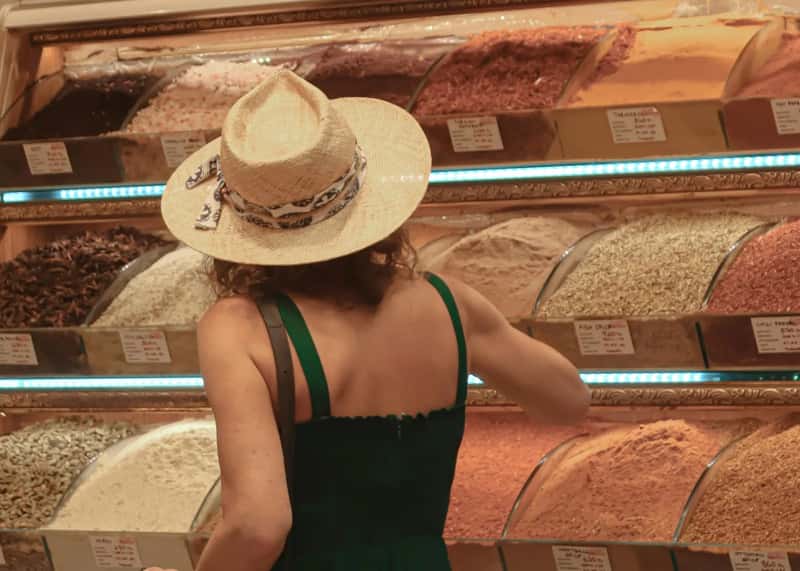
You are in a foreign market at noon.
The noise is enormous. The colors too bright. Your body is here, but your mind is somewhere else entirely – maybe somewhere it hasn’t been in twenty years.
Then you reach for a jar of cumin. You press it to your nose. You breathe.
And something in you – quietly, almost secretly – exhales.
The person standing in that market, inhaling turmeric like it is oxygen, is not eccentric. They are not a foodie. They are a displaced adult reaching – through the ancient architecture of their own nervous system – for the child they left behind somewhere in the shuffle of becoming someone new.
1. The Displaced Self
Modern movement is relentless.
We change cities, change jobs, change identities with a frequency that would have seemed alien to any previous generation. And with each relocation, something happens that researchers are only beginning to fully articulate.
Psychology research suggests we are linked to our environments through three key psychological processes: attachment, familiarity, and identity. Place attachment – distinct from attachment to a person – functions as a mutual caretaking bond between a person and a beloved place.
When that bond is severed repeatedly, something frays.
The psychological research on place attachment suggests that our sense of identity is partly held by the places we return to consistently. When those are continuously reset, identity doesn’t disappear, but it does lose some of its texture.
That texture. That’s what the market is for. That’s why the spice matters.
The displaced self does not announce itself. It doesn’t send a memo. It just quietly moves your hand toward the cardamom and holds it there longer than is socially expected.
2. The Olfactory Shortcut
Not all senses are created equal.
Vision passes through layers of cognitive filtration. Sound routes through complex neural networks. But smell – smell takes a different road entirely.
Odors take a direct route to the limbic system, including the amygdala and the hippocampus, the regions related to emotion and memory.
This is not poetry. This is anatomy.
Unlike sight or sound, scent does not pass through the brain’s rational filtering systems first. This direct route explains why smells can trigger such immediate, emotional responses. A scent can bring back a memory before you’ve had time to consciously place it or even understand why it feels familiar.
This is why the spice aisle of a foreign market can feel more like home than the apartment you’ve rented for eight months.
The brain isn’t confused. The brain is doing exactly what it was designed to do. It is finding its footing in the fastest language it knows.
3. The Anatomy of Grounding
There is a formal psychological practice behind what these travelers are doing instinctively.
It is called sensory grounding. And it is, at its clinical core, a technique for returning a dysregulated nervous system to the present moment.
Sensory grounding techniques harness the senses – sight, hearing, smell, taste, and touch – to anchor individuals firmly in the present. By deliberately activating sensory pathways, these techniques help redirect attention away from intrusive thoughts, traumatic memories, or overwhelming emotions.
The traveler standing in the spice market has not read a clinical paper. They have not attended a workshop.
But their body has found the protocol on its own.
The purpose of smell in this context is to instantly evoke calm, comfort, or alertness, shifting emotional and mental states.
The spice jar is not a souvenir. It is a tool. It is the nervous system self-prescribing.
These techniques mitigate post-traumatic reactions, enable attention reorientation to the present environment, and anchor in the here and now, thus differentiating the past from the present moment.
4. The Inner Child Who Got Left Behind
Every adult traveler carries a passenger they never acknowledge at customs.
Their inner child. The version of themselves that formed its core beliefs about safety, comfort, and belonging long before any passport was issued.
The inner child is a culmination of childhood experiences and unresolved emotions. These inform present-day beliefs, feelings, and reactions.
Perpetual travelers are particularly vulnerable to this dynamic.
The concept of the inner child maintains that everyone has an element of their personality associated with their childhood self. If a person has unresolved trauma that occurred in their youth, their inner child is likely wounded, which can negatively affect their well-being.
The child inside the nomad isn’t interested in Instagram content or bucket lists.
The child inside the nomad wants to know: Where is home? Who are you here? Does anyone know your name?
The spice – familiar, warm, ancient – is one of the few things that answers all three questions at once.
5. The Market at 11 Am in Marrakech
I’ll tell you something I don’t usually admit.
I stood in a spice souk once, theoretically writing about sensory tourism, and I picked up a bag of ras el hanout and just – stopped. Stopped moving. Stopped performing the curiosity of a person who travels for a living. I held that bag to my face for what must have been an awkward amount of time.
I wasn’t smelling Morocco. I was smelling my grandmother’s kitchen. A specific Tuesday. A specific feeling of being small and utterly safe.
Scent memory can evoke a wide range of emotions, from joy and nostalgia to comfort and security. Positive scent associations, in particular, can serve as emotional anchors during stressful or overwhelming moments. For example, the smell of freshly baked bread might remind someone of home and family, instantly creating a sense of warmth and belonging.
I was not being nostalgic. I was being stabilized.
There is a difference. Nostalgia looks backward. Stabilization uses the past as a floor beneath you – right now, in the present, while the market swirls around you and you quietly remember who you are when no one is watching you perform yourself.
6. The Identity Gap in Motion
Travel promises authenticity. It delivers complexity.
The person who moves every three months, every year, every few years, begins to experience something researchers call identity fragmentation – the quiet dissolution of a coherent self-narrative.
Loss of identity is a common challenge faced by those who decide to move abroad for a living, and it can significantly impact mental health. This can result in feelings of isolation, loneliness, and disconnection.
The gap between who you were and who you’re pretending to be in this new city widens slowly.
The journey of voluntary uprooting transcends mere geographical relocation. It is, at its core, an existential undertaking – a deliberate dismantling and subsequent reconstruction of one’s identity. When we remove ourselves from the cultural, social, and linguistic frameworks that have defined us, we encounter not only an unfamiliar external world but also unexplored dimensions of our internal landscape.
The spice market becomes a confession booth for the identity gap.
You step inside. You don’t speak. You just breathe. And for a moment, the gap closes.
7. The Neuroscience of Coming Home
The brain never forgets what safety smelled like in childhood.
This is not sentiment. This is the documented legacy of how olfactory memory is encoded – earlier, more deeply, and with more emotional charge than any other sensory memory.
Childhood is a critical period for emotional development, and sensory experiences during this time tend to leave stronger, more durable memory traces.
The cinnamon in the market isn’t just cinnamon.
Over time, repeated exposure to the same scent during similar emotional experiences strengthens these pathways. This creates what researchers call an odour-evoked autobiographical memory – a memory triggered by smell that feels vivid, personal, and emotionally charged.
The nomad standing at the spice stall isn’t buying a condiment. They are activating a neural map of emotional safety that was drawn decades before they owned a carry-on bag.
In many ways, the brain treats smell not just as an environmental cue, but as a powerful time machine for emotional life experience.
The market knows this. The child inside the adult certainly knows this. The adult is the last to understand it.
8. The Obsession Explained
There is a reason it becomes a ritual. A compulsion, almost.
Every new city. Every unfamiliar market. The same gesture: reach, open, inhale.
What looks obsessive from the outside is actually a sophisticated coping mechanism working at full capacity.
A mental anchor is a specific stimulus or reference point designed to help individuals effectively access desired emotional states or manage their emotions. This technique involves associating a particular sensory experience – be it a sound, smell, or physical action – with a peak emotional state.
The displaced traveler has learned, without being taught, to build portable emotional anchors.
This subjectivity is what makes scent such a powerful and intimate tool for emotional grounding. It allows each person to create their own sensory language of calm, tailored to their memories and preferences.
Each market, then, is not a destination. It is a recalibration station. A place where the inner compass – spinning wildly since the last airport, the last goodbye, the last unfamiliar ceiling – finds magnetic north again.
That north is not a place on a map. It is a smell. It is a feeling. It is the child, briefly found.
9. The Cost of Constant Reinvention
Nobody talks about what perpetual freedom actually costs.
The nomad lifestyle is glorified in every possible medium. But the psychological literature tells a quieter story.
Every single person in one study described a version of this arc: intense aliveness early on, then a gradual flattening, then a hunger for more novelty to reach the same feeling. One person put it plainly: “The first few months were the most alive I’d ever felt. The next year, I kept chasing that first few months.”
This is dopamine economics. This is the identity running on fumes.
And underneath the chasing, underneath the aesthetic of the wanderer, lives a child who wanted to be somewhere specific. Who wanted people to know them over time. Who wanted to open the same spice drawer on the same Tuesday morning and feel – without having to construct it from scratch – that they were home.
A consistent theme in the literature on those who grow up across multiple cultures is the struggle for a sense of belonging to one cultural or ethnic group, feelings of rootlessness, and a need for a cultural home.
The spice market is where that need surfaces. Briefly. Honestly. Without performance.
10. The Quiet Act of Coming Back to Yourself
Here is the hardest truth about sensory grounding in foreign spice markets.
It works. Completely and immediately and without requiring anything of you except presence.
Smell is directly tied to the emotional centers of the brain. Engaging this sense can interrupt anxious loops and provide comfort.
But what it reveals in the working – in that still, private moment between your nose and the cumin jar – is that something inside you has been quietly untethered for a very long time.
It is the parts of the human soul that have been fragmented by experience that need to integrate. Most often, a wounded-child part of self is rejected, ignored, or shamed by the adult self. In order for the parts of self that have been emotionally harmed to fully heal, these parts must first be accepted by the core self.
The traveler who obsessively smells spices is not broken. They are not performing some exotic ritual for a travel diary. They are doing something far more quietly extraordinary.
They are finding the child who got left behind in the chaos of becoming someone worldly. They are picking them up. They are saying, without words: I see you. I remember. You’re still here with me.
Grounding is a stabilization tool, not a healing one. Repeatedly using grounding to suppress anxiety without addressing its source can become avoidance – maintaining anxiety by preventing the natural habituation that comes with tolerating it. The market is not a therapist. The spice jar is not a cure. But it is a door. And sometimes, a door is all you need to remember that the room still exists.
There is something sacred happening in the ordinary chaos of a market stall. Something that has nothing to do with tourism or culture or cuisine. A person standing very still in a moving crowd, holding a small jar, breathing in a direction that goes backward before it goes forward. The body doing what the mind hasn’t managed to do in months: return.
Identity is not lost when you travel. It is not erased by airports and new addresses and the relentless novelty of an examined life. It goes underground. It hides in the oldest, most primitive architecture of who you are – the architecture that was built before language, before ambition, before the first suitcase was ever packed. It lives in the limbic system. It lives in the amygdala. It lives, specifically and stubbornly, in the part of your brain that learned what safe smelled like before it learned anything else.
Go to the market. Reach for the jar you’re drawn to without knowing why. Stand there longer than is polite. The child inside you has been waiting, patiently and without complaint, for you to finally stop moving long enough to remember their name.