You booked the cliff-side hotel six months in advance.
You didn’t know why. Not really.
The calendar at work hadn’t changed. The arguments were the same. The face in the bathroom mirror was the same face, doing the same tired negotiation.
So you found a mountain. A coastline. A canyon rim. Somewhere the world dropped away and you could finally exhale.
Here is the uncomfortable truth no travel brochure will print: when we’re removed from the context of our everyday lives, we’re forced to confront who we are without the labels of work, relationships, or societal expectations. And most of us are not prepared for what we find there.
The “Identity Gap” is real. It is the distance between who you perform yourself to be in your kitchen, your office, your car – and the person who stands at the edge of a precipice and feels, briefly, completely honest. Research defines the motivation for leisure travel as psychological escape – an instinctive reflex to a temporary dissatisfaction caused by a variety of influences. You are not broken. You are just running toward the version of yourself that routine buried.
1. The Altitude of Desperation
Nobody admits they need help.
They say they need a vacation.
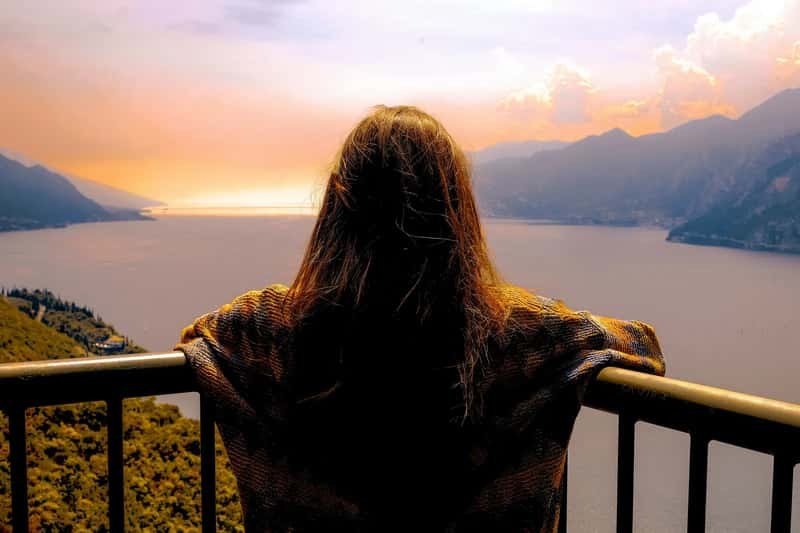
But look at the destination choices. Always somewhere elevated. Always somewhere vast. The grandeur of mountains offers spectacular views, providing ample opportunities to experience the emotion of awe, which quiets negative self-talk by quieting the part of the brain responsible for self-perception. That is not an accident. That is strategy – unconscious, animal, urgent.
The person booking a mountain retreat is not chasing beauty.
They are chasing silence from the internal monologue that has been running too loud for too long.
Long-distance views can serve as a respite from the demands and stresses of daily life. Gazing upon a sweeping landscape can offer a sense of tranquility and calm, helping to reduce stress levels.
The view is a prescription. The altitude is the dosage. The desperation is the diagnosis nobody wrote down.
We arrive at scenic overlooks breathless – and not from the climb.
2. The Temporary Identity
In a new place, you get to be someone else for a week.
Not dishonest. Just unfinished. Unassigned.
Travel often provides the opportunity to reassess personal values and identity, offering an escape from daily constraints and a chance to engage in reflective practices and novel experiences. That word – “reassess” – is clinical. What it really means is: you finally get to ask the questions your schedule refuses to accommodate.
Who would I be if the alarm didn’t go off?
Who am I when no one here knows my name?
By navigating through new experiences, individuals gain insights into who they are beyond the limitations of their immediate environment.
This is why you feel lighter at the airport. Not because you’ve solved anything. Because for a brief, glorious moment, nothing has been assigned to you yet. The self is still wet clay. And a view – an enormous, indifferent, beautiful view – is the only mirror wide enough to reflect the whole of it.
3. The Exit Strategy
People travel, in some cases, to escape from something – their family, colleagues, or residential or work area.
Say it out loud. Let it sit there.
The escape is not shameful. It is evolutionary. Evolutionarily, our ancestors’ ability to explore and adapt to new environments was key to survival. As our species evolved, the need to seek out new territory and discover resources became ingrained in our psyche.
The person who only travels to places with wide open views is doing something deeply ancient.
They are scanning the horizon for danger. For direction. For relief.
One of the greatest appeals of travel is the exhilarating sense of freedom it provides. Leaving behind daily responsibilities and societal expectations, travelers enjoy a rare opportunity to set their own pace and priorities.
The exit strategy is not a sign of weakness.
It is a sign of someone who still has enough self-awareness to know they are suffocating – and enough courage to open a window.
4. The Awe Mechanism
Science has a name for what happens at the edge of the Grand Canyon.
It is not wonder. It is not joy. It is awe – and awe is violent.
In an experiment, participants staring up a grove of very tall trees for as little as one minute experienced measurable increases in awe, and demonstrated more helpful behavior and approached moral dilemmas more ethically than those who spent the same time looking at a building.
Think about that. One minute. One vast, indifferent thing overhead.
In this experience of awe, there is the potential to induce positive effects characterized by increased social connectedness, heightened well-being, and greater life satisfaction.
Awe does something to the ego that therapy takes months to achieve. It makes you small.
Not diminished. Small in the way that is freeing – unhooked from the importance of the email you didn’t answer, the promotion you didn’t get, the version of yourself you’ve been performing for years. “One of the things that may come from awe is the feeling that the individual is part of a much bigger whole.” The view is not the reward. The smallness is.
5. The Mirror You Can’t Hang in a Hallway
I remember standing on a clifftop in the Azores – fog rolling in from the Atlantic, the kind that erases everything – and realizing I had no idea what I actually wanted from my life.
Not my career. My life.
It was the first time in three years I had the silence long enough to let that question form completely. The city doesn’t allow it. The notifications don’t allow it. The to-do list is a very efficient gag.
Travel offers us a temporary break from the stresses of routine, providing a chance to reset mentally and emotionally. Psychologists often emphasize the importance of stepping away from daily stressors to gain perspective – and traveling, especially to a completely different environment, offers that in abundance.
The view from that cliff was not Instagram content.
It was the first honest conversation I’d had with myself in years. Traveling provides us with the time and space to reflect on our own thoughts and emotions. It provides the opportunity to take a step back from our daily lives and really think about what we want out of life. Some mirrors are just wider than others.
6. The Routine as a Cage
For many, the appeal of travel lies not just in exploring new places but in escaping the monotony of everyday life. Modern life often comes with a predictable, sometimes draining routine: work, obligations, responsibilities, and the stress that can accumulate from the daily grind.
The cage is clean. The cage is comfortable. The cage has Wi-Fi.
But it is still a cage.
One of the primary psychological drivers for travel is the desire to escape monotony and routine. Daily life is often predictable, which can lead to a decrease in mental stimulation and, ultimately, boredom.
The person who gravitates toward dramatic landscapes isn’t being dramatic. They are responding to a real and measurable deficit. We live with ubiquitous technology designed to constantly pull for our attention. Many scientists believe our brains were not made for this kind of information bombardment, and that it can lead to mental fatigue, overwhelm, and burnout.
The view from a hillside is not nostalgia.
It is neurological recovery. The brain returning to a frequency it was always meant to operate on – before the inbox, the commute, the performance.
7. The Dopamine Architecture of Elsewhere
The brain is a junkie for novelty. It always has been.
Humans are wired to seek out novelty. Psychologically, we’re driven to experience new things because novelty activates areas of our brain that are associated with motivation and reward.
But view-seekers are after something more specific than novelty.
They are after cognitive reset. Being in nature restores depleted attention circuits, which can then help us be more open to creativity and problem-solving. The vista is not passive. It is working on you while you stare at it.
Research has found that simply staring at a scenic view for 40 seconds was enough to “trigger the brain into a more relaxed state.”
Forty seconds.
That is less time than most people spend deciding what to watch on a streaming platform. Yet the view offers what hours of consumption cannot: genuine quiet. The dopamine architecture of “elsewhere” is not escapism. It is maintenance. The daily life that denies this is not sustainable – and the body, eventually, insists on the horizon.
8. The Seeking-Escaping Duality
Psychology has a clean framework for what view-seekers are doing.
They are not simply running away. They are simultaneously running toward.
Iso-Ahola proposed a theory of leisure motivation composed of both seeking (intrinsic rewards) and escaping (routine environments) elements. According to Iso-Ahola, this dichotomy of motives is not mutually exclusive, and it is often possible for an individual to be engaged in both motives simultaneously.
The person who books the rooftop hotel in Lisbon is escaping their Tuesday. They are also seeking the part of themselves that only surfaces when the backdrop is wide enough.
The four main travel motives that arise whatever the travel experience are novelty seeking, escapism/relaxation, relationships, and self-development.
The view is never just the view.
It is the container for all of that at once – the running from, the running toward, and the brief, terrifying moment in the middle where you are perfectly still and perfectly honest.
9. The Identity Reformation
Travel doesn’t just rest the self. It rebuilds it.
Traveling presents opportunities for personal development in areas of self-efficacy and confidence due to the constant adjustments people make to different cultures, languages, and environments during their travels.
But for the scenic-destination devotee, the transformation happens not through culture shock – but through spatial humility.
Stand at the edge of something immense and your identity becomes briefly negotiable.
Many travelers report that their journeys are deeply tied to self-discovery. In many ways, travel becomes a tool for self-discovery – an opportunity to learn about oneself by experiencing the unfamiliar.
Research confirms this is not metaphor. Experiencing cultural and environmental immersion led participants to discover “new realizations about self-identity that triggered transformative learning.”
The view is the catalyst. The reformation happens in the quiet after. In the hotel room at dusk. In the silence before sleep. In the space between who you flew in as – and who you might become if you let the horizon rearrange you.
10. The Life You Owe Yourself a View Of
Here is what nobody says at the departure gate:
The place you keep flying toward is not the destination.
It is the accusation.
In our modern world, many people feel overwhelmed by the stress and pressures of daily life. Work, relationships, and other responsibilities can create a sense of monotony and confinement. Travel offers an escape from this monotony – whether it’s a beach for tranquility, a mountain for adventure and solitude, or an exotic city offering cultural enrichment and excitement.
Every cliff you’ve stood on. Every rooftop you’ve rented. Every sunrise you’ve set an alarm for – in a city that isn’t yours, in a bed that asks nothing of you – is a data point.
The data says: your life, as currently configured, is not giving you enough width.
For many, travel goes beyond pleasure and adventure – it becomes a pathway to meaning. Whether volunteering abroad, embarking on a spiritual pilgrimage, or simply seeking deeper understanding of oneself and the world, travel can instill a profound sense of purpose.
The view is not a luxury. It is a symptom.
It is what perspective-starvation looks like when it finally gets a passport.
There is a particular kind of sadness that arrives on the last morning of a trip. You wake up before the alarm. The light in the room is different – always different, in the good places. You lie still and you know, with a certainty that feels physical, that you are about to re-enter a life that is slightly too small for you.
That sadness is not about the place you’re leaving. The emotional impact of travel memories often lingers, providing comfort, inspiration, and a sense of identity. What lingers is not the vista itself but the version of yourself who stood in it – unclaimed, unscheduled, wide open to the horizon. The grief is for that person. The one who only gets to exist when everything familiar is far enough away.
The question that no return flight answers is this: what would it take to bring that person home? Not to a hotel room with a view. But to the ordinary Tuesday. To the kitchen. To the meeting. To the life that right now exists in the gaps between your travels, waiting, smaller than it should be, for you to finally give it the same quality of attention you give the sea.
The view was never the point. You were.