The suitcase is open on the bed at midnight.
You are adding a fourth sweater to a three-day trip.
Something in your chest will not let you stop.
You have been here before. Not in this hotel room. Not on this trip. But in this feeling – the one that says more is always safer than enough.
There is a gap between the person who books the ticket – light, adventurous, free – and the person who shows up at the airport dragging 47 pounds of contingency plans. That gap is not a packing problem. It is an identity problem. It is the distance between who you have trained yourself to appear and who you actually are when the world around you stops being controlled and predictable.
The Suitcase Is Not About Clothes
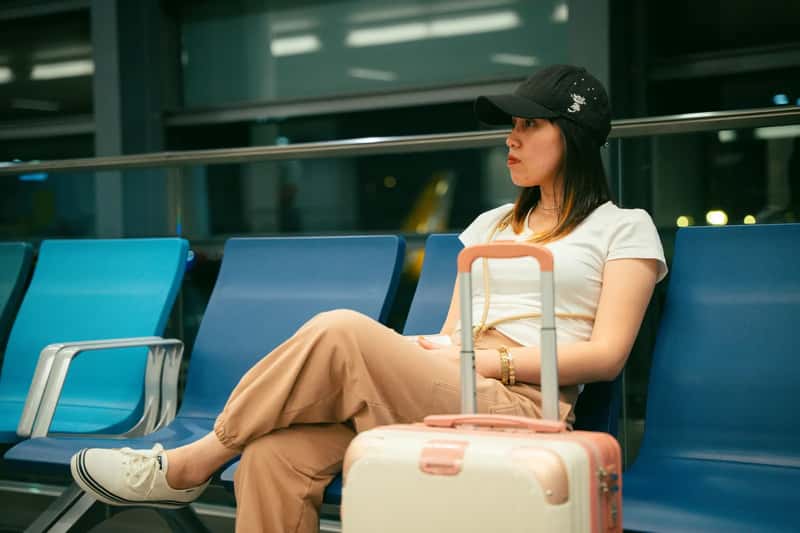
Experts agree the inclination to overpack, driven by an urge to prepare for countless “just in case” scenarios, is rooted in anxiety and the loss of control that comes with leaving one’s personal space.
But here is what those experts often skip over.
The anxiety is not new. It did not start at the departure gate. It started long before you ever owned a passport. The suitcase is just the most honest place your nervous system has left to speak.
When you pack a backup charger for your backup charger, you are not being practical. You are being a child again – one who learned, quietly and early, that no one else was going to handle this. The packing is not about luggage. It is about an old internal contract. If I am prepared enough, nothing bad will happen. And no one will have to save me, because no one ever did.
That is the sentence that never makes it onto the luggage tag.
The Safety Net That Never Arrived
Children whose families and homes do not provide consistent safety, comfort, and protection may develop ways of coping that allow them to survive and function day to day – they may be overly sensitive to the moods of others, always watching to figure out what the adults around them are feeling and how they will behave.
This is the origin story of every chronic over-preparer.
Not a villain. Not a flaw. A survival skill.
When the adults in the room are unpredictable, a child becomes a small, watchful meteorologist – reading the air pressure of a living room, forecasting emotional weather before it arrives. That skill does not evaporate at eighteen. It just migrates. It moves into your packing habits. Your to-do lists. Your backup plans for your backup plans.
Often, the type of trauma contributing to hyper-independence involves neglect from the parent or caregiver. Neglect happens when the person whose role it is to keep the child safe fails to meet these needs. The child learns from these experiences that they cannot rely on others, so they must depend solely on themselves.
The overpacked suitcase is just that lesson, zipped shut and wheeled through another airport.
The Hypervigilant Traveler
For those who grew up in chaotic or neglectful households, fear may have developed into hypervigilance – a chronic high-level of alertness and constant scanning for potential threats. As children, some conflated feeling hypervigilant with the ability to keep themselves safe in the absence of a stable, calm, loving adult.
That child grew up. They bought a rolling carry-on. They packed it like it was armor.
Childhood trauma often means that you grow up on high alert. This leads to a dysregulated nervous system that is seemingly always looking out for potential threats, even when it’s not necessary.
Here is what that looks like in Terminal C at 6 AM. It looks like checking your packing list three times after midnight. It looks like bringing two pairs of shoes for every occasion you might possibly encounter. It looks like that low-grade, unnamed dread that only lifts when the bag is finally, mercilessly, full.
The nervous system does not know the difference between a volatile household and an uncertain itinerary. It only knows the old feeling. And the old feeling says: be ready for everything, because help is not coming.
Loss Aversion and the Art of Worst-Case Packing
According to psychologists, overpacking is often rooted in loss aversion. We pack for worst-case scenarios. But what we’re really trying to pack is control. When the world feels unpredictable, our bags become safety blankets, neatly zipped up.
Loss aversion is not a travel quirk. It is a survival adaptation that became a lifestyle.
The mind that grew up without reliable support learns to calculate risk obsessively. It never quite believes in enough. Enough clothes. Enough options. Enough escape routes. The “just-in-case” mindset encourages people to pack for scenarios that are unlikely to occur. This behavior is closely tied to anxiety, particularly the desire to control uncertain situations.
But controlling the uncertain is an old childhood dream dressed up in practical clothing.
You are not packing for the trip. You are packing against the feeling.
The Mirror in the Middle of the List
I remember standing in my apartment before a weekend trip, paralyzed by a duffel bag that was already full and somehow still not enough. I added a second umbrella. I remember thinking – with full adult clarity – that one umbrella might fail me. That I could not risk it.
It was not about rain.
It was about the years of being the person in the room who handled the thing no one else handled. The one who thought ahead so that the other shoe never dropped without warning. The one who, as a child, could not afford to be caught off guard. The reliance on thoughts, rumination, compulsive thinking, strategizing, future projections do not actually keep you safe and never have. The mind works from old, outdated programming from childhood when the nervous system and brain were still developing.
Two umbrellas. One old nervous system. Still running the same protection protocol from a household that no longer exists.
The Insecure Attachment Blueprint
Bowlby introduced the concept of the “secure base,” where a child uses a caregiver as a stable point of safety from which to explore the world. The child gains confidence in exploring their environment when they feel secure in the attachment to their caregiver. He also identified the importance of early relationships and how disruptions in these bonds could lead to attachment issues later in life, such as anxiety or emotional insecurity.
If no secure base existed, the child builds one out of whatever is available.
A packed bag. A mental checklist. A compulsive inventory of every possible outcome. If you had a caregiver who was attentive and reliable, you’re more likely to have secure, stable relationships as an adult. On the other hand, if your caregiver wasn’t attentive or consistent in their care, you’re more likely to have difficulties.
The overpacker, at their core, is still building that secure base out of carry-on luggage and contingency plans. Still trying to be the caregiver they never had – for themselves, on every single trip.
It is exhausting. It is also understandable. And it deserves to be met with something softer than a packing tip.
The Control Illusion
At its core, overpacking often reflects a lack of trust. Not in people, but in adaptability. It’s a way of trying to control uncertainty by preparing for every possibility.
Control is not the enemy. It was once the lifeline.
When chaos is ambient – when you cannot trust the environment, the caregiver, or the day – control becomes the only currency that buys you safety. Childhood trauma can create an environment that is chaotic, unstable, or unpredictable. The impact of this instability can be profound and lifelong.
The bag that is too heavy is a monument to that instability. Every extra item a small, silent vote of no confidence in the world’s ability to provide what you need when you need it.
The problem is not the control. The problem is that the emergency has been over for years, and no one sent the nervous system a memo.
The Identity in the Luggage
Who you pack for says everything about who you believe you are when stripped of your routines.
The very nature of travel is just fundamentally tricky for people who have a hard time going with the flow: you are going somewhere new and different, where you won’t be able to predict or control everything.
And for someone who learned early that unpredictability meant danger, not adventure – that is not just tricky. That is a full-scale threat response wearing a boarding pass.
The over-preparer does not trust the version of themselves who travels light. That version feels reckless. Naive. Like someone who believes the world will catch them if they fall. Rather than trusting their own ability to adapt, they opt for excess to avoid being caught off-guard. Because being caught off-guard was once genuinely dangerous. The body remembers, even when the mind insists it was a long time ago.
The suitcase is not a travel accessory. It is a portable identity – the one that says I am the person who is always prepared, so I am always safe.
The Weight You Carry That Has Nothing to Do With Miles
Exposure to traumatic events in childhood alters affective and neurobiological development to enhance the identification of potential threats in the environment and magnify emotional responses to those threats. Although these adaptations may promote safety in dangerous environments, they are a central mechanism linking child trauma to the onset of psychopathology.
Put more plainly: the alarm system that kept you safe once is still ringing.
You pack the third pair of shoes because somewhere in your nervous system, the cost of being caught without is still catastrophic. Not inconvenient. Catastrophic. Instead of simplifying travel, overpacking can make it more stressful, reinforcing the very anxiety it aims to reduce.
The weight of the bag mirrors the weight of the internal story. And neither the bag straps nor the psyche were designed to carry this much, this far, this often.
The Heaviest Thing You Will Ever Pack Is the Past
These kinds of learned adaptations make sense when physical and emotional threats are ever-present. As a child grows up and encounters situations and relationships that are safe, these adaptations are no longer helpful, and may in fact be counterproductive and interfere with the capacity to live, love, and be loved.
There it is.
The overpacked bag is not a character flaw. It is a love letter to the child who had to hold everything together alone. It is a form of devotion to that small, serious person who could not risk being unprepared because no one else was paying attention. It is loyalty to a survival strategy that genuinely worked – until it didn’t, until it became the thing that made the journey harder instead of safer.
One clinical goal is to help people realize that their hypervigilance is a normal response to trauma. It helped them survive the trauma, but it’s not working now. The bag full of contingencies, the midnight inventory, the third umbrella – none of it is madness. All of it is memory. The body trying to parent itself through the future the only way it learned how: by carrying everything, trusting nothing, and leaving no gap for the world to fail it again.
Somewhere between the first sweater and the fourth, there is a question that has nothing to do with weather forecasts. It is the quieter question, the one that sits underneath all that careful preparation and asks: when did I decide that the world would not provide?
The answer to that question is not in the bag.
It never was.