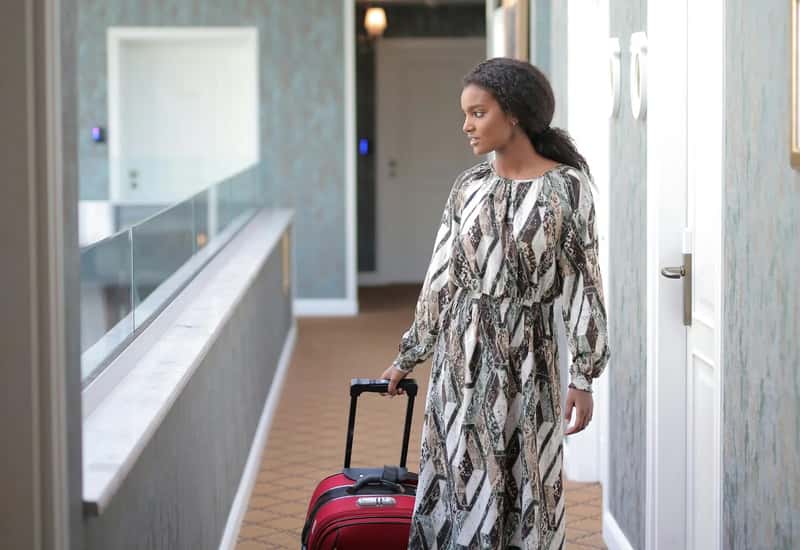
The hotel corridor is silent at 11 AM.
Your bag is packed. Has been since nine.
Checkout is noon. You know this.
And still, you will not call the front desk.
There is a word for this. It lives somewhere between the fluorescent hum of the hallway and the cold logic you’re using to talk yourself out of a perfectly reasonable request. It is not politeness. It is not consideration. It is something older, something that predates this hotel room, this city, this version of you that travels with a carry-on and a carefully constructed sense of self.
This is the Identity Gap – the chasm between the person you perform in public and the person who goes quiet the moment a real need surfaces. The traveler who negotiates international flights with quiet confidence but cannot pick up a phone and ask for sixty extra minutes.
1. The Invisible Child
It started before you could name it.
A household where needs were tolerated, not welcomed. Where asking for something – anything – came with a weight attached. A sigh. A pause. An almost imperceptible tightening around the eyes of the person you needed most.
The fawn response emerges when a person internalizes that safety, love, or even survival depends on appeasing others – especially those who hold power over them. It is a profound psychological adaptation, often shaped in childhood, in homes where love was conditional, inconsistent, or entangled with emotional or physical threat.
You were not dramatic. You were not difficult.
You were a child doing the math.
And the math kept coming up the same way: the less you asked for, the safer you were. The smaller you made yourself, the more room there was to breathe. You didn’t learn to be invisible. You were taught to be.
Now you’re forty-two, standing in a hallway with your suitcase handle extended, doing the exact same math.
2. The Fawn in Room 412
Psychology has a name for what happened to that child. It arrived late to the clinical conversation, added after fight, flight, and freeze.
Coined by therapist Pete Walker, the fawn response refers to a trauma-driven pattern of people-pleasing behaviors designed to diffuse danger when the brain senses threat – especially social or relational threat.
The fawn doesn’t fight the danger. Doesn’t run from it. Doesn’t freeze.
The fawn becomes agreeable. Useful. Small.
Fawn types seek safety by merging with the wishes, needs, and demands of others. They act as if they unconsciously believe that the price of admission to any relationship is the forfeiture of all their needs, rights, preferences, and boundaries.
That is not a hotel guest making a reasonable request.
That is a survivor, still paying an old admission price in a new building. The carpet is different. The wound is not.
3. The Discomfort of Being Seen Wanting
There is a specific kind of shame that arrives the moment you consider asking for something.
Not guilt. Guilt is about what you did. This is older. This is about who you are.
Help-seekers, by simply asking for help, risk exposing their vulnerabilities. Such concerns often lead individuals to resist imposing on others for valuable forms of assistance.
The hotel front desk is not your mother. The front desk agent is not keeping a tally.
But the nervous system doesn’t know that. It was calibrated in a different room, in a different decade, by a different set of rules. And it is running that same old program now, in the lobby, in your chest, behind your sternum where the “no, it’s fine, I’ll just wait” lives.
Asking for help can be awkward and uncomfortable. Even a minor request can invite rejection, expose inadequacies, and make a help-seeker feel shy, embarrassed, and self-conscious.
A minor request. Like sixty minutes. Like simply existing a little longer.
4. The Performance of Not Needing
Watch the people who refuse to ask for late checkouts in action.
They are often the most competent people in the room. Organized. Self-sufficient. They have snacks in their bag before anyone asks. They have the directions before anyone is lost. They are pre-emptively useful, strategically anticipating every need around them – except their own.
The delusion of self-sufficiency holds that people ought to be able to manage everything by themselves. This idea is frequently engrained from an early age and supported by cultural standards that value individualism.
Self-sufficiency, in this context, is not a strength. It is a defense.
It is the adult version of the child who stopped asking. Who learned that wanting something was the first step toward disappointment. Who built an entire personality around not needing – because needing was dangerous, once. In a specific kitchen, in a specific house, in a specific year that they do not talk about at dinner parties.
5. The Body That Remembers the Hallway
I know this room.
Not this hotel. The internal one. The one where you stand with your metaphorical bag packed, entirely ready to leave, fully aware that you have options – and you choose the one that costs you the least friction, even when it costs you the most comfort.
I have sat in airport lounges for four hours rather than ask for a flight change. I have eaten cold food rather than send a plate back. I have slept on a slanted mattress rather than call the front desk. I told myself I was being easy. Low-maintenance. A good traveler.
What I was doing was performing the same disappearing act I’d been rehearsing since childhood. Making myself provisional. Taking up only the space I was sure wouldn’t be contested.
While fawning is meant to neutralize danger, it also causes us to abandon our own needs, thereby reinforcing our wounds.
Every time you shrink. Every time you say “it’s fine.” The wound deepens by exactly one centimeter.
6. The Hotel as Psychological Mirror
Travel is a strange psychological pressure cooker.
You are in unfamiliar territory. Stripped of your context. None of your usual props – the home, the routine, the roles that tell you who you are – are available. You are just a person in a room with a number on the door.
And stripped of context, the oldest patterns surface first.
Our default trauma response is closely tied to our attachment style that typically develops in our formative years. When we are young, we are dependent on our primary caregivers to meet our basic survival needs as well as other additional needs.
The hotel becomes a proxy parent. The front desk, a proxy authority. And the ask – the simple, transactional, entirely reasonable ask – becomes loaded with decades of meaning it was never supposed to carry.
You are not afraid of the receptionist. You are afraid of the voice that told you once, in a different room, that your needs were inconvenient. And you have been honoring that voice ever since. In airports, hotel lobbies, restaurants, meetings. Everywhere you go, you bring that room with you.
7. The Imposition Script
There is a specific internal monologue that runs in the minds of people who grew up feeling like an imposition.
It sounds like: They’re busy. It’s not that important. I can manage. I don’t want to be a bother. It’s fine. I’m fine.
People who fawn are sure about what they really need, but scared to ask for it due to fear of rejection. They do not want to be “too much” – overwhelming – and thus avoid really discussing what they want. This often comes from past experiences of invalidation of being “too much.”
Too much. That phrase lives in the bones of people who grew up shrinking.
You wonder how other people can take up so much space and feel entitled to just express themselves when it feels so dangerous to you.
You watch other travelers walk to the desk with ease. Make requests. Receive upgrades. Smile and carry on. And you feel something complicated. Not quite envy. Something quieter. A recognition of a world that operates on entirely different rules than the ones you were handed.
8. The Chronic Minimizer
People who cannot ask for late checkouts are often the same people who say “it’s okay” before they’ve even assessed whether it actually is.
This is reflexive minimization. An automatic compression of the self to fit whatever space is offered.
The fawn is the child who learns to become invisible or overly helpful to avoid punishment. It’s the adult who minimizes their needs in relationships. It’s the employee who fears negative consequences and retaliation.
The minimizer is not humble. They are haunted.
People who fawn often see themselves as low-maintenance and easy to get along with, which reinforces their people-pleasing tendencies. These behaviors can stem from childhood experiences in abusive or neglectful environments, where children learned to prioritize caregivers’ emotional needs over their own.
Low-maintenance. The ultimate disguise for a person who has simply internalized the belief that their maintenance is not worth the cost. That they are, at some fundamental level, a burden waiting to be acknowledged.
This is not a personality trait. It is a wound wearing a personality’s clothes.
9. The Geography of Unworthiness
There is something specifically brutal about the way this plays out in travel.
Because travel is supposed to be freedom. The open road, the new city, the identity reset that comes with unfamiliar geography. You leave the old self at the departure gate. You arrive somewhere new as someone new.
Except you don’t.
Over time, many survivors confuse the fawn response with their identity, unaware that their constant accommodating is actually trauma playing out in slow motion.
You carry the geography of unworthiness with you in your carry-on. It weighs nothing and everything. It clears security without incident. It sleeps in every hotel room you’ve ever stayed in. It is still there at 11:58 AM, two minutes before checkout, while you stand in the corridor having already decided not to ask.
An unhealthy upbringing may cause individuals to get stuck in a habitual response, even when it no longer serves a purpose. Some individuals have an overactive trauma response that is active or triggered excessively.
The trigger is a phone call. The wound is a childhood. The distance between the two is everything.
10. The Call You Keep Not Making
Here is the weight of it, finally.
Every time you do not make that call, you are not being polite. You are not being considerate. You are conducting a small, quiet ceremony of self-erasure. You are telling yourself, one more time, in one more city, that your comfort is negotiable and your needs are conditional and your presence – your physical, breathing, space-occupying presence – requires a level of justification that other people’s simply does not.
Difficulty saying no, fear of saying what you really feel, and denying your own needs – these are all signs of the fawn response.
A late checkout is sixty minutes. It is a hot shower before a long flight. It is sitting on the edge of the bed in the quiet. It is the space between here and next that you are allowed to simply occupy.
Fawning is not about kindness; it’s about survival. It often hides beneath the surface of what clinicians may label as codependency, low self-esteem, or attachment insecurity.
The hotel will not collapse. The front desk agent will not resent you. The room will not be needed for another three hours. The only thing standing between you and sixty extra minutes of peace is a belief system built in a house that no longer exists, enforced by a version of you that no longer needs to survive it.
There is a version of healing that happens in grand gestures. Breakthroughs in therapists’ offices. Epiphanies on mountain trails. The moment everything clicks and the old wound closes and you walk out of the darkness and into some clean, sunlit version of yourself.
And then there is the other kind. The kind that happens in hotel corridors. The kind that looks like picking up a phone. The kind that sounds like: Hi, I was wondering if a late checkout might be possible? Seven words. A sentence so small it barely registers as an act of courage – and yet, for some people, it is the bravest thing they will do all week. Not because the request is difficult, but because somewhere deep in the wiring, asking for anything still feels like proof that you want too much. That you are too much. That you were always, somehow, just a little bit too much.
The checkout time is not the point. It never was. The point is the moment you decide – quietly, without ceremony, in a hallway that smells like industrial carpet cleaner and someone else’s coffee – that your needs do not require an apology before they can exist.
Pick up the phone.