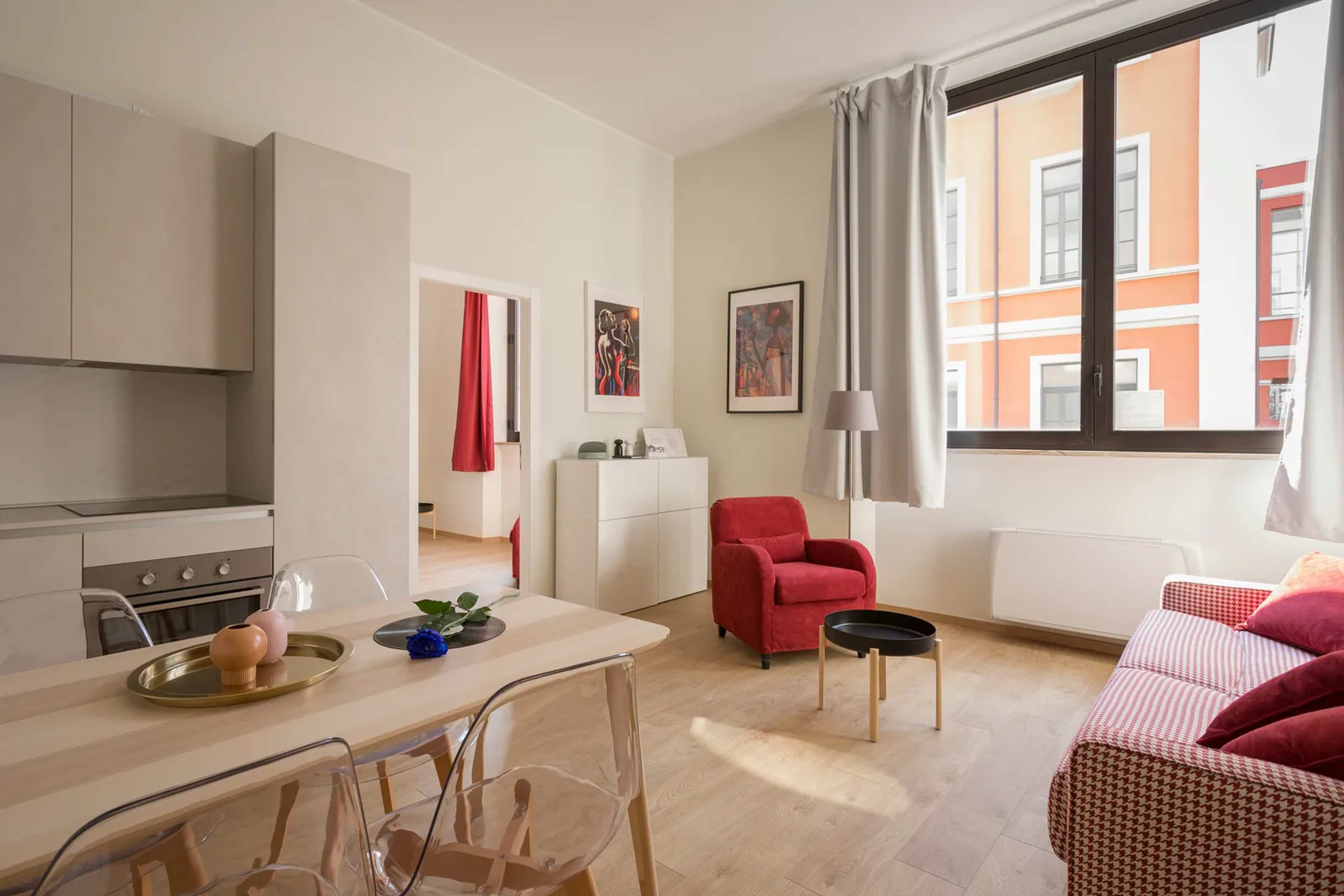
The menu is right there on the nightstand.
You haven’t touched it.
You’ve been awake since 4 AM, hungry, three floors above a city that doesn’t know your name.
And still – you won’t pick up the phone.
There’s a version of you that travels well. Moves through airports with quiet authority. Checks into rooms without flinching at the price tag. But here, alone in a room designed entirely for your comfort, something old and stubborn rises up. It whispers that this – all of this – is too much. That you haven’t done enough today to deserve the warm bread, the silver tray, the knock at the door.
That whisper has a history. It has a childhood address.
1. The Scarcity Blueprint

Before you were a traveler, you were a child watching how the adults around you handled having things.
And if those adults grew up in scarcity – or passed through it – they taught you something without meaning to.
They taught you that resources are finite. That comfort is a liability. That wanting too much is the first step toward losing everything.
The scarcity mindset can pass from generation to generation – parents who lived through economic hardship teach children to rely on spending as little as possible just to get by, and once that lesson is learned, it becomes extraordinarily difficult to shake, especially when it was absorbed during critical developmental periods in childhood.
The hotel room service menu, then, becomes a kind of test. A moment where the old programming either holds or breaks.
Most nights, it holds.
The menu stays closed. You eat a granola bar you packed from home. And something – some ancient, inherited reflex – feels quietly satisfied.
That satisfaction isn’t peace. It’s compliance.
2. The Worthiness Equation
There is a specific arithmetic that some of us learned as children.
Comfort = Work + Permission.
No shortcut. No grace. No being served simply because you are tired and far from home.
Studies suggest that individuals raised in environments of scarcity may develop an instinct to resist temptation in order to maintain survival, and thus exhibit greater resistance when faced with opportunities for indulgence.
This isn’t laziness. It isn’t cheapness in the conventional sense.
It is the body executing a childhood program it was never told to delete.
Research shows that wanting to do something is only a prerequisite for action – consumers must also feel worthy of doing it. A sense of worthiness, like “I’ve worked hard all day, I deserve a reward,” can act as a necessary form of justification.
The people who don’t call room service often aren’t saving money.
They’re saving themselves from feeling like a fraud.
3. The Childhood Room They Never Left
Every hotel room is also, in some way, a mirror.
It shows you how you treat yourself when no one is watching. When there are no performative sacrifices to make. When the only audience is the ceiling and the hum of the air conditioning unit.
Childhood emotional neglect happens when parents fail to respond sufficiently to a child’s emotions. Adults who were emotionally neglected in childhood can become quite perfectionistic and excessively hard on themselves.
The connection to room service avoidance is direct, even if it doesn’t look like it.
If your emotional needs were regularly minimized – if needing things was treated as inconvenient – then as an adult, you don’t stop needing. You just stop asking.
You find a granola bar. You make do. You are very good at making do.
When children receive the message from their parents that their feelings are a burden, excessive, or simply wrong, they take a highly effective, adaptive action – they naturally push their emotions down, under the surface, so that they will trouble no one.
Thirty years later, you still don’t want to trouble anyone.
Not even the kitchen. Not even for eggs.
4. The Performing Traveler
There is a version of travel that is entirely about identity management.
The person who overpacks to feel in control. The person who memorizes the local transit system before landing. The person who refuses room service because “real travelers” don’t do that – they eat street food, they are resourceful, they don’t need to be coddled.
But who wrote the rules for “real travelers”?
Today’s travelers seek more than just a place to stay – they seek an experience that aligns with their values and lifestyle. But for some, those values are not freely chosen. They were inherited. Installed. And they run quietly in the background, shaping every decision that feels like a personal preference but is actually an old instruction.
The refusal to use room service is often a performance of self-sufficiency.
And like all performances, it costs the performer the most.
The audience – the empty room, the untouched menu – doesn’t care either way.
5. The Anecdote at the Edge of the Bed
I have sat in a lot of hotel rooms with a lot of room service menus.
I have read them the way you read a letter you are deciding whether to open.
There was one room in particular – a Tuesday night, some conference city, the kind of beige anonymity that could be anywhere – where I spent forty minutes negotiating with myself over a bowl of pasta listed at a price I could easily afford.
I didn’t order it.
I told myself I wasn’t that hungry. I told myself I’d get something from the vending machine. I told myself a lot of things, and all of them were technically true and none of them were the real reason.
The scarcity mindset is often either a direct response to childhood experience or a pattern inherited from ancestral lineage – or both. Either way, being in survival mode once helped you or your ancestors survive and get to where you are today.
I thought about my mother, who would refold the aluminum foil to use it again. Who would have found a bowl of hotel pasta at that price genuinely alarming. Who loved me completely and also, quietly, taught me that being served was something that happened to other kinds of people.
I ate the vending machine crackers. I thought about identity. I didn’t sleep well.
6. The Architecture of Guilt
Guilt about indulgence doesn’t announce itself with a neon sign.
It arrives as practicality. As preference. As “I just don’t really feel like room service tonight.”
Guilt responses are tied to our mental models around spending – models that were often formed very early in life.
The guilt isn’t about the food. It’s about permission. It’s about whether you believe, at the deepest level, that you are someone who deserves to have things brought to them.
Misplaced guilt becomes deeply ingrained in character and follows individuals into adulthood, surfacing in various forms and situations.
In a hotel room, it surfaces as a closed menu. As a quick calculation of whether you “did enough” today to justify the expense. As a strange, sourceless discomfort with the idea of someone else carrying your food to your door.
Research confirms that consumers experience feelings of guilt when they choose indulgent or hedonic goods, due to their inability to resist the internal pressure to self-deny.
The guilt is real. The reason for the guilt, however, belongs to another time entirely.
7. The Temporary Permission Slip
Here is what hotels are designed to do, psychologically.
Management has gone far to please guests – hiring cleaners and designers, chefs and servers should the guest want room service, on a whim. The hotel and all its labor is set up, in some sense, as an act of hospitality waiting to be received.
The temporary nature of a hotel stay is supposed to grant a kind of permission. You are not at home. The usual rules don’t apply. You can be someone who orders the club sandwich at midnight.
But the people who grew up learning that comfort must be earned don’t find the temporary permission slip convincing.
You may have become highly successful at saving and delaying gratification – but “turning off” this aspect of your personality does not come easily. The attitudes and behaviors picked up from parents while growing up can also hold you back from enjoying yourself.
The hotel gives you the menu. Your childhood gives you the hesitation.
And in that gap between the two, you sit – full of a hunger you won’t name and a permission you won’t take.
8. The Self-Sufficiency Fortress
There is a specific pride that grows in people who were raised to need little.
It feels like strength. It presents as competence. It is, in many rooms and many contexts, genuinely useful.
But self-sufficiency becomes a fortress when it keeps out not just hardship, but softness.
For many people, survival-based scarcity mentality becomes a stress-based negative feedback loop, fueled by beliefs and past experiences rather than current reality. Instead of helping us survive, it keeps us from thriving.
In a hotel room, the fortress looks like this: You navigate an entire 14-hour travel day. You handle delays, lost luggage, a difficult meeting. You perform competence all day long. And then you arrive in a room where someone is literally paid to bring you dinner – and you decline.
Not because you don’t need it.
Because needing things still feels, somewhere in the architecture of your nervous system, like a failure of character.
It’s not you who has done something wrong. It’s your childhood that did something wrong.
9. The Identity Gap in Room 412
The traveler you are on the outside and the child you carry on the inside rarely travel at the same speed.
You can cover twelve time zones in a day. You can speak two languages, navigate three currencies, sleep on planes. You have become, by any external measure, a person of the world.
But the gap follows you through every boarding gate.
A compromised sense of entitlement involves an inability to expect the basic rights and comforts enjoyed by those around one. This isn’t arrogance in reverse – it’s a specific wound. The wound of a child who was taught, however subtly, however lovingly, that their comfort was a luxury the family couldn’t afford to indulge.
That child is now checking into a room that costs more per night than their parents made in a week. And still – still – they cannot pick up the phone.
The basic premise for scarcity thinking is the idea that there isn’t enough to go around. Whenever we have a feeling that either we or others are not good enough, or that there isn’t enough – time, money, love – to go around, it is a good indicator that we are in scarcity mode.
Room 412 sees all of it. The menu. The phone. The silence.
10. The Knock at the Door You Never Answered
Here is the heaviest truth.
The room service menu is not about food. It never was. It is a daily referendum on whether you believe you are the kind of person who deserves to be cared for without having to justify it first.
And for the people who grew up watching their parents reuse paper bags, who internalized the idea that softness was weakness, who learned that asking for things was a form of failure – the menu is a daily defeat before it’s ever opened.
Studies suggest that individuals raised in environments of scarcity may develop an instinct to resist temptation in order to maintain survival, and thus exhibit greater resistance when faced with opportunities for indulgence. The resistance is not rational. It does not respond to your current bank balance or your adult accomplishments. It responds to something older. Something that was written in you before you knew what “indulgence” meant.
When you pull the thread of this behavior back far enough, you almost always end up in childhood. Upbringing shapes how people come to believe they deserve what they do. And the people who never ordered room service as adults were often the children who were quietly, consistently taught that being served was a kind of moral extravagance – something you had to earn by suffering first, by sacrificing first, by proving first.
The proof never quite arrives. It never does. Because the bar was never real. It was a story. A very old one, told in the language of a household that was doing its best under the weight of its own limitations.
Some nights you will travel far enough and feel tired enough and honest enough that you will finally pick up the phone. You will order the thing on the menu that sounds good. You will wait for the knock. You will open the door to a stranger carrying a tray covered by a silver dome, and you will feel – briefly, quietly – something close to the permission you have been waiting for your whole life.
You didn’t have to earn it. You were just hungry. In a room. Far from home. And that was always enough.
The menu is still on the nightstand. It has always been yours.