The hotel room is quiet at midnight.
Your suitcase is still zipped.
The closet hangers are untouched. Perfectly spaced. Waiting.
You have been here three days.
There is a version of you who could unpack. Who could arrange things on the dresser, hang a shirt, slide a drawer open and make something small and temporary feel, just briefly, like yours. But you don’t. You never do. You tell yourself it’s practical. Efficient. That you’ll be gone by Thursday.
But Thursday isn’t really the point, is it?
The distance between who we perform ourselves to be and who we actually are becomes clear when the door clicks shut and the city noise fades below you. It is the distance between the self you show in motion and the self that sits in the corner of a beige room, surrounded by things it refuses to let go of. The self that stays zipped up.
1. The Nervous System Doesn’t Know You Checked In
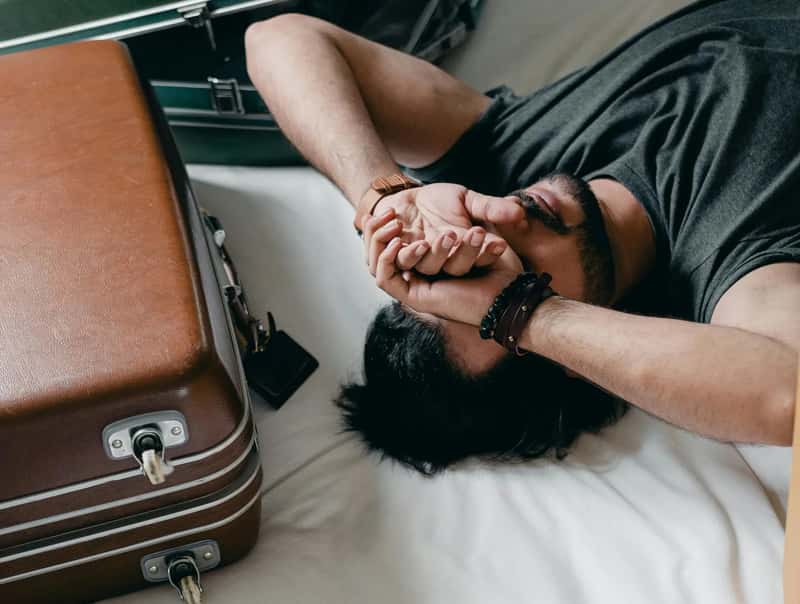
Here is what nobody tells you about the person who lives out of their suitcase.
Their body is not resting.
Their nervous system is running a quiet, exhausting background program – the same one it learned years ago, in a childhood bedroom that wasn’t always safe, in a house that moved too often, in a family that required constant monitoring. If your caregivers were inconsistent, if your home life was unstable, or if you faced constant uncertainty, your nervous system learned to be on high alert – and your sympathetic nervous system, responsible for the fight-or-flight response, keeps you in a state of constant readiness.
The suitcase stays packed because the body stays ready.
Not because of the flight on Thursday. Because of every moment in childhood when leaving had to happen fast. When security was never something you could count on staying.
Whether the cause was childhood trauma or a career in high-stress environments, the result is the same: your brain is stuck in “scan” mode. The hotel closet isn’t a closet. It is a commitment. And commitment, to a nervous system raised on instability, feels like a trap.
2. The Suitcase as Transitional Object
Psychoanalysts have a term for the objects we carry that carry us back.
They call them transitional objects.
According to psychoanalyst Christian Richomme, “the suitcase becomes a transitional object: it holds not just items, but also our securities, our temporary identities.” It provides comfort not because of what’s inside it, but because of what it represents. Control. Readiness. A self that can be gathered up and moved at a moment’s notice.
For people raised in unstable homes, that readiness was not neurotic. It was necessary.
The child who always had a bag half-packed learned something that child in the stable house never did: that safety is not a given. That roots can be pulled. That the ground beneath your feet is not always going to hold.
As Richomme explains, an overpacked suitcase “may symbolize a fear of facing emptiness, of scarcity, or an inability to make choices.” The suitcase you refuse to unpack isn’t disorganized. It is defended.
3. The Architecture of Avoidance
Refusing to use the hotel closet is not a quirk.
It is a structure.
Adverse experiences during childhood leave a lasting imprint on the developing brain and nervous system. When a child grows up in an unsafe environment, their brain adapts to prioritize survival, often at the expense of long-term well-being – a process that can lead to hypervigilance, a state of being constantly on guard for potential threats.
What does hypervigilance look like in a Marriott on a Tuesday evening?
It looks like knowing exactly where the door is. It looks like shoes left on, not tucked away. It looks like a suitcase positioned close – not because you are messy, but because you are, subconsciously, always ready to move.
Always sitting near exits in public spaces. Avoiding large crowds or busy environments. Constant checking behaviors – these are classic expressions of a hypervigilant nervous system that never fully powered down.
The hotel closet is just the exit nearest to your past.
4. Packing for Fear, Not for Need
There is a profound and painful irony in how people raised on instability pack.
They pack everything.
Psychologists and travel experts suggest that the persistence of overpacking has more to do with psychology than logistics. Anxiety, attachment, and past experiences all play a role. The “just in case” shirt. The extra pair of shoes. The medication that expired two years ago but cannot be left behind. Every redundancy is a memory of a time when there wasn’t enough. When things ran out. When you were caught unprepared.
Fear of forgetting something essential, attachment to comforts from home, and unpredictability often lead travelers to pack more than they realistically need.
But there is something even darker beneath the over-prepared suitcase. It is not really about the shirts. It is about the child who learned that you could not trust the world to provide what you needed. So you carry it all yourself. Always. Everywhere.
The weight of that bag is not luggage. It is history.
5. The Exit Strategy
I want to pause here. I want to tell you something I have never framed as psychology, only as habit.
For years, I traveled for work. Long stays. Nice hotels. Rooms that other people clearly enjoyed – rooms with good light and deep bathtubs and closets wide enough to feel generous. I never used them. My suitcase lived on the luggage rack like a second self. Open. Accessible. Ready.
I told myself I was practical. Efficient. That unpacking for three nights was performative.
What I was actually doing was keeping an exit strategy. Not from the hotel. From the feeling of being somewhere. From the dangerous act of settling in. Because settling in meant something could shift and uproot you. It meant you had something to lose. And something to lose meant pain was possible.
Living through repeated unpredictability in childhood can make it harder to use coping responses effectively. Instead, you might find yourself “stuck” in one mode, coping with conflict and challenges just as you coped in childhood: favoring the response that best served your needs by helping you escape further harm.
My exit strategy was not a suitcase. It was a survival reflex wearing a carry-on.
6. The Identity Gap and the Temporary Room
Here is what a hotel room is, stripped of its minibar and its throw pillows.
It is a test.
There is something psychologically destabilizing about living out of a suitcase for days on end. Your objects are compressed, folded against each other, stripped of context. Your favorite shirt is just fabric in a dark cylinder. Your journal is just paper under pressure. Nothing has its relationship to space. Nothing has its meaning.
For people whose identity was never given stable ground to grow in, this isn’t just uncomfortable. It is familiar. It is the emotional texture of their entire childhood. Compressed. Context-free. Stripped of meaning.
The psychology of place posits that individuals require a “good enough” environment in which to live, and they are linked to that environment through three key psychological processes: attachment, familiarity, and identity.
The person living out of their suitcase in Room 412 was never given a “good enough” environment to practice those processes. So they skipped them. They skipped them every time they checked in. And every time they checked out, they told themselves that’s just how they are.
7. The Wiring Runs Deeper Than You Think
This is not a metaphor.
The neuroscience is literal.
When experiences of maltreatment dominate, neural connections related to threat perception and response are strengthened relative to other connections, resulting in a brain that is “hardwired” to expect threat.
The amygdala, often referred to as the brain’s “fear center,” can become hyperactive, sending out alarm signals more readily. Conversely, the prefrontal cortex, responsible for executive functions like impulse control and reasoned decision-making, can be less engaged, making it harder to discern real threats from perceived ones.
In the context of a hotel closet, this means the threat of hanging up a suit is processed, somewhere deep and automatic, with the same architecture as actual danger. Your rational mind says: use the closet. Your amygdala says: stay ready. The amygdala has been running this program since you were seven. It does not lose arguments easily.
While the fight-or-flight system is healthy in short bursts, chronic exposure to stress causes it to remain active. For children exposed to ongoing trauma, this heightened state of alertness becomes their baseline, leading to heightened alertness even in safe environments.
The hotel is safe. Your history is not.
8. The Permanence Problem
There is a specific kind of grief that comes with impermanence.
Not grief for a lost thing. Grief for a never-had thing.
Some individuals thrive in this fluidity, constructing flexible identities that draw from multiple places – they feel at home in several cities. Others struggle with a persistent sense of displacement, especially when they leave behind places that were central to their self-concept.
The person who refuses to unpack has often never had a central place. Never had a room that stayed theirs. Never had a home that didn’t eventually dissolve, move, shatter, or get quietly taken apart while they were at school one Tuesday.
The Permanence Seeker unpacks not because they are naive about the checkout date, but because they need the fiction of rootedness to function. They need, even briefly, even falsely, to live as if this room is theirs.
But their opposite – the person who never unpacks – needs something else entirely. They need the fiction of movement. Because movement, to them, is the only form of safety they ever fully understood.
9. Attachment Avoidance and the Closet You Won’t Open
Attachment theory has a lot to say about suitcases, if you listen carefully enough.
Individuals with avoidant attachment are characterized by a high level of attachment avoidance. They often have difficulty with emotional intimacy and prioritize their independence. They are reserved when it comes to sharing their emotions and vulnerabilities. They tend to have a strong desire to maintain their personal space and may become uncomfortable when others get too close.
Now replace “others” with “a place.” Replace “too close” with “too settled.”
Avoidant individuals tend to have a fear of dependence and will distance themselves from their partner as a way to cope with perceived threats to their independence. They believe that others will eventually abandon and reject them, so they may react by withdrawing emotionally or physically when they feel too close to someone.
Apply that to geography. Apply it to a zip code. Apply it to a hotel room on the fourteenth floor with a very good view and a very unused closet.
The withdrawal isn’t rudeness. It isn’t minimalism. It is a love language written in the grammar of loss – spoken fluently by people who were taught, early and often, that nothing stays.
10. The Soft Architecture of Healing
Here is the hardest thing to say about the person who won’t unpack.
They are not broken. They are brilliant.
Hypervigilance and periods of shutdown may have helped a child detect danger early, endure what could not be avoided, and remain as safe as possible in an unsafe environment. These responses are not learned consciously. They develop automatically through repeated exposure to threat and the absence of reliable protection. From this perspective, many of the patterns adults struggle with today began as intelligent coping mechanisms for very difficult childhood circumstances.
The suitcase was never dysfunction. It was engineering. Brilliant, exhausting, survival-grade engineering built by a child who had no other tools.
But here is the quiet truth that sits beneath that brilliance.
The challenge is that nervous system responses learned in childhood often persist into adulthood, even when the original danger is no longer present. As adults, people who experienced developmental trauma may find that their bodies still react as though threat is imminent – flipping into hyperarousal during conflict or stress, or into hypoarousal when situations feel overwhelming.
Nervous systems are capable of change across the lifespan. Responses that developed in childhood are not fixed traits, even though they can feel deeply ingrained. The closet can be opened. The hanger can be used. Not because it changes anything practical. But because one small act of settling – one deliberate, chosen moment of staying – tells the nervous system something it has waited decades to hear.
We are not leaving tonight. We are safe here. Just for now, we can put the bag down.
The hotel room will forget you by checkout. The housekeeping staff will erase every trace of your presence with a fresh set of sheets and a recycled toiletry kit. The room does not care whether you hung your clothes or lived out of a bag for five days. It has seen both. It judges neither.
But you will carry the choice with you. Not the choice about the closet. The deeper choice – the one about whether you are willing to acknowledge that the constant readiness, the packed bag, the subtle refusal to arrive anywhere fully, costs something. The fluidity of living out of a suitcase reveals unrest. The ugly side of adventure is its uncertainty and variability, the shifting of tides that could be confusing and perilous. The cost is not paid in wrinkled shirts. It is paid in the chronic, low-grade exhaustion of a nervous system that never got the message that the war ended.
Somewhere, right now, there is a person in a hotel room – a good hotel, a comfortable bed, a city with good weather and no particular threats – who cannot bring themselves to open the closet door. And they are not dramatic, or difficult, or avoidant in some clinical, cold sense of that word. They are someone who learned that home was not a safe place. That staying meant getting hurt. That the door had to stay propped open, always, just in case. If that person is you – if you recognize yourself in the zipped bag and the untouched hangers – then know this: the door you’re afraid to open isn’t the closet. It’s the one that leads back to yourself, standing in a childhood hallway, learning for the first time that nothing was going to stay. That door was never supposed to stay locked forever. You just needed someone to tell you it was finally safe to try the handle.