You booked the flight.
Not because of the history.
Not because of the photographs.
Because something in you needed to stand in front of something that had collapsed and was still standing.
There is a gap between who you perform yourself to be and who you actually are at 2 AM when the apartment is quiet and the ceiling feels too low. The traveler who books tickets to Machu Picchu or the Roman Forum isn’t running toward history. They are chasing permission. Permission to believe that something can be utterly abandoned and still be radiant. The identity you carry through airports, through departure lounges, through dusty temples and broken colonnades – it is not the identity you were handed. It is the identity you are still, quietly, negotiating.
1. The Ruinenlust Confession
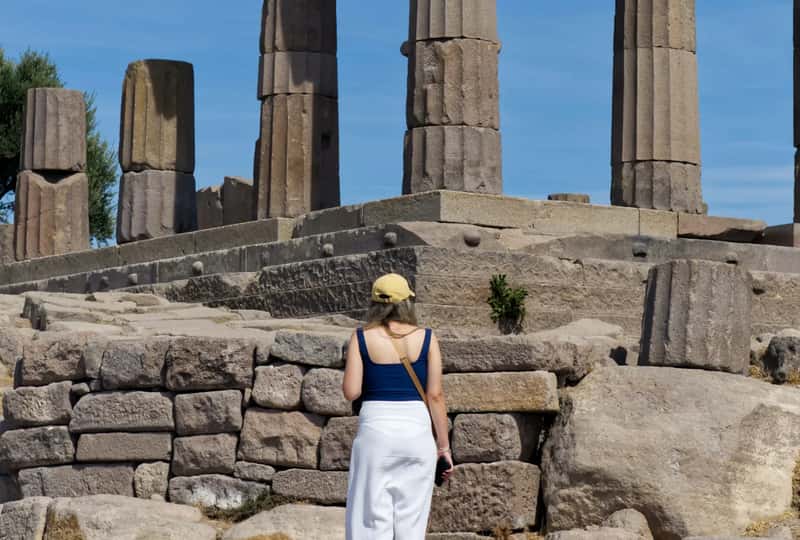
There is a German word for this ache.
Ruinenlust. The compulsive, aching desire to seek out what has fallen apart. And it is not a quirk. It is not a personality type or a niche travel trend. It is a confession.
A confession that the broken thing still has something to say to you.
That you still want to hear it.
The modern world deals in new. Faster. Shinier. Updated. The person who turns away from that gleaming current and points their compass toward crumbled stone is making a statement about value – about what deserves attention. It is a belief system. A quiet revolt against the modern world’s insistence that only new things have value. Every cracked pillar is a vote against obsolescence. Every weed growing through ancient marble is proof that life persists in the unlikeliest corners. The ruins traveler isn’t nostalgic. They are, in the truest sense, radical.
2. The Mortality Mirror
You didn’t come here to think about death.
And yet.
Psychologists suggest our fascination with ruins taps into deep-seated emotions about mortality, memory, and the impermanence of human achievement. The stone arch that has outlasted every emperor who commissioned it. The mosaic floor that has held more footsteps than any one civilization could count. These are not just objects. They are arguments.
Arguments that things end. That endings are not erasures.
Research investigated the influence of mortality anxiety on heritage tourism preference, and found that as individuals’ general mortality anxiety increases, their tendency to search for meaning in life increases, which fosters their heritage travel preference. We don’t visit ruins despite thinking about death. We visit them because thinking about death is the only honest thing left to do. Standing in the shadow of something ancient and broken is the closest most of us will ever get to a genuine reckoning with our own impermanence. It is terrifying. It is also a relief.
3. The Identity Gap
Who are you when everything familiar is stripped away?
No job title. No neighborhood. No furniture.
The identity gap is the space between who you were supposed to become and who you actually are. Ruins don’t judge that gap. They inhabit it. The ancient ruin is, psychologically, the most non-judgmental space a human being can enter. It asks nothing of you. It holds no expectation. It has already survived its own undoing, which means it has no anxiety about yours.
The modern city watches you perform. The ruin just watches.
In contemporary times, international travel is closely linked to heritage, driven by tourists seeking a sense of security in the past amidst global uncertainties and expressing identity through historical connections. The self you bring to the ruins is not the self you take to the office. It is quieter. More honest. More afraid, and more willing to be afraid. That is not weakness. That is the beginning of something true.
4. The Wabi-Sabi Stance
The West has a word for beautiful things.
It doesn’t have a word for beautiful broken things.
Psychologists call it ruin aesthetic, a subset of nostalgia and wabi-sabi – the Japanese worldview that honors imperfection and transience. Wabi-sabi doesn’t grieve the crack in the wall. It studies it. It finds in that crack the evidence of something having lived, having been tested, having endured. The person who seeks out ruins is, consciously or not, practicing wabi-sabi in the field. They are looking at a thing that has been through something – fire, flood, neglect, time – and finding it more beautiful for the ordeal.
This is not sentimentality. This is survival logic.
If the broken wall can be beautiful, the broken self can be beautiful. If the collapsed civilization still commands attention across two thousand years, then the version of you that fell apart last winter doesn’t have to disappear. It just has to weather. The ruins traveler is, without perhaps knowing it, developing a philosophy of self-worth that the modern world refuses to sell them.
5. The Place That Recognized Me
I was in Rome the year I stopped knowing who I was.
Not a dramatic collapse. A slow, quiet one. The kind that happens when you’ve been performing a version of yourself for so long that you forget what the original looked like.
I stood in the Forum at dusk, when most of the tourists had gone and the light came in at that brutal, amber angle that makes everything look like it’s already a memory. I expected to feel small. I expected history to dwarf me. Instead – and I am still reaching for the right word – I felt recognized. I expected to feel like a trespasser. Instead, I felt recognized. Not by the building. By myself. The ruin didn’t fix anything. But it held space for the unfixed version of me without flinching. That, it turns out, is a rare and radical act.
6. The Archaeologist of the Self
You are not just a tourist.
You are an excavation.
The ruin-seeker is not a tourist. They are an archaeologist of the self. Every cracked tile speaks to a version of something that once held together. Every collapsed wall is a referendum on permanence. And somewhere in the act of walking through it all – carefully, reverently – the explorer begins to take inventory. Of their own load-bearing walls. Of the rooms in themselves they have boarded up and stopped visiting.
That is the real fieldwork.
The dust on your boots is just evidence. The reckoning is internal. The person who walks through Angkor Wat in the early morning mist, alone, is not sightseeing. They are auditing. Taking stock of which parts of themselves have been maintained, which parts are overgrown, and which parts – surprisingly, quietly – are still structurally sound. Heritage tourism satisfies the tourists’ desire to understand destination histories, participate in cultural experiences, and pursue authenticity. But the deeper authenticity being pursued is their own.
7. The Open Ending
Modern life delivers conclusions.
Algorithms tell you what to watch next. Notifications tell you what to care about. Everything arrives pre-interpreted, pre-digested, pre-concluded.
The ruin refuses that logic entirely.
In a world where most information arrives pre-digested and pre-concluded, the ruin offers the radical luxury of the open ending. You get to finish the story. You get to choose what it means. That is, quietly, an act of profound psychological autonomy. The mind that stands before broken columns and asks “what happened here?” is a mind practicing the most endangered of cognitive habits: independent meaning-making. When people visit these sites, they instinctively try to fill in the missing story. The mind doesn’t tolerate blank spaces. It searches for narrative, for reason, for meaning. And when no clear explanation is available, imagination becomes its own historian. In that gap between question and answer, the self gets room to breathe.
8. The Permission Slip
You don’t have to be functional to still be worth something.
Read that again. Slowly.
These spaces demand nothing from us while offering everything – a chance to see time made visible, to feel the pull of absence as strongly as presence, to let our minds build what our hands cannot. In their brokenness, ruins become more generous than any complete structure could be. They give us room to imagine, permission to linger, and proof that even after everything falls away, meaning endures in the fragments.
That is the permission slip the ruin writes for you.
You carry it home in your chest, not in your luggage. The modern world, obsessed with optimization and output and relentless forward motion, has no patience for the person who is in the middle of falling apart. The ruins have infinite patience. They have been mid-collapse for centuries and they still command entire plane tickets, entire pilgrimages. If that isn’t proof that falling apart doesn’t disqualify you from being worthy of attention, nothing is.
9. The Recalibration
You don’t return from the ruins the same.
Not broken. Not healed. Recalibrated.
Dark tourism makes a different demand. It asks you to sit with discomfort. To acknowledge that the world contains endings. That human effort is not always rewarded with permanence. And in that sitting – in that deliberate, chosen discomfort – something in the psyche reorganizes itself. Slightly. Permanently.
The recalibration is not dramatic. It rarely announces itself.
Through stress reduction, resilience building, and the cultivation of awe, travel creates emotional transformations that persist long after the journey ends. These changes don’t just make us happier travelers – they make us more emotionally honest, more tolerant of ambiguity, more capable of sitting in the unresolved. The person who stands in the ruins and does not flinch at the evidence of collapse is practicing a kind of psychological courage that the clean, bright, optimized world cannot teach.
10. The Broken Self That Still Holds
Here is the heaviest truth.
You didn’t fly to the ruins to see history.
You flew there to see yourself.
The traveler who returns from the ruins does not come back with souvenirs. They come back with something more durable. A recalibration. A quiet renegotiation with the parts of themselves they had marked for demolition. The parts that felt too damaged to save. Too weathered to justify. Too far gone to deserve the kind of attention that still-standing, still-functioning things receive.
The ruins disagree.
The broken self, it turns out, has the same structural logic as the broken wall. It holds. It weathers. It becomes, with enough light hitting it at the right angle, something worth crossing an ocean to see. Ultimately, ruins serve beautifully as a memento mori. They remind us that, just as all other things are impermanent, so are we. And that impermanence, far from being a sentence, is a form of freedom. Nothing permanent was ever truly alive. Everything that has mattered – every love, every civilization, every version of a self – has been subject to erosion. That is not failure. That is the price of having been real.
There is a particular quality of light that only exists inside ruins. It is the light that gets in through the parts that have fallen away. It is not the clean, controlled light of an intact structure. It is accidental light. Unplanned. Arriving at angles the original architect never intended. And it is, without exception, the most beautiful light in the world – precisely because it was never supposed to be there.
The person who chases ruins is chasing that light. Not the light of something whole and finished and safe, but the light that only becomes possible after the collapse. The light that proves something was there. That it mattered. That even in its most broken state, it was still generating something the intact world could not.
You are the ruin. You are also the light getting in.