The trail ends at a wooden door.
No signal. No neighbors. Just the sound of wind moving through something that doesn’t care about you.
You chose this.
You booked it months ago, told everyone you needed a break, packed light, and drove until the road ran out.
But here is the thing nobody says out loud: the silence you were chasing wasn’t out there. It was the one you’ve been carrying since you were eight years old. You’ve been calling it “needing space.” Loneliness, at its clinical core, is a subjective feeling of being isolated – and it arises from a discrepancy between desired versus actual levels of social connection. That discrepancy doesn’t dissolve when you pack a bag. It follows you up the mountain.
The Childhood Blueprint
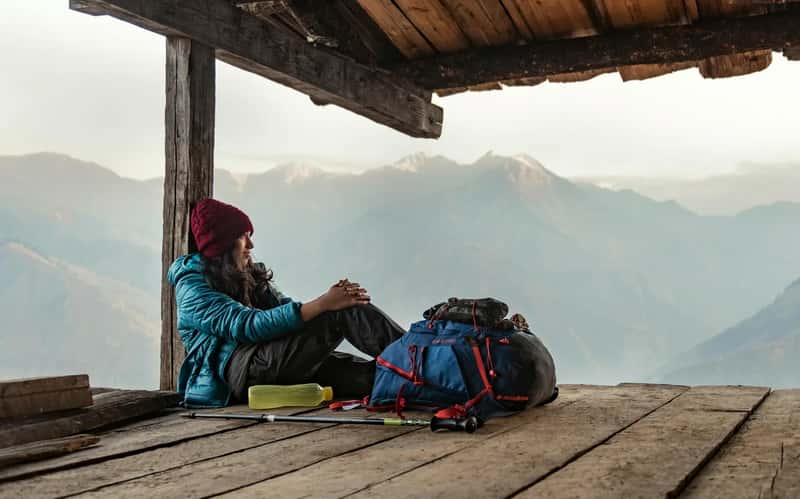
Before you ever booked that remote hut, something was already written into you.
A blueprint. Invisible. Architectural.
It was written in early rooms – kitchens that felt too quiet, bedrooms where comfort didn’t come when you needed it.
Avoidant attachment typically originates from early childhood interactions with primary caregivers. When caregivers are consistently unresponsive or dismissive of a child’s emotional needs, the child learns to suppress those needs and avoid seeking closeness. This coping mechanism can become a stable pattern into adulthood.
That pattern is not a character flaw. It is architecture.
And architecture, once built, shapes every room you walk into – including the ones you build for yourself in the middle of nowhere.
The hut at the end of the trail isn’t escape. It’s the blueprint made physical. It’s the child’s bedroom – finally on your own terms.
The Defense Mechanism in Hiking Boots
We have dressed up withdrawal in the language of wellness.
We call it a “digital detox.” A “reset.” A “solo adventure.”
We give it a hashtag and a Pinterest aesthetic – bare wood, wool blankets, steam rising from a coffee cup at dawn.
But the psychology underneath is older and less photogenic.
Psychologists recognize that isolation can be a defense mechanism, where individuals withdraw due to feelings of inadequacy or fear of judgment.
The fear of judgment is quieter out there. That’s the relief you feel when you arrive.
It isn’t peace exactly. It’s the temporary suspension of the social performance. The exhaustion of pretending to be someone who fits – and the sweet, dangerous relief of a place where no one is watching.
That relief is real. But relief is not healing. And this is the distinction that costs people years.
The Chronic Signal
Here is what the body is actually doing when you crave the remote and the unreachable.
It is sending a signal. A very old, very biological signal.
Researchers have posited that loneliness is the social equivalent of physical pain, hunger, and thirst – the pain of social disconnection and the hunger and thirst for social connection motivating the maintenance and formation of social connections necessary for survival.
But for some of us, that signal has been misfiring for so long we’ve stopped reading it correctly.
For as many as 15 to 30 percent of the general population, loneliness is a chronic state.
When loneliness is chronic, the nervous system stops interpreting it as an alarm. It begins to interpret it as a baseline. As normal. As home.
And you start building your life to match it. Including booking the most remote accommodation you can find and calling it a holiday.
The Identity Gap
There is the version of you that exists in other people’s perception.
Competent. Low-maintenance. Comfortable alone. Fine.
Then there is the version of you that knows exactly how long you’ve felt like a guest in every room you’ve ever entered – including your own life.
Loneliness is when we feel our separateness as human beings. We feel trapped inside our mental space, in separation from other human beings, and from a world that appears to be “out there.”
The identity gap is the distance between those two versions.
When you go to a remote hut, something interesting happens in that gap. The social self – the performing self – has nowhere to perform. It goes quiet. And the other one surfaces.
Some people call that clarity. Some people call it terror. Most people experience both, on alternating afternoons, with no warning at all.
The First-Person Detour
I want to stop here for a moment.
I have sat in a wooden cabin at the edge of a forest with no working phone and a journal I couldn’t bring myself to open. I told everyone I was recharging. I told myself I was processing.
What I was actually doing was conducting an experiment: could I feel at peace in the very condition – aloneness – that had shadowed me since childhood? Could I validate the loneliness by choosing it? Could I make it mine?
The answer, for three days, was mostly no.
On the fourth day, something shifted. Not because the isolation healed me. But because I finally stopped running from what the silence was saying.
Left without distractions, we may be forced to confront unmet needs, emotional injuries, or the vast space between the life we are living and the one we long for.
That confrontation is the real reason we go. Even when we don’t know it yet.
The Avoidant Geography
Some people don’t just visit remote places. They migrate toward them.
They make life choices – careers, relationships, geography – that keep a buffer of distance between themselves and the thing they most want: genuine connection.
The very strategies that are meant to protect people with avoidant attachment from rejection also create a profound sense of isolation. When you habitually keep people at arm’s length and minimize emotional connection, loneliness is inevitable.
The remote hut is the purest expression of this geography.
It is a place you cannot be rejected. A place where no one can leave, because no one ever arrived.
The tragedy is that it often feels like the most honest place in the world. And in a sense, it is. It is the honest architecture of a life organized around protecting a wound.
The Validation Loop
There is a psychological mechanism at work in the extreme isolation seeker that rarely gets named.
Validation-seeking. But not the social kind.
This is internal validation. The need to confirm what you already feel – that you are, fundamentally, alone. That isolation is your natural state. That the distance between you and others is not a wound but a fact.
People who believe that satisfying relationships are unavailable to them, or who anticipate rejection when they seek connection, may find that aloneness activates these painful beliefs. What might be neutral solitude for a person with secure attachment becomes loneliness-tinged for someone with chronic fears of abandonment or unworthiness.
Choosing the hut confirms the belief. The belief makes the hut feel necessary. The loop closes.
And every time it closes, it gets a little harder to open. The walls get a little thicker. The trail back to other people gets a little more overgrown.
The Neuroscience of Chosen Distance
The brain of a chronically lonely person is not the same brain as the one that chooses solitude from a place of security.
The wiring is different. The threat detection is different. The very way the social world is perceived is different.
The loneliness-linked neurobiological profiles converge on a collection of brain regions known as the default mode network. This higher associative network shows more consistent loneliness associations in grey matter volume than other cortical brain networks. Lonely individuals display stronger functional communication in the default network and greater microstructural integrity of its fornix pathway. The findings fit with the possibility that the up-regulation of these neural circuits supports mentalizing, reminiscence, and imagination to fill the social void.
In other words, when the chronically lonely person sits alone in a mountain hut, their brain is not resting.
It is working. Hard. Constructing social contact from memory and imagination. Running simulations of connection that never quite satisfy. The silence outside is not matched by silence inside.
The Difference Between Solitude and Exile
There is a solitude that heals. And there is a solitude that confirms exile.
They can look identical from the outside. Same hut. Same mountain. Same Instagram photo at golden hour.
What transforms aloneness into either loneliness or solitude is entirely internal – the meaning we assign, the feelings that arise, and the degree to which our actual social life matches what we need.
The person who chooses solitude from fullness returns to the world refreshed. The person who chooses isolation from an old wound returns exactly as they left – perhaps with a better Instagram grid, but carrying the same quiet ache in the chest.
Solitude becomes distressing when we haven’t yet developed the internal scaffolding to hold ourselves through it.
Developing that scaffolding is the real work. Not the booking. Not the trail. Not the carefully packed notebook you may or may not open.
The Heaviest Truth: You Were Never Looking for a Place. You Were Looking for Permission.
Permission to feel what you’ve always felt.
Permission to be the person who was always a little outside of it – outside the warmth, outside the easy belonging, outside the rooms where people seemed to know how to simply be with each other.
Early experiences saturated with insecure attachment patterns not only make it impossible to perceive closeness, depth, and intimacy in adult relationships with others but may actually lead to the frustration of the sense of belonging and to a subjective feeling of separation from others – namely, to loneliness.
The remote hut is a pilgrimage to that feeling.
You strip away every distraction – the noise, the obligations, the performance of being a person who has it together – and you arrive at the core truth of yourself: that you have felt, in some fundamental register, alone since before you had words for it.
And standing in that recognition, in the thin mountain air, with no signal and no audience, something shifts. Not because the loneliness disappears. But because you finally stop treating it as a secret. You stop hiding it inside productivity and travel and the mythology of independence. This kind of loneliness is not evidence of failure – it is often a sign of emotional movement, a transitional state between identities and ways of being. There are also forms of necessary loneliness – the kind that emerges after a rupture or a confrontation with truth. These periods of loneliness are initiatory. They strip away the familiar, not to punish us, but to prepare us.
The danger is not going to the hut. The danger is leaving without ever asking why you needed to go in the first place. The core of avoidant attachment is emotional suppression – the persistent habit of pushing down your needs and managing everything by yourself. But emotional suppression doesn’t make emotions disappear. It just buries them. The trail, the hut, the silence – none of them bury anything. They excavate. If you let them.
The most radical thing a chronically lonely person can do is not find a more remote mountain. It is to sit with the loneliness, in whatever room they are already in, and finally introduce themselves to it – not as an enemy to be outrun, but as the oldest and most honest part of who they are. Not the whole story. Just the beginning of one that, finally, tells the truth.
The door of the hut opens inward.