The map says you are here.
But you’re not sure you believe it.
You drove three hours to stand in a town that stopped existing before you were born.
There is peeling paint on a door that leads to nowhere. And somehow, it feels like home.
We move through our lives performing competence. We curate our feeds, our offices, our conversations. We present the finished version – the renovated interior, the tidy narrative. But there is another version. The one we locked up. The one we walked away from. The one we haven’t visited in years. The identity gap – the cavernous distance between the person we advertise and the person who still sits in the dark – doesn’t disappear just because we stop looking. It waits. And sometimes, it finds us in a ghost town at noon, when the dust settles and the silence is too honest.
1. The Ruined Mirror
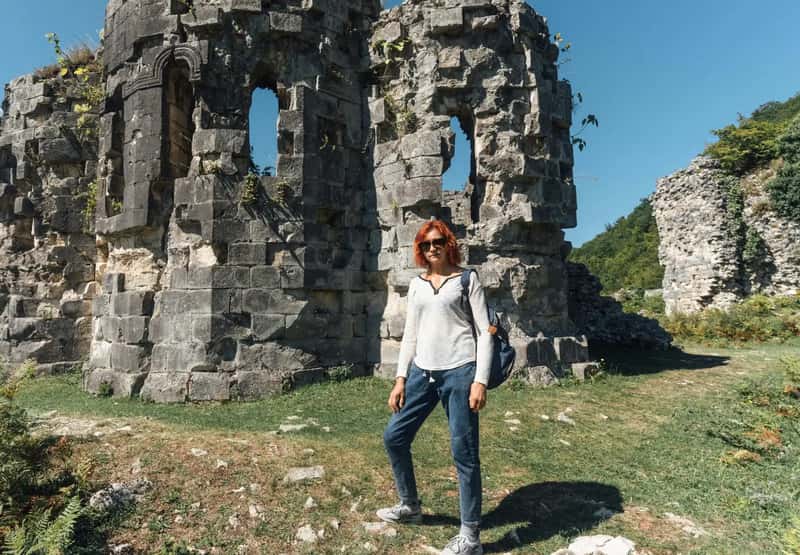
There is a German word for it. Ruinenlust.
Ruinenlust literally translates as “ruin-lust” – the pleasure or fascination derived from viewing ruins. The term captures a complex emotional duality: the sadness of witnessing decay mixed with the sublime pleasure of feeling time pass.
But here’s what the dictionary won’t tell you.
The ruin you’re looking at isn’t just a building.
Ruins capture our imagination, mysterious, full of hints of the past and futures’ potential. In a world that struggles to protect and decipher its logic, ruins put up an obscure mirror. They are illogical, dysfunctional, and disorderly; they expose mankind’s faults and shortcomings.
That mirror is aimed directly at you.
The crumbling facade isn’t just architecture. It’s every version of yourself you’ve refused to acknowledge. The abandoned room isn’t just a room. It’s the conversation you never finished. The life you partially lived. Ruinenlust challenges us to see not just failure but allegory – to recognize that in the crumbling concrete lies a potent mirror reflecting our anxieties about memory, permanence, and the political cost of the accelerated life.
You came for the aesthetics. You stayed for the reckoning.
2. The Sensation Seeker’s Real Agenda
Psychology has a clinical name for people who seek out edge experiences.
This drive is related to the psychological concept of sensation seeking – a personality trait characterized by a desire for novel, complex, and intense experiences.
But sensation seeking is rarely just about adrenaline.
It’s about permission.
In the ordinary world, there are rules about how much of yourself you’re allowed to reveal. In an abandoned building, those rules collapse along with the ceiling plaster. Higher openness to experience, preference for solitude, artistic temperament, and sensation-seeking all correlate with attraction to abandoned places. These aren’t random traits. They are the traits of people who feel too large for their current container.
The ghost town gives them room.
Room to be unfinished. Room to be uncertain. Room to stand inside a metaphor and let it breathe on them. Urban exploration offers a form of escapism from the monotony of everyday life. It allows individuals to step outside their comfort zones, confront their fears, and push their limits. What the research doesn’t say, but what every ruin-seeker already knows, is that the limit they’re confronting is most often an internal one.
3. The Frozen Clock and the Unfrozen Self
Something strange happens inside abandoned spaces.
Time doesn’t just slow. It splits.
One reason people flock to deserted sites is the eerie sensation of experiencing two timelines at once. The present day collides with the lingering echoes of the past. You might be dressed in modern clothes, but the walls around you witnessed events dating back decades, sometimes centuries. Bricks that once sheltered families or workers in a vastly different era now stand silent and broken, yet somehow still alive with memory.
That temporal collision does something neurologically profound.
It interrupts your current narrative long enough for another one to surface. The self you’ve been performing gets momentarily suspended. And in the gap, the older self – the one who wanted different things, who dreamed differently, who was hurt and never healed – walks back into the room.
Ruins help us imagine the past, afford us interesting aesthetic opportunities in the present, and ask us to project ourselves into the future. We think about those who once lived, our own current experience, and what will be. In standing between those three timelines, you become temporarily unstuck from the version of yourself you’re most tired of.
4. The Dopamine of Discovery
There’s a neurological seduction happening in these places.
Your brain is being rewired in real time.
Abandoned spaces offer unpredictability, hidden details, and opportunities for discovery. The brain’s novelty-seeking circuits – dopamine-driven – reward exploration. For many people this feels like a low-stakes puzzle: mapping a place, imagining past uses, and finding visual fragments that tell a story.
But the story being told is not just the building’s.
In psychology, interest is described as a positive emotional drive that compels us to seek information, solve riddles, and uncover hidden truths. Abandoned sites practically drip with half-told tales. The peeling wallpaper, the scattered papers on the floor, or the rusted machinery each raise silent questions.
Who lived here? What were their dreams? Why did they leave?
These are not questions about the building. These are the questions about yourself that you drove three hours to ask. The ruin is just the safest place you could think of to finally ask them.
5. The Personal Archaeology
I’ll tell you something I rarely admit.
I once spent an entire afternoon in a decommissioned textile mill in a town no one had mapped correctly. There were no other people. The light came through broken skylights in cathedral columns. My phone had no signal. And I sat on a collapsed beam and cried – not for the building, but for a version of myself I had been systematically abandoning for about a decade.
I had been efficient about it. Professional. Quiet. I had renovated my interior so thoroughly that I’d bricked over the rooms I didn’t want anyone to see. The mill didn’t judge those rooms. It had its own bricked-over sections. And somehow, that symmetry cracked something open.
Like Piranesi’s figures, we wander among the fragments and eroded inscriptions of the past in an attempt to access its mysteries. We follow traces of memory and discover that memory itself is in a state of continuous decay – that we are our own ruins.
We are our own ruins. Read that again. Let it sit with you for a moment in the quiet.
6. The Uncanny and the Repressed Interior
Freud had a word for the feeling that stalks you inside abandoned places.
Unheimlich. The uncanny.
Sigmund Freud sought to discover the identity of this unknown presence. As the pioneer of psychoanalysis, Freud attempted to map the “corridors” and “recesses” of the mind in a manner analogous to an urban geographer who surveys the physical terrains of towns and cities. His psychological approach can uncover important features of the places we use and inhabit – not least, places that have become uncanny.
The uncanny feeling in abandoned places is recognition.
It is the sensation of meeting something familiar that you had convinced yourself was gone. The uncanny displaces us, but it does so for good reason. The disclosure of neglected and repressed aspects of ourselves can enlarge and enrich our attitudes to life, and it can even overcome unhelpful prejudices that we had, till then, upheld.
The ghost town doesn’t haunt you.
The parts of yourself you abandoned in it do.
7. The Nostalgia That Isn’t Yours
Here is the subtle paradox.
You can feel nostalgia for places you’ve never been. For lives you never lived. For a version of yourself that technically never existed.
The evidence shows that someone who experiences historical nostalgia might even have an emotional attachment to or longing for times in history that predate their own birth. That is very different from personal nostalgia.
And yet it lands in the body as grief.
Nostalgia, by motivating us to remember the past in our own life, helps to unite us to that authentic self and remind us of who we have been and then compare that to who we feel we are today. That gives us a sense of who we want to be down the road in the future.
In a ghost town, you’re not mourning the town. You’re mourning the unlived life. The un-chosen path. The person you were before you got very good at being practical. The ruin provides the architecture for a grief that has no other acceptable container in modern life.
8. The Permission of Decay
The modern world has very little tolerance for incompleteness.
You are expected to be optimized. Functional. Performing at full capacity with good lighting and no visible structural damage.
The incomplete form of the ruin – a solitary arch, a broken staircase leading nowhere – acts as a powerful creative stimulus. It forces the imagination to participate in the mental reconstruction of the lost whole. Unlike a complete building, which dictates its own narrative, the ruin offers an open-ended narrative potential. The missing parts must be filled by the observer’s mind, making the encounter with the ruin an intensely personal, active, and imaginative experience.
The ruin gives you permission to be unfinished.
That is an extraordinarily rare gift in contemporary life. Ruinenlust is associated with the pleasure found in ruins – a pleasure that may derive from the beauty found in desolation and decay, from an imagining of a past and thus a future, from destruction and the hope for rebirth, or from an understanding of the passage of time and the inevitability of death. The ruin is the only space that doesn’t ask you to explain the missing parts of yourself. It has missing parts too. You are, for once, in good company.
9. The Dark Tourism of the Interior
Scientists have a name for deliberately visiting places of darkness and difficulty.
Dark tourism.
And the research confirms what the ruin-seekers already feel in their bones. Self-reflection and self-rumination were determinants of self-discovery, which subsequently affected well-being. This study offers a new theoretical lens for understanding the role of dark tourism in promoting tourists’ well-being.
Discomfort is a gateway. Not a destination. A gateway.
If dark tourism could be considered a contemporary mechanism for confronting death, allowing consumers to reflect on death, mortality, and one’s own identity, it is essential to understand the different ways in which affects in dark places allow these confrontations.
The ghost town is a confrontation. Not with death – with the life not yet fully examined.
It’s natural to be intrigued by sites associated with human tragedy. We visit such places in order to learn and understand, to connect with our own history and identity, and out of simple curiosity. But beneath that curiosity lives something older and more urgent: the need to be witnessed in the places that most resemble our private collapse.
10. The Self That Was Left Behind
This is the heaviest one.
The most honest one.
The reason you seek out ghost towns isn’t adventure. It isn’t aesthetics. It isn’t even curiosity, though curiosity is a useful disguise.
Place attachment refers to the affective bond that develops between individuals and the specific locations that matter to them. This bond evolves through emotional connections, shared meanings, and personal understandings of a specific place or its features. It is not merely about liking a location – it is a deep psychological connection that shapes behaviour, identity, and well-being.
The place you’re most attached to isn’t the ruin.
It’s the self you left inside one.
Nostalgia serves as a psychological bridge, linking the individual to what matters to them. It reinforces the sense of self by reconnecting the individual with significant aspects of their personal history and identity. Ghost towns are the physical form of that bridge. They are the only places that still remember the version of you that modern life has successfully repressed. The cracked foundation isn’t just concrete. It is the foundational self – the one formed before the performance began – asking you to come back and check on it.
You drove out here to find something.
You already know what it is.
There is a particular quality of light inside an abandoned building at four in the afternoon. It comes in sideways, through windows that haven’t been cleaned in years. It illuminates dust that has been settling for decades. It is the most honest light you will ever stand in. It does not flatter. It does not frame. It simply falls across whatever is there – broken, useful, forgotten, or still somehow intact – and makes no judgment about any of it.
Most of us have not stood in that kind of light in a very long time. We have been in offices and airports and living rooms with perfect overhead lighting designed to minimize shadow. We have been places that make us look finished. The ghost town is one of the last spaces that will let you be unfinished without consequence. The walls will not be disappointed in you. The collapsed roof asks nothing. The town does not need you to be better than you are. It just needs you to be present – fully, uncomfortably, honestly present – inside the parts of yourself you drove all this way to revisit.
So stay a little longer. Walk the whole street, even the blocks that look like they have nothing left. Notice what you feel in your chest when you stand in the room that looks most like the part of you you’ve been avoiding. You didn’t come here for the photographs. You came here because something in you remembered that forgetting yourself completely is the slowest kind of ruin there is – and you’re not ready to be left behind.