You put the phone in your pocket.
No music. No podcast. No curated playlist to smooth the edges.
Just a foreign street, afternoon cobblestones, and the person beside you.
And everything you thought you knew about them begins to rearrange itself in the quiet.
Here is the uncomfortable truth about modern relationships: most of them exist inside a performance. We document the dinners. We frame the sunsets. We caption the intimacy before we’ve even felt it. This process of crafting an online persona leads us to view identity itself as a type of performance – and that idea is central to understanding how social media shapes modern connection. We have become so fluent in the language of digital self-presentation that we have forgotten the dialect of simply being together in a room – or on a road – without an audience.
1. The Dissolving Self
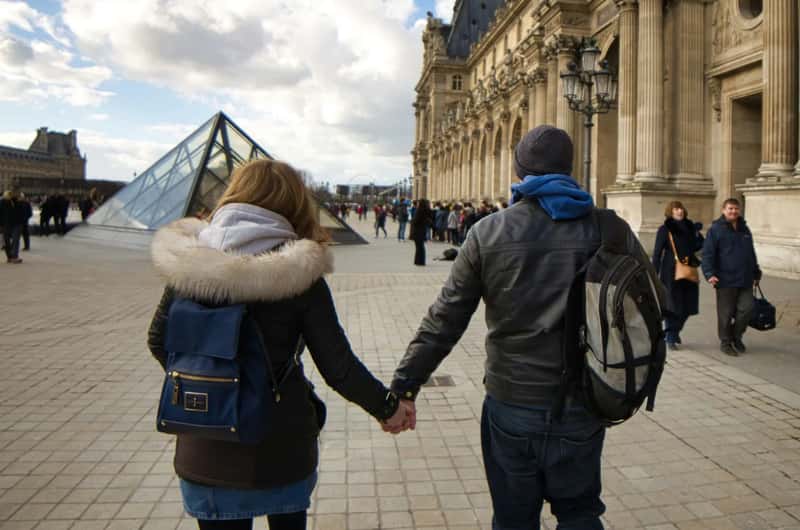
Travel has always been in the business of dissolving identity. But it works slowly, usually. The silent walking tour accelerates the process.
Strip the city from its familiarity. Strip the relationship from its routine anchor.
What’s left?
Being away may allow the walker to separate not only from society but also from ego or other inner distractions. The concept of liminality illustrates this processual aspect – the liminar is away, disconnected from usual roles and obligations, with the time to find or create him or herself anew.
This is where a relationship gets honest.
Not in the therapy chair. Not in the argument at midnight. Here. On an unfamiliar street. In a silence that neither of you arranged.
The liminal space doesn’t care about your carefully curated couple persona. It has no algorithm. It offers no likes. It only offers the present tense – and the present tense is the most terrifying place two people can stand together.
2. The Two-Minute Crack
Everyone believes they’re comfortable with silence. Almost no one actually is.
Much to her surprise, the creator who launched the silent walking trend noticed that after two minutes of anxiety-producing, mind-racing, mental-mayhem, she suddenly entered a flow state where everything went quiet, where she could hear herself.
Two minutes. That’s the threshold.
In a relationship, that threshold is even shorter. Because the silence isn’t just yours. It belongs to both of you. And one of you will crack first. The mouth opens. Two minutes into silence, most people crack. After two minutes of anxiety-producing, mind-racing, mental-mayhem, the body revolts. The mouth opens. Words pour out like a pressure valve releasing.
Watch who breaks first. Watch why they break. Watch what they say when they do.
That two-minute window is a diagnostic. It tells you everything about a person’s relationship to their own interiority – and by extension, their relationship to yours.
3. The Curated Self vs. The Moving Self
Social media encourages users to craft and present an idealized version of themselves. Through carefully selected posts, curated images, and strategically timed updates, individuals control how others perceive them. Scholars refer to this phenomenon as the “curated self.”
The curated self cannot walk a silent street without twitching.
It needs to comment. To photograph. To narrate.
In the digital media age, travel photography and online sharing have become significant means for tourists to document their travel experiences, display identity, and express emotions.
The silent walking tour removes the camera from the equation. It removes the caption. It removes the audience entirely. And without an audience, the curated self has nowhere to perform. What surfaces instead is the unedited version. The version your partner has never properly met. The version that is either perfectly compatible with your own rawness – or startlingly, devastatingly not.
4. The Nervous System Knows
You don’t fall in love with someone’s thoughts. You fall in love with how your nervous system feels beside theirs.
Brain imaging studies show that when people feel genuinely safe with another person, their nervous system shifts into parasympathetic activation – the physiological state of rest and digestion. This state is incompatible with the performance orientation that drives constant talking. True relaxation allows silence to emerge naturally.
The body knows before the mind admits it.
When we stop expending mental energy on self-monitoring and impression management, we free up cognitive resources. This shift is measurable in heart rate variability, cortisol levels, and brain wave patterns. Comfortable silence literally reflects a different neurological state than anxious silence.
The walking tour is just the stage. The nervous system is the judge. And the nervous system cannot be fooled by charm, or wit, or a perfectly timed joke lobbed into the quiet to break the tension.
5. The First-Person Reckoning
I took a silent walking tour once. A city with too many hills. Not enough signposts. Someone I believed I loved completely.
We had agreed to the silence as a kind of game. Thirty minutes, no talking. Just walk. By minute four, they were narrating under their breath. Little jokes. Tiny observations lobbed at me like lifelines.
I felt it immediately. Not irritation. Something sadder than that. A recognition.
I felt it immediately – not irritation, but something sadder. A recognition that the silence was asking a question they couldn’t face. By minute twelve, I noticed I wasn’t uncomfortable.
That asymmetry – their discomfort and my strange peace – was the most honest data point our relationship ever produced. More honest than any conversation. More revealing than any argument. The silence had asked its question. Only one of us had an answer.
6. The Digital Performance Tax
Every relationship that lives primarily inside a screen pays a tax. The tax is presence.
The performance is often influenced by feedback loops, such as likes, shares, comments, and follows, creating a sort of “social currency” that reinforces specific behaviors and attributes.
We become addicted to the loop. We need the response. We mistake the response for love.
The chaos of modern life, constant streams of information from social media, work demands, and being perpetually available – can leave us overwhelmed, with stress often spilling into our relationships.
The silent walking tour collects that tax in full and refuses to let you defer payment. There is no phone to check. No notification to defer to. No digital buffer between you and the person who chose to walk this road beside you. The performance tax comes due in the first fifty meters. You will feel it as either suffocation or relief. Neither answer is wrong. Both answers are final.
7. The Liminal Intimacy
There is a specific kind of intimacy that only silence can generate. Words reach for meaning. Silence arrives there directly.
A study defines silence as more than just the absence of communication. It’s seen as a deeper quality of presence and active listening. This silence allows for a deep human connection, helping love to emerge through emotions, mental imagery, and sensory experiences, culminating in a therapeutic experience.
On a silent walking tour, every shared glance becomes vocabulary. Every slowed pace is a sentence. Every shoulder that drifts closer is a paragraph that no words could have written.
There is only the shared act of moving through the world without needing it to look like anything at all. That, it turns out, is one of the most intimate things two people can do.
Not the dinner. Not the photograph at the viewpoint. This. The cobblestones. The agreement to keep walking without explanation. The willingness to be a little lost together and not panic about it.
8. The Self-Silencing Trap
There is a crucial difference between chosen quiet and collapsed quiet.
One is sanctuary. The other is slow erasure.
There is a crucial difference between chosen quiet and suppressed self. One is freedom. The other is slow erosion. Self-silencing involves chronically suppressing your authentic thoughts and feelings to avoid conflict or maintain relationships, leading to depression, anxiety, and identity erosion.
Some people on a silent walking tour are not at peace. They are simply too exhausted to perform anymore. They have been self-silencing for so long that the silence on the tour feels indistinguishable from the silence they carry home every evening. Watch for this. The quiet that radiates ease looks entirely different from the quiet that radiates surrender. One is a person breathing. The other is a person disappearing. Mindful awareness is frequently described as a focus on present sensory input without cognitive elaboration or emotional reactivity, and is associated with improved task performance and decreased stress-related symptomology. Know which silence you’re standing inside.
9. The Neurological Re-Boot
Something measurable happens to the brain when the performance stops.
When we’re constantly plugged in – screens, notifications, podcasts – our sympathetic nervous system stays activated, triggering the “fight or flight” response. Silent walking allows the parasympathetic nervous system to take over, triggering the “rest and digest” response. Research shows that even two minutes of silence significantly lowers heart rate and blood pressure.
Two people sharing this neurological reset beside each other are having a co-regulated experience that most couples never access through conversation alone.
A 2013 study involving mice found that silence can catalyze neurogenesis by creating new brain cells. While it’s crucial to remember that human brains are considerably more complex, this research provides a hopeful glimmer into how our brains might react to silence. Silent walking may combine the mental acuity benefits of walking with the neurological benefits of silence to turn into an all-around workout for the brain.
A relationship that can co-regulate in silence has a structural advantage that no amount of dinner-table conversation can replicate. It has learned to rest together. And rest is where the real person lives.
10. The Revelation That Changes Everything
The silent tour doesn’t break relationships. It simply holds up a mirror that has no filter.
Two people on a silent walking tour in a place neither has mapped must rely on something deeper than habit – they must rely on actual presence. And presence, stripped of its performance costume, looks very different from what we thought it was.
This is the heaviest point. Because the revelation that arrives in the silence is not always the one you wanted.
The stranger you become most comfortable being silent beside is not always the person you thought you loved most. That reckoning – quiet as it arrives – changes everything. The body knows before the mind admits it.
Sometimes you walk in silence beside someone and you feel the whole city soften. Your breath slows. Your shoulders drop two inches. The noise you didn’t know you were carrying simply… releases. You don’t need to say anything. You don’t need to document it. You don’t need to perform the peace for anyone. It is simply, finally, yours.
And sometimes – and this is the part that takes the longest to name – you walk in silence beside someone you love and you realize the silence feels lonelier than being alone. Not because they are absent. Because they are present, and the presence reveals a gap that all the words in the world had been papering over.
The silent tour doesn’t destroy relationships. It merely reveals what was always true about them. That truth was always there, walking one step behind you, waiting for you to stop performing long enough to turn around.
The question the silent walking tour asks is simple. Savage in its simplicity. Can you be still beside this person? Can you move through an unmapped place without filling the space between you with noise, with content, with the endless static of needing to be witnessed? The cobblestones don’t care about your couple aesthetic. The afternoon light asks nothing of you. It only illuminates.
So walk. Put the phone away. Let the city be loud so you can both be quiet. And pay attention – not to the architecture, not to the street food stalls, not to the perfect shot for the feed – but to the feeling in your chest as the silence settles between you like a third presence. That feeling is the only review of your relationship that has ever told the truth.