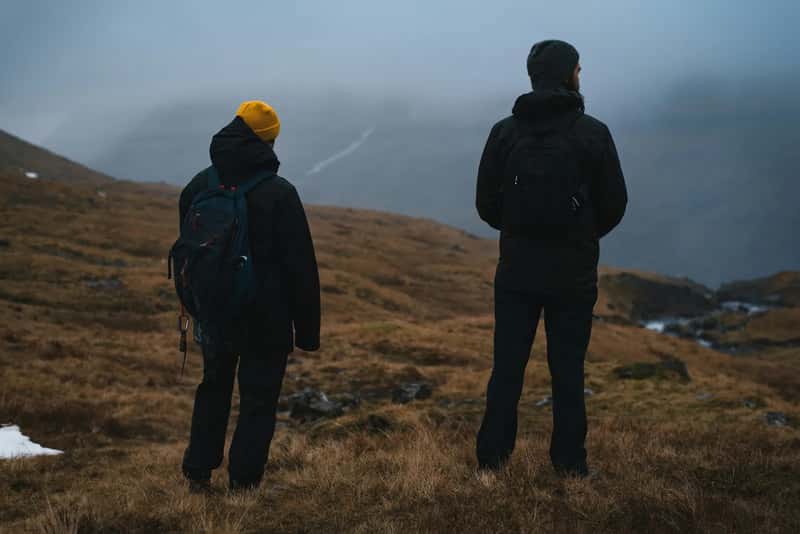
Two people. One path. No words.
No podcast to hide behind. No curated playlist to set the mood.
Just cobblestones, afternoon light, and the terrifying weight of shared silence.
Watch how quickly a person reaches for their phone. Watch how quickly they start narrating every storefront, every pigeon, every crack in the pavement. Watch the performance begin. What survives that walk is real. What cannot survive it was never what you thought it was. Neither verdict is a tragedy. Both are, in their own quiet way, a kind of grace – the grace of finally knowing exactly where you are standing, and with whom, and whether the ground beneath you is solid enough to stay.
1. The Performance Contract
Every relationship, from the first date to the twentieth year, operates on an unspoken contract.
The terms are rarely discussed. They are performed.
Constantly monitoring yourself, dismissing your own needs, and performing a version of yourself that feels acceptable to others – this is not love. This is labor. And most of us confuse the two for years.
A silent walking tour detonates the contract.
There is no agreed-upon script for two people walking a foreign street together without speaking. No social convention to hide behind. The silence arrives like an audit nobody asked for.
The question it asks is brutal in its simplicity: Can you be next to this person without becoming someone else?
The answer is always immediate. And it is always honest. You cannot fake ease. You can only discover whether it exists. The silent tour doesn’t destroy relationships. It merely reveals what was always true about them.
2. The Noise We Carry
We talk about travel as escape. But we are staggeringly bad at escaping ourselves.
In a society characterized by constant technological advancements and perpetual connectivity, silent walking encourages individuals to embark on walks devoid of electronic distractions, providing an opportunity for intentional disconnection from the digital realm.
The noise is not external. The city hum is manageable. It is the inner static that terrifies us.
Two minutes into silence, most people crack. After two minutes of anxiety-producing, mind-racing, mental-mayhem, the body revolts. The mouth opens. Words pour out like a pressure valve releasing.
That moment – that exact moment of unbearable quiet – is not a flaw. It is data.
It tells you everything about how comfortable a person is with their own inner world. And by extension, how comfortable they can be with yours.
The noise we carry into silence is the noise we carry into intimacy. You don’t get to silence one without confronting the other.
3. The Comfortable Stranger
Here is a strange truth about silence and connection.
The silence that makes us uncomfortable in casual relationships is the same silence that signals profound safety with those we truly trust. Understanding this paradox changes how we view human connection.
Discomfort is not a sign the relationship is failing. It is a sign the relationship has been depending on performance to survive.
A new city offers no familiarity. No routine anchor. No shared reference point to fall back on. Two people on a silent walking tour in a place neither has mapped must rely on something deeper than habit – they must rely on actual presence.
And presence, stripped of its performance costume, looks very different from what we thought it was.
The stranger you become most comfortable being silent beside is not always the person you thought you loved most. That reckoning – quiet as it arrives – changes everything.
4. The Neurological Verdict
The body knows before the mind admits it.
Brain imaging studies show that when people feel genuinely safe with another person, their nervous system shifts into parasympathetic activation – the physiological state of rest and digestion. This state is incompatible with the performance orientation that drives constant talking. True relaxation allows silence to emerge naturally.
Read that again. Performance and safety cannot occupy the same neurological space.
When you are performing – narrating, entertaining, managing – your nervous system is running hot. Your body is working. When silence feels comfortable beside another person, your body has decided, at a cellular level, that it is safe to stop working.
When we stop expending mental energy on self-monitoring and impression management, we free up cognitive resources. This shift is measurable in heart rate variability, cortisol levels, and brain wave patterns. Comfortable silence literally reflects a different neurological state than anxious silence.
The walking tour is just the stage. The nervous system is the judge.
5. The Anecdote (Where Theory Gets Personal)
I took a silent walking tour once, in a city with too many hills and not enough signposts, with someone I believed I loved completely.
We had agreed to the silence as a kind of game. Thirty minutes, no talking. Just walk.
By minute four, they were narrating under their breath. Little jokes. Tiny observations lobbed at me like lifelines. I felt it immediately – not irritation, but something sadder. A recognition that the silence was asking a question they couldn’t face.
By minute twelve, I noticed I wasn’t uncomfortable. I was watching the light move across old tile work. I was present. Completely and privately present in a way that felt unfamiliar and right.
And I understood then what the silence was actually measuring. Not whether we could stop talking. But whether we needed each other to keep going.
We did not last much longer after that city. Not because of the silence. Because of what the silence found.
6. The Attachment Fingerprint
How a person behaves in deliberate silence with a partner is a direct expression of their attachment style. This is not a metaphor. It is measurable.
Individuals may be silent because of self-imposed pressures and demands on themselves to say or do the right thing. Introjected silence has been observed in participants who were asked to identify reasons for silence – they elicited themes of anxiety and inhibition, and fear of being judged negatively.
Anxious attachers fill the silence. They have to. The quiet reads as withdrawal, and withdrawal reads as threat.
Avoidant attachers disappear into the silence. They are there physically. Elsewhere, entirely, in every other way.
In the context of romantic relationships, intrinsically motivated silence may create a sense of intimacy and enhance mutual understanding and relationship closeness.
That last type – the person who chooses silence because they want to be present with you – is rare. And when you walk beside them, through a foreign city, through the afternoon light, you feel the difference in your chest before you name it in your mind.
7. The Identity Dissolve
Travel has always been in the business of dissolving identity. But it works slowly, usually. The silent walking tour accelerates the process.
Being away may allow the walker to separate not only from society but also from ego or other inner distractions. The concept of liminality illustrates this processual aspect – the liminar is away, disconnected from usual roles and obligations, with the time to find or create him/herself anew.
Strip the roles. Strip the noise. Strip the audience.
What remains? What is there when there is no one to perform for?
Experiencing silence and solitude in the wilderness may yield many more psychological rewards than mere restoration, including the cognitive and social freedom required for self-reflection and significant connection to internal and external reality.
In a relationship, this dissolve is terrifying precisely because it is bilateral. Both people arrive at their stripped-down selves simultaneously. There is nowhere to hide. There is no more careful construction of the person you decided they should love.
There is only who you are when the city is quiet and your feet keep moving and the performance has run out of material.
8. The Intimacy That Doesn’t Need Applause
We have been taught that intimacy is demonstrative. It speaks. It declares. It posts.
We have not been taught what researchers are only recently beginning to quantify.
Intrinsic silences that felt comfortable were associated with many positive emotions and high ratings of how well the relationship fulfilled their needs. During these intrinsic silences, positive feelings were “low-arousal” – they were relaxed and peaceful rather than happy or excited.
Peaceful. Not ecstatic. Not performatively joyful.
Peaceful, like a body that has decided it does not need to prove anything to anyone standing nearby.
Many people mistake constant interaction for intimacy, never recognizing that the ability to be quietly present together represents a higher form of trust.
A silent walking tour is not romantic in the conventional sense. There are no grand gestures. No Instagram moments. There is only the shared act of moving through the world without needing it to look like anything at all. That, it turns out, is one of the most intimate things two people can do.
9. The Silence That Self-Silences
Not all silence is sanctuary. This point requires its own reckoning.
There is a crucial difference between chosen quiet and suppressed self. One is freedom. The other is slow erosion.
Self-silencing involves chronically suppressing your authentic thoughts and feelings to avoid conflict or maintain relationships, leading to depression, anxiety, and identity erosion.
Some people on a silent walking tour are not practicing presence. They are practicing disappearance. They have been disappearing for years inside this relationship, swallowing observations, burying opinions, narrowing themselves to fit a shape the other person finds acceptable.
Suppressed thoughts and emotions don’t simply vanish. They tend to resurface as anxiety.
The silent tour will catch this, too. Watch for the person who seems relieved to stop talking. There is a difference between the relief of comfortable quiet and the relief of someone who has been exhausted by the performance of being seen. One is rest. The other is defeat. Learn to tell them apart.
10. The Question the Walk Actually Asks
After everything – after the neuroscience, the attachment theory, the stripped identities, and the quiet revelations on unfamiliar streets – the silent walking tour is asking one question.
Only one.
And it is not: Can you be silent?
Silence can be comforting, especially in established relationships where there is a strong sense of mutual understanding and acceptance. Walking together in silence can be a shared experience of companionship and relaxation, deepening the connection between friends.
The question is: Whose silence is this?
Is it a silence born of safety – the kind where neither person needs to fill the void with performance or justification, and silence becomes a container for genuine connection? Or is it a silence born of distance – two people walking in parallel universes, connected only by geography and old habit?
The body knows the answer. The body always knows. Pay attention to how your chest feels when the tour goes quiet. Pay attention to whether you are expanding into the silence or contracting away from it. That sensation – that specific, undeniable sensation – is the most honest relationship data you will ever collect.
There is no methodology more precise. No questionnaire more revealing. No therapist’s couch that cuts to the marrow as quickly as thirty unscripted minutes on a foreign street with someone you claim to know.
We live inside so much noise. We build relationships inside that noise and call it connection. We confuse the volume of our shared life – the plans, the arguments, the group chats, the inside jokes – for the depth of it. We never test the depth because testing it requires removing everything we use to avoid the test.
The silent walking tour removes it all. It takes two people who have, perhaps for years, been performing for each other – performing patience, performing desire, performing a version of themselves that is loveable and low-maintenance and not-too-much – and asks them to simply walk. Together. Without the costume. Without the script. Without the safety net of sound.
Go somewhere you don’t know. Walk until the performance runs out. Then pay very careful attention to who is still beside you in the silence.