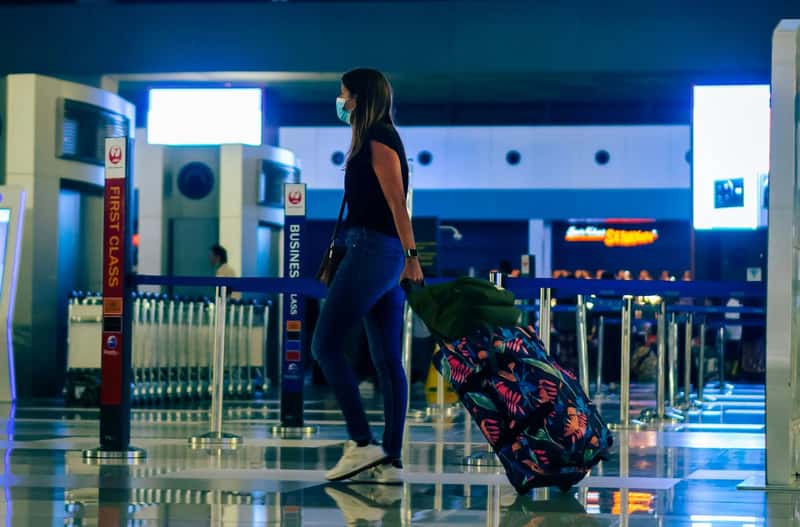
The terminal is empty at midnight.
The fluorescent lights don’t blink. They just burn.
Your bag hits the floor with a sound that echoes longer than it should.
You are not tired. You are something more specific than tired.
You are the gap between who you were before takeoff and whoever it is that just landed.
There is a particular kind of person who knows this feeling intimately. Not the person who dreads airports. The one who quietly, privately, almost shamefully – needs them. The one whose nervous system learned, somewhere between childhood and the first long-haul flight, that danger feels more manageable than stillness. That chaos has a grammar you can read. That motion is the closest thing to peace you’ve ever found.
A liminal space is a place or state of transition, an in-between zone that exists on the threshold between what came before and what has not yet arrived. The midnight airport is not a metaphor for that. It simply is that – with bad coffee and departure boards.
The identity gap lives here. Between who you perform at home and who you become the moment you stop having an address. Between the version of yourself with a job title and the version of yourself with just a gate number.
1. The Dissolving Self
Perhaps one of the most profound psychological effects of airports is how they temporarily strip away our usual identity markers. In the international transit zone, national boundaries become fluid, and our usual social roles temporarily suspend.
At midnight, this effect is amplified tenfold.
The crowd is gone. The retail theater is shuttered. The distractions are dead.
What remains is you. Just you. Without the props.
We define ourselves in terms of time and place. We know who we are in relation to our daily routines and our familiar environments. Strip those away at midnight and something raw surfaces. Something that doesn’t have a LinkedIn profile or a morning routine.
For the person who was raised in a high-stakes household – one where calm was not a given, where vigilance was survival – this dissolution isn’t threatening.
It’s recognizable. It feels, uncomfortably, like home.
The self is not missing. It’s just between drafts.
2. The Engineered Helplessness
The psychology of airport stress is primarily driven by “Engineered Helplessness,” a concept rooted in behavioral psychology. From the moment of entry, your agency is dismantled: you are told where to stand, when to disrobe, and how much liquid you may possess. This state of “liminality” – the psychological discomfort of being in a transition zone with no personal control – triggers the sympathetic nervous system.
For most people, this is distressing.
For the nervous system raised on chaos, this is oddly clarifying.
When someone else controls the environment, there is nothing left to manage. The hypervigilance that felt like a burden back home suddenly has a purpose. You already know how to read a room that might turn. You already know how to stay alert without showing it.
The midnight airport doesn’t make you anxious. It gives your anxiety a legitimate target.
That distinction is everything.
3. The Temporal Vacuum
Airports distort the normal rhythm of life. There are no clocks in sight. You’re surrounded by artificial lighting. You’re in a transitional space with no natural cues for routine. Psychologists call this a temporal vacuum – a place where time feels simultaneously fast and slow.
At midnight, time doesn’t just distort. It disappears entirely.
There is no morning yet. There is no yesterday anymore. There is only the gate, the hum of the HVAC, and the slow crawl of the departures board.
For the anxiety-wired traveler, this is not disorientation.
This is relief.
When time ceases to make demands, the nervous system exhales. The deadlines, the expectations, the version of you that has to show up on Monday – none of them exist here. Not yet. Not at midnight, in Terminal B, under the fluorescent buzz.
The temporal vacuum isn’t a void. It’s a reprieve.
4. The Prefrontal Fade
Under the high-stakes pressure of a “Final Call,” the Prefrontal Cortex – responsible for emotional regulation – begins to fatigue. When an authority figure issues an arbitrary command, the brain, already depleted of cognitive load capacity, defaults to the Amygdala.
This is the moment the mask slips.
Not in the dramatic sense. No one is screaming at the gate agent. But the carefully maintained persona – the composed professional, the patient parent, the unfazed frequent flyer – that architecture quietly collapses.
What’s left is the unmediated self.
And for certain people, that unmediated self is not stranger or worse. It’s actually cleaner. More honest. The person who learned to survive chaos stopped needing the persona long ago.
The Prefrontal fade doesn’t expose weakness. It exposes what was always there beneath the performance.
The question is whether you’re prepared to look at it.
5. The Anecdote at Gate C-11
I remember the exact moment I understood this about myself.
It was 1:17 AM in an airport I won’t name because the city doesn’t matter. My flight had been delayed five hours. Everyone else in the gate area was miserable – slack-jawed, phone-bright, radiating that particular fury of stolen sleep.
I was not miserable.
I was, against all reason, at peace.
There was nothing to do. Nowhere to be. No version of myself that was required. I bought a terrible sandwich. I watched a man in a business suit fall asleep mid-email. I felt the kind of stillness I could never locate in my own apartment.
A sense of identity is important to our psychological health, but can become constricting. Like actors who are stuck playing the same character in a soap opera week after week, we enjoy the security of our roles but long to test and stretch ourselves with new challenges.
The midnight delay didn’t steal time from me. It gave me back something I’d been running from. The version of me that doesn’t need to perform anything for anyone. He showed up at Gate C-11 at 1:17 AM. I hadn’t seen him in years.
6. The Identity Fluid Zone
The travel mindset is a psychological state characterized by heightened emotional sensitivity, loosened behavioral constraints, elevated openness to novelty, and a distinctive relationship with time, money, and identity. It is not simply excitement about a destination. It is a deep cognitive and emotional reorientation that begins the moment a person commits to traveling and continues until they fully re-enter the rhythms of ordinary daily life.
Midnight accelerates all of this.
The airport at noon is still a social theater. There are people to perform for. Status to signal. Composure to maintain.
The airport at midnight is something else entirely.
Business people in crisp suits sprawl across terminal floors for quick naps, while others splurge on luxury items they’d never consider buying in their regular lives. The usual rules of self-presentation quietly dissolve. The CEO is horizontal on a row of plastic seats. The rigid professional is barefoot. The identity fluid zone is open for business, and admission is involuntary.
This is where the psychologically complex traveler thrives. Not because they are immune to vulnerability, but because they’ve been practicing it for years under far harder conditions.
7. The Thin Place
In Celtic cultures, there is a concept of special “thin places” – often sacred groves or forests – where it’s believed that the veil between the material and spiritual world is thin.
The midnight airport is the secular version of a thin place.
The architecture hasn’t changed. The same gates. The same carpet patterned to hide decades of grief. But something in the quality of the air at midnight shifts the experience entirely. The veil between who you are and who you’ve been trying to become gets gossamer-thin.
The lines of culture and identity blur. At the airport, everyone morphs into the same anticipatory entity, suspended in the act of waiting.
In that suspension, something honest surfaces.
The person who was taught that stillness means danger doesn’t need the sacred grove. They need the fluorescent thin place at Gate 14B. The one where no one is watching. The one where the overhead announcement is the only voice that exists. That is where the real conversation with the self begins.
8. The Nervous System’s Strange Reward
For some people, just the thought of being in an airport can trigger racing thoughts, sweaty palms, and a tightening in the chest. Airport anxiety is more than simple nervousness; it’s a very real form of stress that can make travel feel overwhelming.
But the inverse is equally real, and far less studied.
For the nervous system trained in high-stakes environments – raised on unpredictability, shaped by households where calm was a lie you told yourself before something broke – airports don’t trigger anxiety. They resolve it.
The threat is visible here. The stakes are legible. You might miss a connection. You might lose your bag. These are concrete, survivable catastrophes. The nervous system knows exactly what it’s afraid of.
Compare that to the ambient dread of ordinary life. The formless anxiety of a Tuesday morning. The low hum of existential uncertainty with no departure board to consult.
The midnight airport is hard. But it is specifically hard. And specific hardship, for certain nervous systems, is the closest thing to rest.
9. The Communitas at 2 Am
Airports may play host to pro-social behavior, where strangers share their travel and holiday plans, speaking with unusual intimacy. In no man’s land, normal social inhibitions don’t apply.
At 2 AM, this intimacy sharpens into something almost unbearable in its honesty.
The woman at the charging station tells you her mother is sick. The man in the baseball cap is going home to bury his father. The young couple, barely twenty, are moving somewhere neither of them has been. Normal social scaffolding has been packed into the overhead bin.
Airports are a space where strangers, for one shining hour, are on equal footing, comrades in their shared desire to depart. It is remarkable how quickly strangers become kindred spirits when their flight is delayed.
This is the hidden gift of the midnight arrival. The masks are too heavy to keep on. The pretense costs more than anyone can afford at this hour. What remains is raw, unperformed humanness. And for the traveler who has always felt more comfortable with the unmasked version of life, this accidental community at Gate 9 at 2 AM is not an inconvenience.
It is, quietly, a kind of grace.
10. The Cost of the Calm
Here is what no one says out loud.
The person who finds peace in the midnight airport – who breathes easier in transit than at home, who feels more themselves under fluorescent lights than in their own kitchen – that person is not uniquely evolved. They are not a romantic wanderer built differently from the rest.
They are someone whose nervous system was never given permission to rest without a reason.
The psychology of airport stress proves that travel rage is rarely about the flight itself; it is about the cumulative erosion of dignity and physical ease. And conversely, the peace that certain travelers find in transit is rarely about the destination. It is about the cumulative erasure of expectation. Of identity demands. Of the performance of being someone stable and located and known.
Liminal spaces force us to confront the inherent impermanence of human existence. They serve as a poignant reminder of life’s fleeting passage.
The cost of the calm is this: you have to ask yourself why permanence never felt safe. Why arrival always carries a faint dread. Why the place you are going – the home, the return, the reunion – sits heavier in your chest than the terminal you’re leaving behind.
That is not a travel problem. That is the deeper thing.
And the midnight airport, in all its brutal fluorescent honesty, is simply the room where you finally get quiet enough to hear it.
There is a particular courage in admitting that the transit zone has been doing emotional labor you were never taught to do yourself. That the departure lounge at 3 AM has been your therapist, your confessional, your permission slip. That you have been using movement as a sophisticated, socially acceptable substitute for stillness.
The midnight airport doesn’t ask you to fix this. It never has. It just holds the question open under those relentless lights, in that particular silence that isn’t quite silence, between the version of you that boarded and the version of you that hasn’t yet decided where to land.
Maybe the most honest thing you’ll ever do is sit in that gap – bag at your feet, gate number blinking – and stop pretending you’re in a hurry to leave it.