You book the flight at midnight.
Not because you found a deal.
Because the walls of your apartment were starting to answer back.
Because the life you assembled, carefully and correctly, started to feel like a room you didn’t decorate.
Because somewhere between the farmer’s market and the standing desk, you lost the plot – and a cobblestone street in a foreign city started to look a lot like a solution.
There is a particular kind of person who insists on eating where the locals eat. Who rents an apartment instead of booking a hotel. Who learns six phrases in a language they’ll never fully speak and wears them like armor. This person is not necessarily adventurous. They are, more often than not, quietly exhausted by who they are when they stay in one place too long.
1. The Temporary Identity
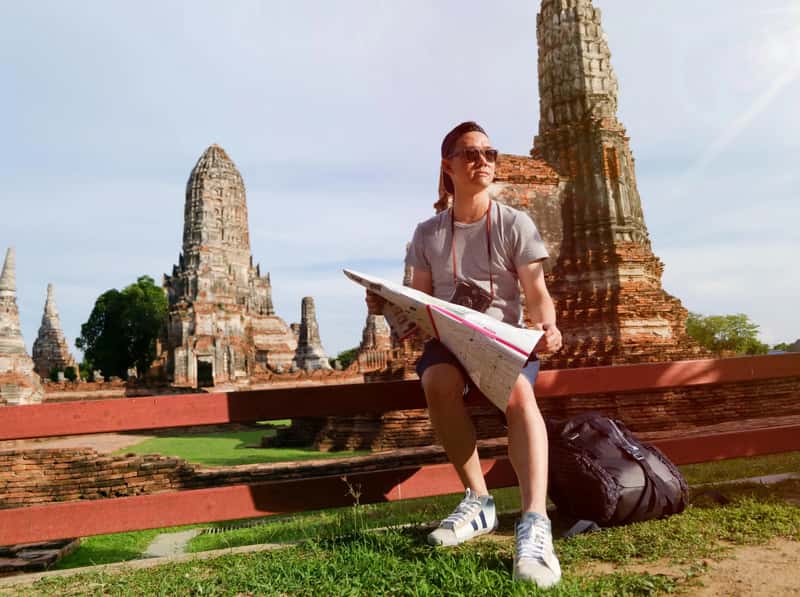
The temporary identity is seductive precisely because it is temporary. It asks nothing of you. It carries no mortgage, no recurring disappointment, no awkward family dinner where someone asks how the “big dream” is going.
In a borrowed city, you get to be the version of yourself that wakes up early. That reads in cafés. That has opinions about espresso.
Nobody there knows about the promotion you didn’t get. The relationship that quietly corroded. The Sunday afternoons that feel like small funerals.
You get to be whoever you want to be for exactly as long as your visa allows. Then you land. The carousel spins. And you are, once again, undeniably yourself.
This is the psychological core of the “live like a local” compulsion. It is not cultural immersion. It is identity tourism. And the destination is always the same: a version of you that the current you cannot seem to locate at home.
The tragedy is not in the wanting. The tragedy is in mistaking the costume for the person.
2. The Dopamine Architecture
Since travel activates entirely different neural networks than our day-to-day routines, it becomes a potent escape mechanism.
Your brain doesn’t know the difference between a breakthrough and a boarding pass.
The stimulation and novelty of new environments can act like a psychological reset, giving us a temporary break from the realities we don’t want to face.
This is the neurological seduction of movement. Every new street corner is a micro-dose of dopamine. Every unfamiliar menu is a tiny act of reinvention.
Much like relying on hallucinogens to experience a euphoric or altered state, constantly seeking the next trip can create an unhealthy dependence. The brain craves the dopamine rush it gets from new experiences, and over time, the regular pace of life may start to feel dull or unsatisfying in comparison.
Which is to say: the more you travel to feel alive, the less alive you feel when you stop.
The architecture of escape is self-defeating. Every time you use a new city to feel better about your life, you quietly deepen the belief that your life, as it stands, cannot make you feel better on its own.
3. The Exit Strategy
Psychology professor Joseph Troiani at Adler University notes that travel can turn into a compulsive behavior for people who are looking to escape reality or use it as an avoidance strategy.
The exit strategy is not a travel plan.
It is a feeling that precedes every booking. That low, familiar hum of something being wrong – not dramatically wrong, just wrong enough to make staying feel unbearable.
Like other escapist behaviors, when something stressful occurs, a habitual pattern sets in – which might be immediately looking up flights and planning trips.
Notice the sequence. Life presses down. The browser opens. The search begins. Dates are selected. A deposit is made.
And for a moment – just a moment – the pressure lifts.
That relief you feel? It isn’t wanderlust. It’s the psychological equivalent of looking away from something you don’t want to see.
The exit strategy masquerades as spontaneity. As freedom. As a personality trait. But underneath the linen and the good intentions, it is avoidance wearing a very convincing disguise.
4. The Belonging Displacement
The “local” costume is a way of saying: I am not a tourist. I am not a stranger. I belong somewhere – even if that somewhere is not my actual home.
Belonging is not a travel amenity. It is a psychological need – one of the deepest we carry.
When that need goes unmet at home – in the community that knows your name, in the relationships that have seen your worst Tuesday – we go looking for it somewhere else.
We find a neighborhood bar in Lisbon. A morning market in Oaxaca. A bench in a park in Kyoto where no one speaks to us, but the silence feels like acceptance.
Projecting dissatisfaction onto one’s environment can be a way of avoiding the true causes of that distress. Those causes may include existential crises, major losses, feelings of loneliness or disconnection, and unfulfilling work.
Belonging displacement is not a geographic problem. You cannot solve loneliness with a longitude. You cannot cure disconnection with a time zone change.
You can only delay the reckoning.
5. The Edited Self
I remember sitting in a rented apartment, three floors above a street where I didn’t know anyone’s name and no one knew mine. It felt, for a few days, like freedom. Like I had quietly slipped out of my own life and no one had noticed. But after the fourth morning of that particular silence, I understood what it actually was. It wasn’t freedom. It was the absence of accountability. And I had confused the two for years.
For some, the thrill of discovering unfamiliar cultures becomes a defining aspect of their identity, driving them to prioritize travel above all else – behavior that can stem from a desire to escape mundane routines or seek validation through social media.
Abroad, we edit ourselves ruthlessly. We leave out the parts that embarrass us. The stagnation. The half-finished projects. The relationships we maintain out of habit rather than love.
The edited self is lighter. More interesting. Capable of lingering over coffee and looking like someone who has figured something out.
Research shows that engaging in escapism that disconnects us from ourselves and discourages self-awareness strongly predicts lower life satisfaction – likely because personal growth requires us to confront uncomfortable truths.
The edited self feels like progress. But it is, in its way, a form of self-abandonment. Every version of yourself you leave out of your travel persona is a conversation with the mirror you’re not ready to have.
6. The Motion Illusion
The distance feels like progress. The motion feels like momentum. Until you stop moving and realize you’ve been standing still the entire time.
This is the cruelest trick the traveling mind plays on itself.
Physical movement creates a visceral sense of forward momentum. New airports. New stamps in a passport. New photographs accumulating in a camera roll that functions, quietly, as a record of a life that looks more interesting than it feels.
Relying on travel to reset your brain or escape everyday stress can prevent you from developing emotional resilience and problem-solving skills for your current situation. In the long run, life’s stressors will continue to build, and running away from them through constant travel can lead to deeper dissatisfaction.
The motion illusion is particularly seductive because it produces real evidence. You can point to the map and say: look how far I’ve come. Look how many places I’ve been.
But the internal coordinates don’t shift with the external ones. The thing you were running from is as close as it was at departure.
It waited. It always waits.
7. The Identity Reorganization (That Doesn’t Reorganize Anything)
Sociologist Karen Stein, who studies culture and travel, writes that travel and vacations are a means to reshift and reorganize identities – a way to reexamine priorities and devote attention to identities we have unwillingly had to put in the background.
This is the generous reading.
The darker one is that we aren’t reorganizing at all. We are temporarily suspending the identity we’ve built – the one we dislike – and living inside a placeholder.
A placeholder is not a new identity. It is a waiting room.
Restlessness may require changes to the internal environment, not the external one, or perhaps different life choices at home – which ultimately result in the psychological changes that actually matter.
Identity reorganization, the kind that sticks, is unglamorous. It happens in ordinary rooms. In difficult conversations. In the quiet decision to stop pretending a life is working when it isn’t.
It does not require a plane ticket. It requires, most painfully, stillness.
8. The Social Media Acceleration
There is a feedback loop between travel escapism and the performance of travel escapism. And in the age of curated digital identity, the two have become almost indistinguishable.
Several studies, including one carried out at Duzce University, have found a connection between the time we spend on social networks and the tendency toward escapism.
Every photograph of a narrow street. Every caption about “slow mornings.” Every tagged location in a city that is not where you actually live.
These are not travel documents. They are evidence submissions in the ongoing court case you are making against your real life.
Rising living costs and economic pressures leave many struggling to achieve stability. The need to escape often arises as a response to these pressures – including the desire to escape during periods of transition, when one’s sense of purpose feels unclear.
Social media accelerates the travel-as-identity loop because it provides external validation for the internal avoidance. Every like is a small confirmation that the person in the photographs – the one with the sea view and the aperitivo – is more worthy of admiration than the one who will be back at a desk they resent in eleven days.
The algorithm rewards the escape. It has no opinion on what you return to.
9. The Homecoming Dread
You can identify the travel escapist not by how they leave. By how they feel about coming back.
The psychologically healthy traveler feels satisfied after a trip and does not dread coming home. Travel helps with well-being but is not their only way of coping – one tool in a toolbox, rather than the entire toolbox.
The homecoming dread is the most honest signal the psyche sends.
It arrives somewhere between the descent and the baggage claim. A heaviness that has nothing to do with jet lag. The sudden, physical reality of returning to a life that, somewhere over the Atlantic, you briefly pretended didn’t exist.
Going on a trip just because you feel like disconnecting is a healthy idea. However, if you go on that journey because you want to get away from your partner, your job, your circumstances – you have a problem that needs to be fixed, not a destination that needs to be reached.
Homecoming dread is the body’s way of showing you the blueprint of the life you actually need to build. It is not a sign that you belong somewhere else.
It is a sign that somewhere is waiting for you to finally arrive.
10. The Unbearable Weight of a Life You Chose
The harder question is not whether you can live like a local somewhere else. It is why living like yourself at home feels so unbearable.
This is the question that lives beneath all the others.
It doesn’t fit in a caption. It doesn’t soften in the golden hour. It waits, patient and immovable, in the specific silence of your home when you return and set your bag down and the door clicks shut behind you.
Projecting dissatisfaction onto one’s environment is a way of avoiding the true causes of that distress – which can include existential crises, feelings of loneliness or disconnection, unfulfilling work, or chronic stress.
The life you built is not a failure. It is a first draft.
But a first draft only becomes something better when you sit with it long enough to understand what’s wrong – not when you exile yourself from it for ten days at a time and return unchanged, calling the whole exercise “expanding your perspective.”
Escapism is resolved not with more distance, but with coping. And coping means actions. Deliberate, uncomfortable, unglamorous actions. The kind that don’t photograph well and can’t be tagged with a location.
Research shows that engaging in escapism that disconnects us from ourselves and discourages self-awareness strongly predicts lower life satisfaction – because personal growth requires us to confront uncomfortable truths, and avoiding them stands in the way of a deeper sense of fulfillment.
The local you are trying to live like, in Lisbon or Buenos Aires or Chiang Mai, is not a freer person. They are just a person you have not yet had time to be disappointed by. They have their own walls that answer back. Their own Sunday afternoons that feel like small funerals. Their own browser history, full of flights to somewhere else.
The work – the real work, the work that travel keeps interrupting – is not to find a city where you finally feel like yourself.
It is to become someone you don’t need to escape from.
You already know what that requires. You’ve known for a while, probably. You’ve just been very good at finding somewhere new to be when the knowing gets too loud.
The bag will always be there, half-packed, at the foot of the bed. The question is whether you zip it closed again, or finally unpack it, sit down in the quiet of your own life, and begin.