The train moves.
You don’t know where you’re going. Not really.
The seat is uncomfortable. The coffee is lukewarm.
And the person next to you just told you something true.
Something you have never told anyone at the dinner table.
There is a version of you that the stranger met and your family hasn’t. That gap between the two is not geography. It is the accumulated weight of every time you swallowed something true because the stakes felt too high. Many people don’t withhold vulnerability out of stubbornness or pride. They do so because, somewhere along the way, they learned it wasn’t safe or welcomed. The train simply removed that lesson, temporarily. It suspended the old rules. It said: for the next four hours, you don’t have to be the person they made you.
1. The Stranger-On-The-Train Effect Is Clinically Real
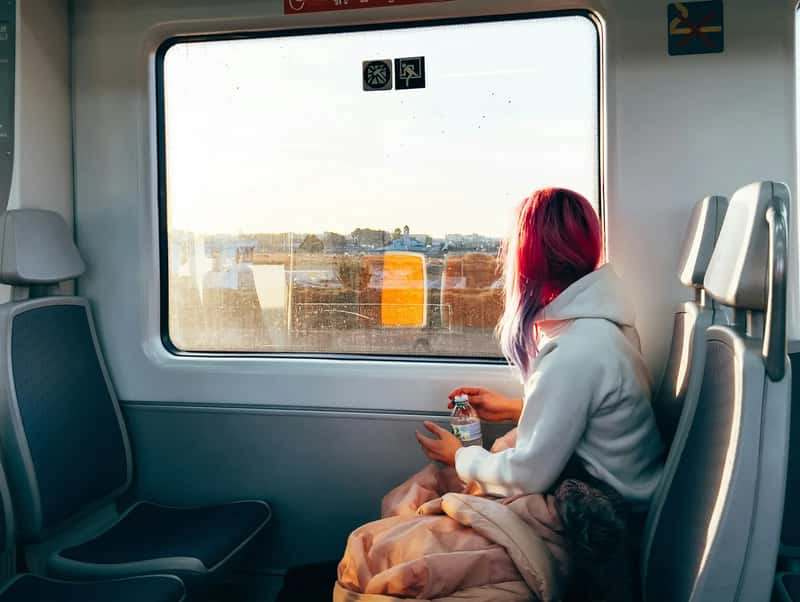
This is not a romantic notion. It is not a travel blogger’s fantasy.
Psychologists have documented what is sometimes referred to as the “stranger-on-the-train effect” – the surprising ease with which people open up to someone they may never see again.
It has a mechanism. A logic. A cold, precise psychology behind it.
Mario Luis Small, a Harvard sociologist, found in his research that people consistently said they would trust those in their inner circle – but when asked whom they had last shared concerns with, it was often a random person on a plane, their hairdresser, or a stranger in a waiting room.
Your instinct to confide in the unknown is not weakness. It is not avoidance.
It is your nervous system doing the math. And the math is simple: the lower the stakes, the wider the opening. The train gives you permission. Your living room never did.
2. The Temporary Nature of Travel Disarms the Brain’s Guard
Your brain is a relentless risk-calculator.
It weighs every word against future consequence. Will they remember this? Will they use it? Will I see their face at Christmas, carrying what I just admitted?
With strangers, the temporary nature of the connection removes pressure and encourages honesty.
The train compartment is a sealed world. What happens inside it has no downstream. There is no next Tuesday. No shared office. No holiday photograph that will look strange because of what you said at mile marker 47.
Strangers are less judgmental, and as psychologist Louise Lambert notes, “even if they are, we know the interaction will be brief and won’t be repeated. So, we take more risks in opening.”
The expiration date is the point. The ending is what makes the beginning possible.
3. Family Carries the Weight of Your Entire History
Your mother does not see you. Not really.
She sees the seven-year-old who cried at the dentist. The teenager who failed the exam. The adult who moved away and called less than promised.
As one analysis noted, “our closest relationships are our most complex ones.” A spouse is a friend, often a co-parent, also a lover. A mother has your entire life’s history in her head. When we need comfort, we’re unsure which of their roles these people might play – and wary that it might be a role that gives us something other than the unconditional support we’re looking for in the moment.
The stranger has none of that file. They meet you at this sentence, not at your origin.
A stranger will know us at that point in time during the conversation. As leadership advisor Ana Caragea observes, “This frees us from the expectations our close ones might have of us. Once we’re free, we open up more.”
Freedom is not geographic. It is relational. And sometimes, it takes a stranger to hand it back to you.
4. The Vulnerability Paradox: Closeness Creates Distance
Here is the cruel irony that nobody frames correctly.
The people we love most are often the people we lie to most efficiently.
According to what psychologists describe as “the vulnerability paradox,” it’s often easier to open up to those we are not relatively close to – the people where the stakes feel low.
With family, the risk calculation is brutal.
If you cry in front of your partner, they might judge you as “too emotional.” If you talk about your problems to a friend, they might judge you as “too self-centered.”
We have been trained, through years of careful relational management, to protect the bonds we value most by withholding the truths that would deepen them. We guard what we love. We hide from what we need. The stranger on the train has no such power over us – and so we give them everything.
5. The Liminal Space Rewrites Your Identity in Real Time
I remember a train from Edinburgh to London. Seven years ago. A Tuesday in November.
I was sitting with a grief I had not named yet – something about direction, about becoming someone I no longer recognized. The man across from me was reading a worn paperback. He looked up once. He asked a simple question.
I talked for forty minutes. I said things I had not said to anyone who loved me.
He listened without the weight of knowing me. And when we reached King’s Cross, he nodded, picked up his bag, and walked away into the crowd. I sat in my seat for a moment longer than necessary. Something had shifted.
Travel places people in what anthropologists call a liminal space – a transitional state between everyday identities and routines. In that in-between, the old self loosens. The performed version – the capable one, the together one, the one who has it handled – quietly unravels. What’s left is just you, mid-sentence, on a moving train, telling the truth for the first time in months.
6. Situational Intimacy: When Shared Context Creates Instant Depth
There is a chemistry to shared displacement.
Two people in the same unfamiliar corridor. The same delay. The same bad coffee. The same window.
One reason travel connections can feel so intense is that they are shaped by what psychologists sometimes describe as situational intimacy – when people navigate unfamiliar environments together, experiencing novelty and vulnerability at the same time.
This is not accident. It is architecture.
Research suggests that shared novel experiences can strengthen emotional bonding by activating positive emotions and reward systems in the brain.
Your brain chemistry does not distinguish between novelty and depth. It just knows that something new is happening, and it opens. The shared context of transit – the uncertainty, the suspension of ordinary life – becomes the room where honesty lives. You didn’t plan to say what you said. The train built the room. The stranger just sat down in it.
7. The Absence of Emotional Load Sets You Free
Family doesn’t just know your story. They feel implicated in it.
Their advice is tangled in their anxiety. Their response is filtered through their own history with you.
Another reason behind this phenomenon lies in the concept of “emotional load.” Friends and family members are often intertwined with our daily lives and experiences, which can make it difficult for them to maintain emotional objectivity. Strangers, on the other hand, are unburdened by any emotional baggage or prior knowledge of our lives.
A stranger listens without the static.
Friends often try to help, fix, or respond based on their own experiences. While this comes from a good place, it can make it harder to fully express yourself. Strangers, however, often listen without stepping in. There is less emotional involvement, which can create a more neutral space for sharing – one that allows people to speak freely without feeling redirected or evaluated.
That neutrality is not coldness. It is precision. It is a clean, uncomplicated witness. And some of us are starving for exactly that.
8. Anonymity Is Not Emptiness – It’s Permission
People confuse anonymity with meaninglessness.
They are not the same thing. Anonymity is the condition under which certain truths can finally exist.
When someone does not know your past, your habits, or your social circle, there is a sense of freedom that naturally follows. There is no fear of your words being tied back to your identity in a meaningful way. You are not worried about how this information might affect your relationships later. This allows people to speak more honestly and without filters.
The train gives you a temporary name.
Not your family name. Not your work title. Not the role you’ve been playing for fifteen years. Just: the person in seat 14C. The person with the lukewarm coffee and the complicated year. Trust without history is still real trust. In this context, it is not about deep emotional bonds but about the absence of risk. When there is nothing to lose, it becomes easier to trust the moment. That is not shallow. That is a specific, necessary kind of grace.
9. The Beautiful Mess: Why Strangers Find Your Vulnerability Attractive
You think your rawness is a liability. It isn’t.
A now-famous series of seven studies carried out at the University of Mannheim, published in the Journal of Personality and Social Psychology, revealed that participants tended to think that showing their own vulnerabilities would make them appear “weak and inadequate.” However, the “beautiful mess” effect kicked in when they spoke of others’ vulnerability, finding it endearing and even desirable.
The stranger on the train is not pitying you. They are recognizing you.
Research has found support for a “vulnerability theory of emotional bonding,” according to which the strength of a new emotional bond can be predicted by measures of the vulnerability that each of two persons shows with respect to one another.
When you are unguarded, something in the other person responds. Not with judgment. With relief. Because your willingness to be real gives them permission to be real too. The compartment fills with something quiet and honest. Two people, temporarily freed from their own performances, recognizing each other across the gap.
10. The Returning Self: What You Owe the Person You Were on the Train
The train arrives. The doors open. The moment ends.
You step back into the version of yourself that your family recognizes. The capable one. The managed one. The one who says “fine” when asked how they are.
But something happened in that compartment. Something real and unrepeatable. Not every meaningful connection needs to last forever. Psychologists have long recognized the value of what are sometimes called “weak ties” – brief or situational relationships that still contribute to a sense of connection, perspective, and well-being.
The danger is not that you opened up to a stranger.
The danger is that you arrive home and close again entirely. That you treat the train-version of yourself as a tourist – visiting, never staying. Vulnerability in a relationship means allowing ourselves to be known in our raw, unguarded state. It’s showing the feelings we’re not proud of – our fears, our neediness, our longing. It’s asking for reassurance not to control the other, but because we’re truly afraid. The stranger gave you a rehearsal. What happens next is your choice.
Research shows that one third of people, when facing a personal crisis, actively avoided the people closest to them. “You are about as likely to deliberately avoid the people you are close to as you are to actually talk to them when you need somebody,” the research concludes. The person you loved most – yourself, unedited – showed up on a train. And then you packed that person back into your luggage when you arrived.
The question – the one that lingers long after the platform empties – is not why you open up to strangers. The question is what it would cost to offer the same tenderness to someone permanent. To stay in the gap, not just pass through it. To arrive somewhere, finally, as yourself.