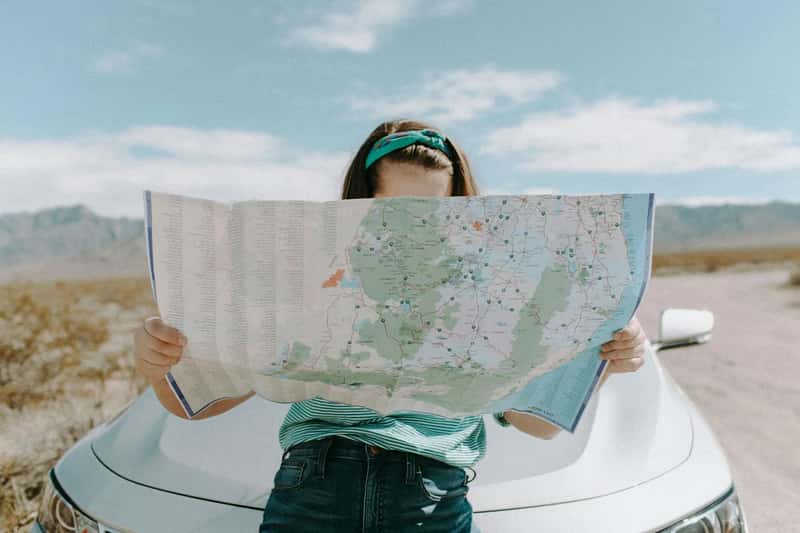
You unfold it on the hood of a rental car.
Your fingers trace a road that has no name on any app.
Something in your chest loosens.
You haven’t felt that in years.
That sensation – the one that feels like relief but arrives dressed as curiosity – is not nostalgia. It is something deeper and more urgent. It is the quiet, stubborn insistence of the self trying to claw back what the machine took on loan and never returned. We have been outsourcing our movement, our instinct, our geography of the world to invisible code for the better part of a decade. We believed it was convenience. Psychology is now starting to suggest it was something closer to surrender.
1. The Borrowed Brain
We did not notice it happening.
That is the most important part of this story.
GPS-based navigation apps minimized the need for using our internal navigation system, reduced the cognitive requirements of navigation and the probability of mistakes, and further saved energy in finding a target location. It sounded like progress. It felt like progress. But the brain, that ancient, ungrateful organ, does not grant free passes. Every time we handed the map to the machine, the machine took a little more of the territory.
We borrowed a brain and forgot we had our own.
When using a GPS-based navigation app, the brain might rarely invoke spatial cognition. Rarely. That word sits in the body like a splinter. We walk through cities every day and our brain is essentially asleep at the wheel. We are passengers in our own movement. The traveler who once arrived somewhere and owned that knowledge – who could close their eyes and reconstruct the route – has been replaced by a creature who simply follows the blue dot.
The blue dot does not remember anything for you.
2. The Hippocampus Doesn’t Forgive
There is a structure deep in the brain that was built specifically for this.
The hippocampus. Ancient. Loyal. Patient.
The hippocampus is well known to play a critical role in spatial learning, memory and navigation, and has long been thought to contain the “cognitive map.” It is, in a very real sense, the original map. It predates cartography. It predates language. It is the part of us that knows, instinctively, that north is that way.
And we have been starving it.
The relationship between GPS use and spatial memory decline is dose-dependent, in that those who used GPS to a greater extent between two time points demonstrated a larger decline in spatial memory. More GPS. Less you. The equation is brutal in its simplicity. The hippocampus does not protest loudly. It simply dims. It recedes. It waits, in the dark, for someone to ask it a question it was built to answer.
The paper map revival is, among other things, a biological act.
It is feeding a hungry organ.
3. The Passive Passenger
Modern navigation turned movement into consumption.
You consumed a route. You did not make one.
Traditional turn-by-turn navigation promotes passive spatial navigation and ultimately, poor spatial learning of the surrounding environment. The city you visited last summer – do you remember how to get from the hotel to the restaurant where you ate on the second night? Probably not. Because you were never really there. Your body was present. Your spatial mind was not invited.
In a study directly comparing the wayfinding abilities of GPS users, map users, and direct experience users, GPS users traveled longer distances, took longer to complete the navigation task, and had a worse topological understanding of the routes when compared to the map users. This is the data behind the feeling. The feeling that you’ve been somewhere a dozen times and it still feels unfamiliar. The city never stuck because you were never truly navigating it.
You were being navigated.
There is a profound difference.
4. The Algorithm as Identity Thief
The turn-by-turn instruction is just where it starts.
Navigation was merely the first domain we surrendered.
From playlists on Spotify to language model-generated replies, personalized news feeds, to self-tracking wellbeing apps, algorithms co-create the way we know ourselves and belong in the world today. The algorithm does not stop at the street corner. It moves into your music, your news, your romantic choices, your self-image. It builds a version of you out of your past behavior and then serves that version back to you on a loop, calling it preference.
The rise of the Algorithmic Self presents a profound ethical dilemma at the intersection of autonomy and algorithmic determinism. As AI systems increasingly shape our preferences, decisions, and self-perceptions, the individual’s sense of authorship over their own life may erode.
Authorship.
That is the word. That is what is at stake. Not just where you walk. But who is doing the walking.
5. The Weight of the Paper
I bought a road atlas last spring. A real one. Spiral-bound, coffee-stained within three days, page corners folded into triangles pointing at towns I wanted to find on foot.
I did not do it because I read a study. I did it because something felt like it needed doing. Something in the gesture of opening the thing felt like an act of reclamation. My fingers on the paper. My eyes moving without instruction. No voice telling me to turn left in three hundred meters. Just the map, the road, and the very strange, very old sensation of trusting my own reading of space.
What I did not understand then, and understand now, is that the gesture was psychological before it was geographical. In an environment marked by economic uncertainty and institutional fatigue, the appeal of analog is not simply sentimental; it offers tangibility, predictability, and personal agency – qualities that feel scarce in algorithmically mediated life. I was not looking for a map. I was looking for myself at the edge of it.
The paper map found me first.
6. Convenience Without Consent
Here is the contract nobody signed.
We wanted convenience. The algorithm delivered convenience, and then kept the change. Technological trust mediators function as black boxes, prioritizing platform objectives over user agency. This dynamic leads users to confuse algorithmic filtering with autonomous choice, eroding genuine decision-making autonomy under the pretense of control.
We thought we were choosing. We were being chosen for.
Algorithms deviate from a user’s authentic self, create self-reinforcing loops that narrow the user’s self, and lead to a decline in the user’s capacities. A narrowed self. Think about that cartographically. A map that keeps shrinking. Only the roads you have already traveled. Only the destinations the system predicts you will accept. The territory of you, quietly reducing, year after year, to a set of confirmed preferences.
The paper map, with its unmarked roads and unnamed villages, is the opposite of this. It is an open question. It is possibility, unfiltered.
7. The Analog as Self-Defense
The revolt is real and it is growing.
A recent poll reveals that half of Americans are actively trying to disconnect from the digital world whenever possible, embracing simpler, more tactile experiences. Half. This is not a fringe movement. This is a majority impulse expressing itself through notebooks and vinyl records and, yes, folded paper maps that refuse to update themselves.
What emerges from the 2026 analog nostalgia wave is not a rejection of technology so much as a renegotiation of its terms: people are signaling that convenience without consent is no longer a universally winning proposition.
Convenience without consent.
That phrase should live on a wall somewhere.
The paper map is not anti-technology. It is pro-self. It is the act of inserting a human body back into a decision that had been quietly automated away. It is the refusal to be a passenger in your own geography.
8. The Cognitive Map You Were Born to Build
Tolman knew this in 1948.
Before GPS. Before the internet. Before any of this.
He proposed that the brain functions more like a map control room than a telephone exchange – incoming information is not simply connected to outgoing responses through one-to-one switches. Instead, stimuli are processed and elaborated into a tentative, map-like representation of the environment.
Broad maps allow for flexible, creative navigation. Flexible. Creative. These are not words we associate with being told to turn left. They are words we associate with wandering, with being momentarily lost, with looking up at a building and deciding, on the basis of nothing algorithmic, to walk toward it.
That decision is a cognitive act. It builds the map. It builds the self that holds the map. Recent studies have found that exercising spatial cognition might protect against age-related memory decline. The paper map is not just a navigation tool. It is a form of cognitive exercise for a muscle that a decade of GPS has left in atrophy.
9. The Anemoia of the Untracked Route
There is a word for the longing: anemoia.
A nostalgia for a past you never lived.
This wave of anemoia – longing for a past you never lived – makes perfect sense once you hear Gen Z explain it themselves. Young people who have never navigated without a phone are nonetheless yearning for the texture of that experience. They are hungry for something they cannot name precisely because the algorithm never let them taste it.
“I am nostalgic for a time when I was present, when my generation was between 5 and 10, when we were still doing things in the real world,” shared one 19-year-old university student.
Present. That word again. Presence is the thing the algorithm cannot manufacture. It can route your body through a city. It cannot place your mind inside the journey. The paper map demands presence as its entry fee. You must look at it, orient yourself, feel the north, estimate the distance. You must be there to use it. And in being there, you arrive somewhere the GPS never takes you.
You arrive in yourself.
10. The Map Is Not the Territory. But It Gives the Territory Back to You.
Here is the heaviest truth of all of this.
The paper map revival is not about paper. It is not about nostalgia, though nostalgia is part of the flavoring. It is not even, fundamentally, about navigation.
It is about the reclamation of the right to be uncertain in a physical space and to resolve that uncertainty with your own cognition. The control of the environment by algorithmic decisions, especially those with high autonomy, may blur the boundary between “human” and “tool” and bring about the annihilation of human uniqueness, threatening human identity and the sense of control. The map, folded and creased and slightly wrong at the edges, is a counter-argument to this annihilation. It says: you are the navigator. The route is yours to make. The error is yours to correct. The discovery is yours to keep.
Analog practices become a form of self-defense – an attempt to reclaim focus and reduce the ambient pressure of perpetual optimization. That ambient pressure is the low hum of a decade lived inside algorithmic instruction. It is the subtle exhaustion of having every decision pre-digested. It is the quiet grief of a self that has been, turn by turn, rerouted away from its own instincts.
The paper map says: enough.
Somewhere tonight, someone is standing on a corner in a city they do not fully know. They have their phone in their pocket, dark and silent. In their hands, they hold a printed map, slightly wrong, beautifully imprecise. They are looking up at the street signs with eyes that are working hard, a hippocampus that is firing up like an old engine asked to run for the first time in years.
They are making a mistake. They are going slightly the wrong way. And something in them – something below language and prior to thought – is deeply, completely alive.
That feeling has a name, but you have to find it yourself. The algorithm cannot search for it. The GPS cannot route you there. You have to get a little lost first, in the good way, in the old way, in the way that the body remembers even when the mind has been trained to forget.
There is a version of you that knows exactly where it is. It has been waiting at the fold of a map, patient as geography, for you to come and find it.