You are standing at a crossroads.
A blue dot tells you where to go.
You go.
You arrive. You remember nothing.
Not the name of the street. Not the smell of the bakery on the corner. Not the moment you almost turned left instead of right – the moment that might have changed everything.
This is the difference between the person who navigates and the person who is navigated. Between the traveler who chooses the road and the passenger who simply obeys the voice. Between the self who is fully present in a place and the self who is merely passing through a coordinate.
The paper map is coming back. Not as nostalgia. Not as a retro aesthetic. As a psychological refusal. A quiet, folded, ink-smudged act of reclaiming the self.
1. The Surrendered Route
Spatial navigation, which had been a process performed exclusively by the human brain and perceptual system, has now been surrendered to technology. In doing so, we also surrendered our agency.
Think about that word. Surrendered.
Not handed over. Not lent. Surrendered – the way you surrender something in defeat.
The user does not make any decisions about the navigation process. They simply input a desired location and follow the directions on the app.
Every turn becomes a command. Every route becomes a verdict. And somewhere inside that transaction, a part of your identity – the part that wonders, that detours, that chooses – goes quiet.
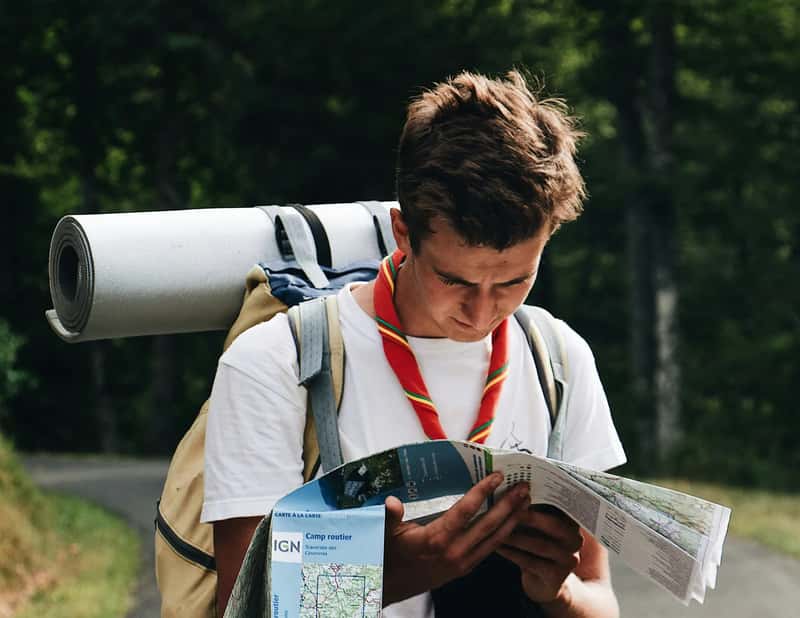
The paper map asks you to participate. To look. To think. To decide. It does not bark orders. It offers possibilities and waits for you to be human enough to choose one.
The act of choosing your own route is not a small thing. It is, psychologically speaking, one of the oldest and most fundamental expressions of selfhood. To reach for a paper map is to reach for that self again.
2. The Passive Passenger
There is a clinical term for what GPS has done to our brains.
Researchers call it technological “infantilization.”
Montello referred to this long-term damage as technological “infantilization,” which makes modern navigators less capable of navigating space without the aid of navigation systems than before, and this bears the potential to become even more dependent on technology.
Dependent. The word lands like a quiet diagnosis.
Technology thus erodes our spatial cognitive abilities, instead of guiding or incentivizing them, which impacts our independence, autonomy, and quality of life.
We were once explorers. Now we are passengers in our own lives, watching the world slide past a windshield, waiting to be told we have arrived. The paper map, in its physicality and its demand for active engagement, is the antidote to that passivity. It is a refusal to be infantilized. It is a deeply adult act.
3. The Hippocampus Has Opinions
Your brain built a room for maps. It has always had one.
The hippocampus is well known to play a critical role in spatial learning, memory and navigation, and has long been thought to contain the “cognitive map.”
That room is going dark.
Greater GPS use since initial testing was associated with a steeper decline in hippocampal-dependent spatial memory.
The science is unambiguous. Studies show heavy reliance on GPS weakens spatial memory and limits exploration, reducing the brain’s ability to naturally form detailed mental maps.
But here is the part that should stop you cold: the hippocampus does not only store maps. It stores memories. It stores identity. The memories anchored to places – the café where you first fell in love, the street corner where everything changed – live in that same neural architecture.
When we stop navigating, we do not just stop remembering where we are. We start forgetting who we were when we were there.
4. The Algorithm That Owns Your Walk
The algorithm is not neutral.
It is built on efficiency. On traffic data. On optimization. It wants to move you from point A to point B in the least amount of time, burning the least amount of fuel, avoiding the highest density of congestion.
Digitized mapping solutions simply have the mission to get you from one point to the next in the most convenient and efficient way. There is no need to gaze at the world around you.
No gaze. No pause. No detour down the alley that smells like rain and jasmine and something you cannot name but will never forget.
Participants subjected to algorithmic surveillance perceived they had less autonomy, criticized the surveillance more, performed worse, and reported greater intentions to resist.
The resistance is instinctive. The paper map is that resistance made physical – a sheet of folded paper that belongs to no server, reports to no company, and cannot be updated with sponsored routes or traffic-weighted bias. It is yours. Completely, stubbornly yours.
5. The Bakery I Almost Missed
I was in Lisbon. The phone was dying. There was no charger and there was no time and there was a bakery – small, yellow-doored, three streets off the route the algorithm would have chosen – that I would never have found if I had not been navigating by instinct and a hand-drawn sketch on a paper napkin.
Inside: the smell of custard and warm pastry. A woman behind the counter who was perhaps eighty and who handed me a tart without asking, as if she knew I had earned it.
I stood there for twenty minutes. I was late for everything. I did not care.
The algorithm would have routed me past that door without a second glance. Bohbot said: “When we get lost, it activates the hippocampus, it gets us completely out of the habit mode. Getting lost is good!”
The bakery was the gap. And I was in it. And I was, for those twenty minutes, exactly and entirely myself.
6. The Broad Map vs. The Narrow Strip
Psychologist Edward Tolman spent his career studying how brains understand space.
He had an insight that holds more urgency today than it did in 1948.
Tolman distinguished between narrow strip maps and broad comprehensive maps. Narrow maps result from brain damage, insufficient environmental cues, excessive repetition of a single route, or overly strong motivation and frustration. Broad maps, on the other hand, allow for flexible, creative navigation.
GPS gives you a strip. A corridor. A single, non-negotiable corridor through the city.
The paper map gives you the whole world laid flat on a table. It gives you context. It gives you the relationship between where you are and everywhere you could be instead.
The trend toward paper maps seems to allude to the human need for more than just a stoic computerized voice handing out cold instructions. What you get from a traditional paper map is the ability to see yourself in your surroundings – to grasp the context of the space you are in.
Context is identity. Without it, you are just a moving dot. With it, you are a person going somewhere.
7. The Allocentric Mind
There are two ways to navigate. Two entirely different cognitive modes that use different parts of the brain and reveal fundamentally different orientations toward the world.
Allocentric navigation is what you use when reading a paper map. You’re creating a mental model of the environment from an external perspective, understanding how different locations relate to each other in space.
Egocentric navigation – the GPS mode – is smaller. It is the self at the center. Turn here. Walk straight. The world is organized around your body, your momentum, your next instruction.
Research from University College London found that people who regularly use allocentric navigation have increased gray matter in their hippocampus, the brain region associated with spatial memory and navigation.
More gray matter. More brain. More self.
The paper map is not just a navigation tool. It is a cognitive workout. A way of staying inside your own mind rather than outsourcing it to a server farm somewhere in northern Virginia.
8. The Psychogeography of Drift
In 1950s Paris, a group of artists and theorists began doing something that looked, from the outside, like simply walking around.
They called it the dérive. The drift.
People develop subconscious, or even unconscious, relationships with spaces. The dérive was designed to access those relationships directly – to let the city’s psychological textures, rather than efficiency or habit, determine the route.
The SI’s toolbox was to move through places and take a walking dérive – translated as “drift” in English – to find the form or shape of a given space. To decide on a direction, these drifts rely on playful elements, such as tossing dice or following maps of one place to navigate another.
A paper map folded in a jacket pocket is a modern dérive toolkit. It is permission to look up. To deviate. To let the city offer something unscheduled. The algorithm cannot drift. Only humans can drift. And in the drifting, the self is discovered.
9. The Nostalgia That Is Not Nostalgia
The return of the paper map is often dismissed as nostalgia. Retro tourism. A quirky trend among people who also use film cameras and buy vinyl records.
That reading is too shallow.
A key reason for nostalgia’s prevalence, impact, and appeal is that it brings to the fore self-humanity – namely, internalizing the qualities regarded as uniquely human, such as moral reasoning, rational thought, personal agency, and emotional complexity, and integrating them into one’s self-concept.
Personal agency. That is the key phrase. The paper map is not a romantic object. It is an agency object. It is proof, held in both hands, that you are choosing your own direction.
In 2026, travelers will reject conventions and lean into passions that feel distinctive and truly their own. Every trip becomes a bold expression of individuality and identity.
The paper map is not a step backward. It is a step inward. Toward the self that algorithms were slowly, quietly, efficiently erasing.
10. The Map You Draw in Your Head
Here is what no algorithm can give you.
The map you make yourself.
Mental mapping encompasses the way people perceive, navigate, and interact with their environment, influenced by both personal experiences and objective realities. Each person’s mental map is unique, shaped by prior experiences, motivations, and subjective feelings.
Your map has the bakery on it. The bad corner. The shortcut that only works on rainy Tuesdays. The view from the bridge that makes everything feel temporarily survivable.
The brain connections that we make when we explore and navigate our environment help us better connect to the world around while nourishing what is called topophilia – “a strong sense of place, which often becomes mixed with the sense of cultural identity among certain people and a love of certain aspects of such a place.”
This is the deepest truth of the paper map revival. It is not about paper. It is not about maps. It is about topophilia – the love of place, the love of the specific, the love of a world that remembers you because you remember it.
The creation of cognitive maps, development of spatial expertise, and exploration of novel environments can have a positive impact on hippocampal structure and function. Every time you unfold a paper map, you are doing something neurologically radical. You are building your brain back. You are refusing the strip and choosing the world.
There is something happening in the quiet spaces between where we are and where we are going. Something that cannot be measured in arrival times or traffic density scores or algorithmic efficiency ratings. It is the sound of someone – maybe you – deciding to look up from the blue dot and see the actual street.
The paper map is a political object. It is a psychological document. It is, in its most essential form, a piece of technology that gives everything back – the confusion, the choices, the wrong turns, the unexpected right ones. It gives you back the cognitive labor of knowing where you are and what it means to be there. And in that labor, in that beautiful, slightly inconvenient friction of figuring it out for yourself, the self is quietly reassembled.
The algorithm decides where you walk. The paper map remembers that you were always the one who was supposed to.