You are standing on a corner you do not recognize.
Your phone is dead.
Your pulse is not.
Something ancient and electric moves through you – not panic, but something older. Something that remembers.
We have built identities around the illusion of knowing exactly where we are at all times. We are the GPS generation. Pinned. Located. Tracked. And yet, in the quiet erosion of that certainty, something has begun to push back. The paper map is returning. Not in nostalgia shops. Not as a retro prop for Instagram aesthetics. It is returning in the hands of people who can no longer stand the sound of a voice telling them where to go. People who have begun, slowly and subconsciously, to want their own routes back.
The Surrendered Route
Spatial navigation, which had been a process performed exclusively by the human brain and perceptual system, has now been surrendered to technology. In doing so, we also surrendered our agency.
Think about that word. Surrendered.
Not handed over. Not loaned out for the weekend. Surrendered – the way you surrender something when you have stopped believing you deserve to keep it.
By following a set of digital turn-by-turn directions, GPS navigation apps treat us as passive passengers rather than active explorers, removing our agency to make decisions. In turn this inhibits our ability to create proper mental maps of the surrounding environment, and negatively impacts the hippocampus, which is critical for brain health.
The hippocampus. The oldest librarian in the building.
We handed it a pink slip and called it progress. And the trouble with surrendering slowly is that you barely notice the weight leaving your hands. You only notice later, standing on a corner you do not recognize, with a dead phone and a racing pulse, that something important is gone.
The paper map is a refusal to surrender again.
The Infantilized Navigator
Psychology has a clinical name for what the algorithm has done to us.
Researchers call it technological “infantilization” – which makes modern navigators less capable of navigating space without the aid of navigation systems than before, and this bears the potential to become even more dependent on technology.
Dependent. The word lands like a quiet diagnosis.
Technology erodes our spatial cognitive abilities, instead of guiding or incentivizing them, which impacts our independence, autonomy, and quality of life.
We were given a tool. The tool became a crutch. The crutch became a chair. Now we are seated passengers in a journey that was once the most human thing we did – moving through the world and knowing, bone-deep, where we were.
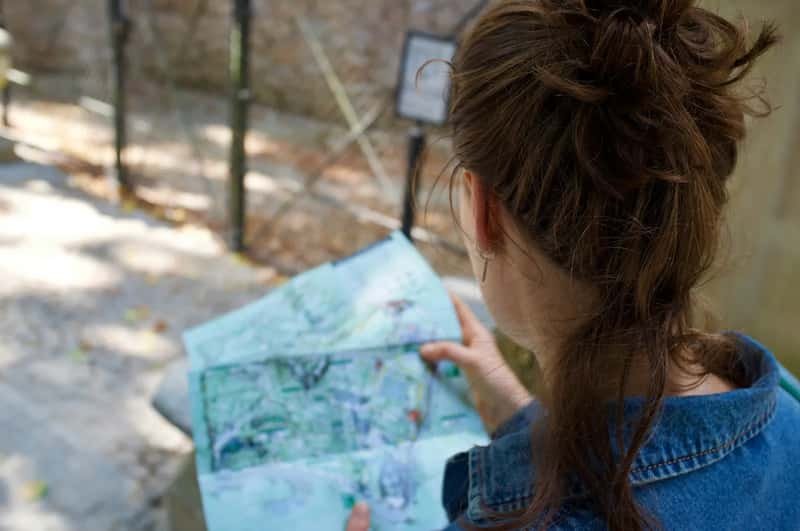
The paper map does not infantilize. It demands. It asks you to orient yourself, to read the landscape, to make a decision with your own two eyes. It treats you like an adult. And that feeling – the weight of being trusted to find your own way – is something the algorithm was never designed to give you.
The Attention Theft
The navigation system does not just redirect your feet. It redirects your eyes. Your attention. The entire perceptual bandwidth you were born to use.
The use of a navigation system reduces what properties from the surroundings a navigator selects and diminishes the navigator’s allocation of attentional resources. The navigation system designers pre-determine which properties get selected and how they are represented by the system, which also pre-determines the allocation of attention.
Read that again. Slowly.
Someone else is pre-determining where your eyes go.
You are not walking through a city. You are walking through someone else’s edit of a city. A curated corridor, stripped of surprise. The corner café that always smells of burnt sugar and cardamom. The mosaic on the wall that someone left for you, specifically, to find. These things exist outside the algorithm’s frame. They always did. You just stopped looking.
The paper map gives your attention back. No one pre-determines the view.
The Strip Map Mind
Edward Tolman, the mid-century psychologist, described two kinds of cognitive maps. Broad ones, which allow for flexible and creative navigation. And narrow ones – strip maps – which he associated with constraint, repetition, and an excess of emotional pressure.
Tolman distinguished between narrow strip maps and broad comprehensive maps. Narrow maps, he argued, result from brain damage, insufficient environmental cues, excessive repetition of a single route, or overly strong motivation and frustration. Broad maps, on the other hand, allow for flexible, creative navigation.
The GPS gives you a strip map every single time.
A thin, luminous corridor from here to there. No peripheral vision. No cognitive sprawl. No sense of the city as a living, breathing, three-dimensional thing that surrounds you in all directions at once. We have been living inside a strip for years. The paper map hands you the whole territory. It is overwhelming. It is glorious. It is the difference between a hallway and an open field.
The Hippocampus You Are Quietly Killing
Here is the part that should make you set down your phone.
Greater GPS use since initial testing was associated with a steeper decline in hippocampal-dependent spatial memory.
The hippocampus. Behind your ear. Near the base of your skull. It oversees spatial memory, yes – but that is not all it does. It oversees spatial orientation and memory, is key to planning and decision-making, and appears to play a role in our ability to imagine the future. A reduction in the size of the hippocampus is seen in Alzheimer’s disease and other types of cognitive impairment.
I remember the first time I drove a familiar route without GPS and realized, with a slow cold dread, that I could not recall the name of the street I had turned onto dozens of times. It was gone. Not forgotten – never encoded in the first place. The algorithm had always been there to catch me. And in catching me, it had ensured I never learned to catch myself.
I bought a paper map the next day. Not as a stunt. As an act of grief, and then recovery.
The Resistance That Lives in the Body
The rebellion against GPS is not happening in think-tanks or academic papers first. It is happening in the body.
Participants subjected to algorithmic surveillance perceived they had less autonomy, criticized the surveillance more, performed worse, and reported greater intentions to resist. The resistance is instinctive.
That instinct is older than the iPhone. Older than the car. It is the same instinct that made your ancestor stop, scan the horizon, and choose a direction based on nothing more than light and wind and the smell of water somewhere to the east.
The paper map is that instinct given paper form. It is the body saying: I remember how to do this. I would like to try again. The rebellion is not loud. It does not march. It simply unfolds – quietly, in the hands of someone standing at a crossroads, choosing for themselves.
The Memory That Gps Cannot Build
There is a kind of memory that only gets made when you are lost.
Research comparing paper maps with navigation systems has found that pedestrians using paper maps show better spatial knowledge and orientation, but at the cost of lower navigation performance – longer duration to destination – compared to when they are using navigation systems.
Longer duration. As if duration were the enemy.
As if the minutes spent turning the map sideways, finding the sun, squinting at a street name, were not the very minutes that would lodge this city in your memory forever. The algorithm gets you there faster. The map gets you there with the city inside you. People who travel along given routes using GPS gain less knowledge about those routes compared to people who travel the same routes without an aid, using a map, or after being guided by an experimenter. The knowledge is the point. The knowledge is the whole point.
Speed is what you trade when you decide the destination matters more than the journey. Most of us made that trade without knowing we were making it.
The Place That Loves You
There is a word for what happens when you truly navigate a place. When you walk it without instruction, commit its corners to memory, feel its logic settle into your body like a second skeleton.
The brain connections that we make when we explore and navigate our environment help us better connect to the world around us while nourishing what is called topophilia – “a strong sense of place, which often becomes mixed with the sense of cultural identity among certain people and a love of certain aspects of such a place.”
Topophilia. The love of place.
Not the love of a coordinate. Not the love of a pin on a map. The love of a specific corner at a specific hour when the light does a specific thing to the stone and you know, in your chest, that you belong here because you learned this place the hard way.
The algorithm cannot give you topophilia. It can only give you arrival. And arrival without belonging is just location. The paper map builds the love. Slowly, messily, gloriously.
The Brain You Are Building Back
The neurological news is better than you think. The damage is not necessarily permanent.
The creation of cognitive maps, development of spatial expertise, and exploration of novel environments can have a positive impact on hippocampal structure and function.
Positive impact. On the structure of the brain itself.
Recent studies have found that exercising spatial cognition might protect against age-related memory decline. Therefore, it is important that, while using technology, we still engage with the world around us, as we know it is important for brain health.
Every time you unfold a paper map, you are doing something neurologically radical. You are rebuilding a faculty that the algorithm was quietly dismantling. You are not being nostalgic. You are being strategic. You are choosing, deliberately and with full knowledge of what you are doing, to think your way through a place instead of being told your way through it. That is not a small act. That is an act of profound self-reclamation.
The Quiet, Folded Act of Reclaiming the Self
This is the deepest truth of the paper map revival. It is not about paper. It is not about maps. It is about topophilia – the love of place, the love of the specific, the love of a world that remembers you because you remember it.
The act of choosing your own route is not a small thing. It is, psychologically speaking, one of the oldest and most fundamental expressions of selfhood. To reach for a paper map is to reach for that self again.
This is the identity gap the algorithm exploits and the paper map closes. The gap between the person who navigates and the person who is navigated. Between the traveler who chooses the road and the passenger who simply obeys the voice. We became passengers so gradually that we called it convenience. We called it efficiency. We called it progress. We did not call it what it was: a slow renegotiation of who gets to decide where we go.
The paper map has no algorithm. It has no data on your preferences, your history, your most efficient route to work. It knows nothing about you. And that is precisely why it sets you free. Freedom, it turns out, does not feel like a shortcut. It feels like unfolding something in your hands and not knowing yet where you will end up. It feels like trusting yourself with the territory.
Put down the phone. Unfold the map. Stand in the middle of a city that does not know your name and does not care where you have been. Let the streets surprise you. Let yourself get turned around, just slightly, just enough to have to think. Let your hippocampus do the ancient, gorgeous, irreplaceable work it was built to do. Somewhere between the legend and the scale bar, between the blue lines of rivers and the bold dots of cities, you will find something the algorithm never indexed.
You will find the part of you that still knows how to be somewhere.