The city never sleeps.
Neither do you.
Somewhere between the fourth notification and the sixth open tab, you stopped looking up.
The sky became a ceiling. The night became a backdrop for streetlights. The stars – those ancient, indifferent, magnificent fires – became something you vaguely remember from a childhood camping trip.
There is a gap between the person you perform during the day and the person who stands in a field at 2 AM, neck craned, mouth slightly open, absolutely undone by the sheer volume of light pouring out of a universe that does not know your name – and does not need to. That gap is where identity lives. That gap is where the real self waits, quietly, for the noise to stop.
1. The Vanishing Ceiling
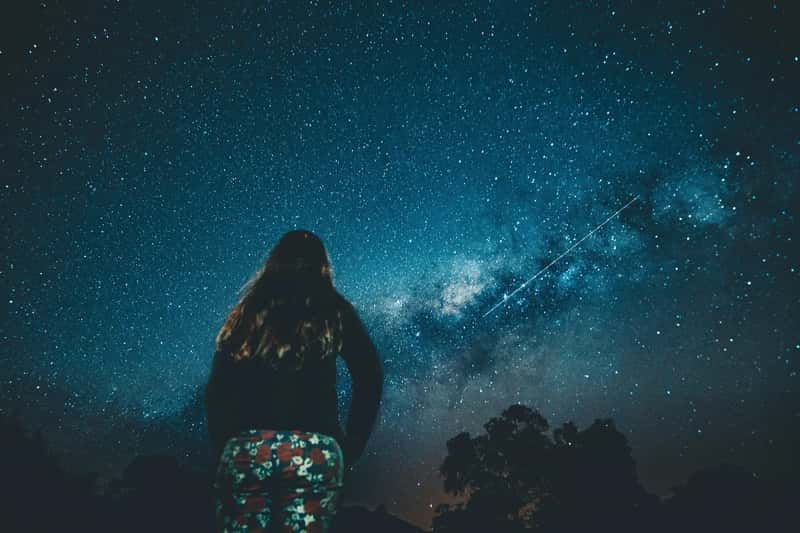
We have, without ceremony, erased the sky.
In the USA and Europe, 90% of citizens live under light-polluted skies. Ninety percent. That is not a statistic. That is a civilization collectively pulling the blinds on its own cosmological address.
In the last century and a half, the rise of light pollution has significantly altered our night skies, negatively affecting human health, wildlife, and ecosystems.
We built the glow. We called it progress. We forgot to ask what we were trading.
What we traded was perspective. The visceral, cellular, ancient knowledge that we are small. That smallness, it turns out, is not a wound. It is a relief. The modern psyche carries the unbearable weight of being the center of its own universe. The actual universe offers a cure. But first, you have to be able to see it.
Most of us no longer can.
2. The Hunger We Didn’t Know Had a Name
Something is pulling people out of cities. Past midnight. Into fields. Into national parks. Into the cold.
Interest in astrotourism – traveling for the sky’s wonders – has soared in the United States since the pandemic. Analysts say the global nighttime tourism market, now around $10 billion, could double by 2035.
That is not a travel trend. That is a symptom.
Psychology has a word for what people are chasing: awe. Research shows that experiencing awe – the feeling of being in the presence of something vast – shifts our focus away from our own ego. The ego, in the modern world, is exhausted from overwork. It has been performing identity for so long that it has forgotten what it feels like to simply exist inside something larger than itself.
Dark sky tourism is what happens when the hunger finally finds its name.
3. The Science of Standing Small
This is not soft metaphor. This is neuroscience.
Growing global evidence shows that awe-filled experiences activate brain regions tied to emotional regulation, reduce cortisol levels, and restore a sense of calm.
Feelings of awe have been shown to reduce inflammation, lower the heart rate, and increase the presence of the hormone oxytocin, boosting positive emotions.
The body knows what the mind resists admitting: that surrender to scale is not weakness. It is medicine.
Research showed that visual stimulation with images of dark night sky significantly reduced the concentration of oxygenated hemoglobin in the right prefrontal cortex, and the psychological rating of healing was significantly higher compared to bright night sky.
The dark heals. The quiet recalibrates. The stars do something to the nervous system that no app, no supplement, and no self-help framework has been able to replicate.
And we have been living without it.
4. The Urban Identity Trap
The city gives you an identity, then charges rent for it.
It tells you who to be through what you consume, where you live, how fast you walk. It measures your worth in productivity and your relevance in impressions. Light pollution is linked with a decrease of average nightly sleep length in adolescents, with a study published in JAMA Psychiatry finding that in areas with high outdoor light pollution, sleep for the average American teen was likely to dip below healthy levels.
When people get less than adequate sleep, they risk poor performance at work and in school, increased mood swings and irritability, and heightened risk for depression and anxiety.
Beneath the insomnia is the deeper wound: a self that has never been allowed to go quiet. The urban identity is a costume that never comes off. Dark sky tourism is, at its core, an act of undressing. Of stripping the costume in a field somewhere in Montana or Namibia or the Atacama, and standing there in just your original skin, looking up at something that remembers what you are.
5. The Personal Reckoning
I drove four hours once. No destination worth mentioning. Just away from the amber haze of the city, following a road that got narrower and darker as it went.
When I finally stopped and stepped out of the car, the first thing I noticed was the silence. The second thing was the sky. The Milky Way – a thing I had intellectually known existed – appeared above me like a revelation I hadn’t earned. My chest did something unfamiliar. It loosened.
I stayed two hours. I drove back before dawn. For weeks afterward, something about my relationship to my own urgency had shifted. The emails seemed slightly less catastrophic. The deadlines, slightly less total. I had been reminded – by geometry and light-years and the sheer indifference of deep space – that the scale of my anxiety did not match the scale of my actual existence.
That is not mysticism. Research has noted that the cosmic element – the vastness, the awe – induces a uniquely profound shift that not only calms individuals but transforms their understanding of self and their role in the universe.
6. The Overview Effect, Democratized
Astronauts have a term for it.
The “Overview Effect” is a cognitive shift often described by astronauts when viewing Earth from space. By guiding ordinary individuals to gaze at the cosmos, researchers aspire to replicate this profound shift, eliciting feelings of tranquility, gratitude, and a shared sense of humanity.
Dark sky tourism is the ground-level version. It is the Overview Effect for people who will never leave the atmosphere but desperately need to feel, just once, that the planet they live on is floating.
Among populations with low light pollution, a feeling of “wonder about the universe” is prevalent, and this human emotion mediates the association between low light pollution and behavioral interest in astronomy.
Wonder is not naïve. Wonder is a recalibration mechanism. It is how the psyche rewrites the story it tells about the size of its own problems. You cannot stare into the Andromeda Galaxy – two and a half million light-years away, visible to the naked eye – and remain entirely convinced that your inbox is a genuine crisis.
7. The Collective Burnout Signal
When millions of people start traveling hundreds of miles to stand in darkness, you have to ask: what are they running from?
Visitors at the Jasper Dark Sky Festival were middle-aged, balanced between genders, traveled an average of 430 km, and were primarily urban-based. Urban. Middle-aged. Traveling far. These are not the demographics of casual recreation. These are the demographics of people who have been performing competence for two decades and need, urgently, to be relieved of it.
A greater connection to the night sky was significantly and positively related to a person’s mental health and happiness, and those who live in more light-polluted areas are less connected to the night sky and feel less likely to protect it.
Disconnection compounds. The less sky you see, the less you feel connected to what the sky represents: the longer story. The bigger picture. The evidence that you are part of something ancient and ongoing, not merely the protagonist of a quarterly performance review.
8. The Sensory Re-Entry
The body has to be coaxed back into the present. The mind, left to its own devices in the modern world, lives almost entirely in the future – in the anticipation of threat, the projection of consequence, the rehearsal of conversations that may never happen.
The dark sky is sensory immersion that the anxious mind cannot argue with. Stargazing, nocturnal wildlife watching, and wellness activities are all useful ways of connecting to the natural night while developing mindfulness, and practicing these activities regularly can result in reduced levels of stress and tension, which also contributes to overall physical and mental health.
Away from the city and looking up at the stars on a clear night, the quiet only disturbed by the occasional hoot of an owl, everyday stresses become lighter, even if only temporarily. When you’re captivated by what’s in front of you, negative emotions seem to dissipate.
The sensory experience bypasses cognition. It does not ask you to reframe your thinking. It simply places your body in a field, surrounds it with ancient light, and waits for the nervous system to remember what peace felt like before the notifications started.
9. The Identity That Travels
There is a version of you that only appears in certain conditions. Away from your job title. Away from your social media persona. Away from the role you play in your family, your office, your neighborhood.
Drawing upon the concept of emplacement, which emphasizes the connections between mind, body, and environment, researchers explore how sensory engagement with natural darkness contributes to a new epistemic understanding of dark-sky ecologies.
That word – emplacement – is doing profound psychological work. It means that the self is not portable in the way we pretend. We are shaped by our environments. The fluorescent office, the scrolling feed, the gridlocked commute – these are not neutral containers. They are identity architects, building a version of you that is efficient, reactive, and chronically overstimulated.
Dark sky tourism places you in an environment that dismantles that construction. The person standing under the Milky Way at midnight is not the person who answered forty-three emails that day. They are something older. Something truer. Since ancient times, people have watched the stars, understood the movements of astronomical beings, and incorporated them into their lives and culture. That self is not lost. It is waiting for the right darkness.
10. The Rarest Resource
We have made darkness scarce.
And in doing so, we have made perspective scarce. We have made awe scarce. We have made the biological experience of smallness – which turns out to be psychologically essential – into a luxury that requires a road trip, a reservation, and a certified dark sky destination.
One-quarter of Gen Z travelers are interested in traveling specifically for astrotourism, according to a 2024 survey. A generation raised entirely inside the glow of screens is now traveling hundreds of miles to escape it. That is not ironic. That is desperate. That is a generation that has never known what it feels like to be cosmologically located – to know, in the body, not just the mind, that the universe is incomprehensibly large and that this fact is not terrifying but profoundly, physically relieving.
Dark-sky festivals effectively build ecological awareness and empower stakeholders to protect the night sky, evidenced by respondents noting that the skills and knowledge gained would help them educate others and take action to reduce light pollution in their communities.
The movement growing around dark skies is not merely recreational or environmental. It is psychological. It is a civilization collectively reaching for the thing it quietly, desperately knows it has lost: the felt sense of its own true scale.
We are not merely tourists seeking a view. We are a species in identity crisis, packing into cars and driving toward the one mirror that has never lied to us – the sky that shows us exactly how large we are not, and somehow, in that revelation, makes us feel more whole than we have in years.
The stars do not care who you are professionally. They do not respond to your credentials or your follower count or the velocity of your ambition. They simply burn, as they have burned for billions of years, indifferent and magnificent, patient as mathematics. And when you stand beneath them long enough, something in you – the part that has been white-knuckling the illusion of control – finally, quietly, lets go.
Maybe that is the only journey that has ever mattered: not the one to the dark sky reserve, but the one back to the self that was always small enough to look up with wonder, and wise enough to find comfort there.