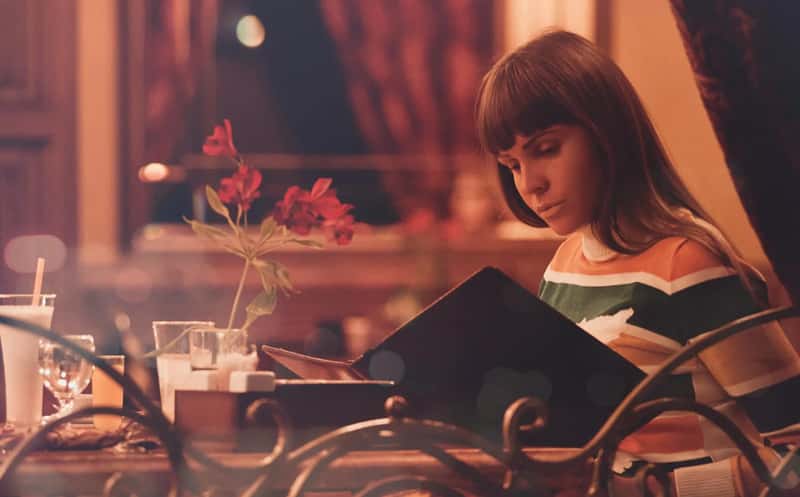
The table is set for one.
The book is open.
The world keeps spinning, loudly, at the next table over.
You don’t look up.
There is a particular kind of person who does this regularly. Not out of sadness. Not out of failure to secure companions. They do it because somewhere between the breadbasket and the second chapter, they found something the noise outside could never offer them: themselves. We live in an era that pathologizes stillness, that reads a quiet table as a distress signal, that mistakes a spine-cracked paperback for a white flag. But the serial solo diner who reads at the table isn’t waving a flag. They’re building a wall – ten bricks high – and they know exactly what they’re keeping out.
1. The Corner Table Protocol
It begins with the choosing of the seat.
This is not incidental. It is architectural.
To protect your solitude, the instinct is to position yourself in an out-of-the-way place – a table off in a corner, out of the traffic flow, somewhere with sufficient light to read but without the drift of passing strangers. This is not shyness dressed up as preference. This is spatial sovereignty. The serial solo diner understands, perhaps unconsciously, that environment is the first layer of the fortress. You cannot build inward peace on an exposed perimeter.
The corner table is a declaration.
It says: I am here, but I am not available.
There is a profound psychological literacy in that. The ability to curate your surroundings, to occupy space on your own terms, is the opening move of a person who has stopped waiting for permission to exist comfortably in the world. Eating solo can be a small way to reclaim agency – you choose where to go, what to eat, how long to linger – and the cumulative effect of doing things on your own terms can build confidence. It’s a subtle but powerful way of practicing self-trust.
The corner is the first brick.
2. The Book as Armor
It is not just reading. It is signaling.
The open book on the table is a force field with a spine and a cover price. Whatever you choose as your dining companion, placing it directly on the table and angling your gaze downwards will make it difficult for those around you to catch your attention – and signals that you are content in your isolation.
Content. Not desperate. Not performing.
There is a radical difference between those two states, and the world rarely credits the solo reader with the former. But the psychology is unambiguous. Research shows that people comfortable with solitude tend to have higher self-esteem and are less likely to be swayed by peer pressure. They’ve learned that their worth isn’t determined by who’s sitting across from them.
The book is not a prop for looking busy.
It is the honest answer to the unasked question: What do you need right now?
This. Exactly this.
3. The Spotlight Effect Dismantled
Here is the uncomfortable truth about the solo diner’s deepest anxiety.
Nobody is watching.
The self-consciousness of dining alone fades faster than you’d expect, partly because of a well-documented phenomenon: researchers found that people consistently overestimate how much attention others are paying to them – a bias called the spotlight effect. The table beside you is absorbed in its own theater. Its own arguments. Its own silences. Your solitude is, statistically, invisible to everyone but you.
And yet the fear persists.
A study published in 2025 found that U.S. news headlines are ten times more likely to frame being alone negatively than positively. This makes sense given that American culture holds up extraversion as the ideal – indeed as the basis for what’s normal. We have been marinated in a narrative that frames aloneness as lack. No wonder sitting down with a novel feels like a minor act of defiance.
Dismantle the spotlight. Pick up the fork. Turn the page.
4. The Autonomy Architecture
Self-Determination Theory has a name for what the solo diner is doing.
They call it satisfying a basic psychological need.
Autonomy is a fundamental psychological need, and fulfilling it is essential for overall well-being. According to Self-Determination Theory, developed by psychologists Edward Deci and Richard Ryan, autonomy, competence, and relatedness are three basic psychological needs that drive human motivation and well-being – and eating alone in restaurants satisfies the need for autonomy by allowing individuals to take control of their dining experience.
Nobody negotiates the menu here.
Nobody asks if you really want the pasta again.
Eating alone at a restaurant allows you to embrace independence. Without the need for conversation, you can focus on your meal and your own thoughts. This is a time to be self-indulgent, order exactly what you crave, and linger as long as you like over dessert. It’s your time, your rules. This is not selfishness. This is the sound of a psyche finally breathing out.
5. The Pressure Valve
I remember the first time I understood what I was actually doing at a restaurant alone.
It was a Tuesday. An unremarkable one. I had come from a meeting that required me to perform enthusiasm I did not feel, to mirror energy that was not mine. I chose a small place with dim lighting and a window. I ordered something warm. I opened a book I’d been carrying for three weeks without starting. And somewhere between the soup and page fourteen, something unwound in my chest.
I wasn’t reading to kill time. I was reading to kill the noise.
Many people intriguingly weave the desire for eating alone with their introvert personality. Many view the contemporary world as overly social and report using solo dining as a chance to recover from the pressures of the socially demanding and otherwise chaotic everyday life.
By taking the social pressure off, solitude can free us to be who we “are,” according to a 2023 study in Scientific Reports. Researchers found that on days when participants chose to spend more time alone, they felt not only less stressed, but also less “controlled” or pressured to behave in a certain way.
The restaurant table, that Tuesday, was my pressure valve.
6. The Identity Recalibration
There is a version of you that only emerges alone.
Not a hidden version. Not a secret one. The real one. The one unfiltered by the social contract’s relentless demand that you be legible, agreeable, and appropriately engaged. Solitude helps us define and nurture our character and grows our resilience and independence. We can free ourselves from the demands of others and discover our natural and personal likes and dislikes.
The serial solo diner knows this intuitively.
Research has documented a long list of benefits gained when we choose to spend time by ourselves, ranging from opportunities to recharge and experience personal growth, to making time to connect with our emotions and our creativity. Being alone can help remind people who they are – so it makes sense that when asked why they prefer to dine solo, people say simply, “I want more me time.”
The book is the mirror. The table is the room where you finally look into it without flinching.
7. The Decision Muscle
Solo diners make better decisions.
Not a romantic claim. An empirical one.
Research from the Journal of Personality and Social Psychology suggests that people who spend time alone regularly develop stronger decision-making abilities because they’re forced to rely on their own judgment rather than group consensus. The serial diner is, meal by meal, strengthening a muscle that crowded tables atrophy. There is no committee here. No social thermometer to read before committing to an opinion. People comfortable dining alone have typically learned to trust their own judgment. They don’t need a committee to make decisions. They’ve developed their own taste, literally and figuratively.
Every solo meal is a small rehearsal.
A rehearsal for trusting yourself when the stakes are higher than the dessert menu.
Research in social psychology shows that people who regularly spend time alone are less susceptible to groupthink and more likely to maintain their values even when they go against the grain. In a world of endless influence and comparison, that’s a superpower.
8. The Mindfulness That Doesn’t Require a Mat
There is a meditation happening at that table.
It doesn’t announce itself.
When you eat alone, there’s more room to tune in to the texture of your food, the way your body feels, and the quiet around you. Solo meals offer a perfect opportunity to practice mindfulness without the pressure of meditating. You’re just present, bite by bite. This is the kind of awareness that wellness culture charges a premium to simulate in a studio. The serial solo diner finds it between the appetizer and the entrée.
The book deepens it.
Reading in public requires a calibrated attentiveness – the kind that holds a fictional world in the foreground while the real world hums, softly, at the edge of perception. It is a dual consciousness. A practiced grace. Psychologists suggest that spending time alone can enhance creativity and problem-solving skills. When dining solo, individuals have the chance to reflect on their day, process their thoughts, and engage in deep thinking, leading to increased mental clarity and better decision-making.
9. The Emotional Independence Infrastructure
To sit with yourself in public is to pass a test that most people quietly fail.
It requires that you have done a certain interior work. That the quiet, when it comes, does not fill immediately with dread. Solo diners have typically done the inner work. They’re comfortable with their thoughts, even the uncomfortable ones. While others might need constant distraction or validation, they can process their emotions independently.
This is not a minor achievement in 2026.
Recent studies that examined the role of conscious decision in alone time found that the negative effects typically associated with being alone were reduced or entirely eliminated when participants purposefully set aside the time for a solo activity. Some even reported decreased stress, reduced moodiness, and improved sleeping habits.
The fortress is not just about keeping the world out. It is about keeping yourself in. About refusing to lose the thread of who you are in the ambient noise of what everyone else needs you to be.
This self-awareness extends beyond food choices. These individuals often have a clearer understanding of their values, goals, and boundaries.
10. The Restoration That Nobody Sees
This is the heaviest brick.
The one at the top. The one the fortress cannot stand without.
Solitude is far more than a passive interlude between social interactions. It actively meets psychological needs. During periods of solitude, people can feel more or less autonomous and competent. When people felt more autonomy during solitude, they also felt more peaceful. When they felt more competent during solitude, they felt less lonely.
Less lonely. Alone at a table. With a book.
The world has this entirely backwards.
Solitude not only can satisfy basic psychological needs; it can also compensate for needs not met when socializing. Time alone helps increase overall well-being, and on days when social interactions leave people wanting more autonomy, competence, or relatedness, solitude can help restore the balance. The serial solo diner is not retreating from life. They are restoring their capacity to live it fully. The restaurant table is not a surrender. It is a charging station – analog, unhurried, profoundly human.
Solitude not only satisfies the psychological needs for autonomy, competence, and relatedness, but can also restore well-being when social interactions fall short. Quiet moments alone aren’t merely breaks from the social world; they are fundamental to maintaining our emotional and psychological balance.
Ten bricks. A fortress built not against people, but against the version of yourself that disappears when surrounded by them.
The restaurant empties slowly around closing time. The server refills the water glass without being asked. The book is nearly finished. The plate has been cleared. Outside, the city continues its relentless performance – its group chats, its shared appetizers, its social contracts signed in eye contact and laughter.
In here, something else is true. Something quieter and more durable. Solitude’s benefits don’t automatically appear whenever we take a break from the social world. They arrive when we are truly alone – when we intentionally carve out the time and space to connect with ourselves. The serial solo diner understands this without being able to articulate it. They understand it the way the body understands rest. Not as a concept. As a relief.
The check arrives. The book is marked. The coat goes on. And for a moment, before re-entering the noise, there is a stillness that belongs entirely to the person who chose this table, this book, this quiet. Not because they couldn’t find company. But because they found something better.
Themselves.