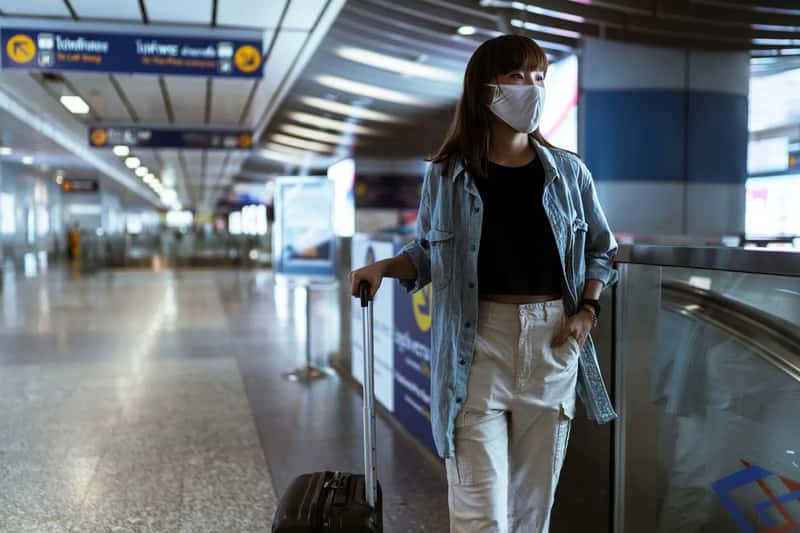
The airport terminal is grey and cold at 4 AM.
She is already moving.
The bag is heavy. Both of them.
She does not ask.
She never asks.
There is a version of every woman who has learned to travel light on the outside and catastrophically heavy on the inside. She zips the bag herself. Lifts it herself. Finds her gate herself. Does all of it with the kind of quiet competence that gets mistaken for strength – and is, more often than not, something much older and much sadder than strength.
The identity gap is this: the woman who hauls her own luggage through a crowded terminal is not always a woman who wants to. Hyper-independence is more than just being self-sufficient – it’s a psychological pattern where someone becomes so determined to handle everything alone that it interferes with their relationships, well-being, and ability to receive support. It’s a trauma response disguised as a strength. The woman who never asks for help in the airport is performing a version of herself that was written by every person who wasn’t there when she needed them.
She’s not traveling. She’s proving something.
1. The Survival Blueprint
It started before she ever owned a suitcase.
Hyper-independence doesn’t come out of nowhere. It’s a learned response to unmet needs.
Somewhere in her early architecture – a childhood bedroom, a dinner table where no one asked how she felt, a parent too consumed by their own chaos to notice hers – she drew up a blueprint. Handle it yourself. Don’t wait for rescue. Rescue is a fairy tale.
When her emotions weren’t met with care, comfort, or attunement, she likely learned that relying on others wasn’t safe or effective. She adapted. She became the strong one, the one who doesn’t ask for anything. Because asking meant risking rejection, disappointment, or shame.
The blueprint was smart. It protected her. The tragedy is that she never stopped building from it. She carried the blueprint into every relationship, every airport, every heavy bag she refused to hand off. The survival plan became the personality. The personality became the prison.
2. The Vanishing Act
The first time someone promised to be there and wasn’t, she filed it quietly.
Psychologists say extreme self-reliance often grows out of disappointment rather than natural strength. When someone experiences enough moments where support doesn’t arrive – when promises fall through, when people disappear during hard times – the brain quietly adjusts its expectations. It stops assuming anyone will show up. And once that expectation changes, independence stops being a personality trait. It becomes a survival strategy.
The vanishing act doesn’t always look dramatic. Sometimes it’s the partner who said “I’ll handle that” and didn’t. The friend who went quiet exactly when the crisis hit. The parent who looked right through the pain and called it fine.
Each vanishing act added weight. Not to the bag – to the belief. I can’t count on anyone. She wheels the bag herself. She carries the belief even farther.
3. The Worthiness Wound
Beneath every refused hand is a quiet, terrible question: Do I deserve help?
A significant barrier to receiving is a sense of worthiness. This feeling of unworthiness is often unconscious – meaning women are not consciously aware that they think this way – but it shows up in their inability to fully receive compliments, help, or gifts.
She waves off the offer. “I’ve got it.” She smiles while her shoulder aches.
Women who struggle with receiving often have underlying beliefs that they’re undeserving of help, or that accepting support makes them weak. But learning to receive creates deeper connections and actually strengthens relationships rather than diminishing them.
The worthiness wound is not loud. It doesn’t announce itself in the departure hall. It just sits at the bottom of her chest, quiet and dense, whispering that support is something other women get. Women who are softer. Easier. Less complicated. Not her. She hefts the bag again. The wound stays packed neatly inside it.
4. The Performance of Capability
She has been called strong so many times that the word no longer feels like a compliment.
It feels like a sentence.
Hyper-independence in women is often praised by others. She may be called “strong,” “capable,” or “unstoppable.” But behind that strength can be a lifetime of unspoken emotional labor, chronic burnout, and quiet loneliness.
The performance is exhausting precisely because it never closes. There is no intermission. She performs capable at the check-in counter. She performs capable in the relationship. She performs capable in the doctor’s office, the boardroom, the argument she has alone in the car at midnight.
Many hyper-independent women silently struggle with self-doubt. Despite appearing competent and in control, they often feel they’re faking their strength. They might also feel guilt over wanting emotional support, as if it contradicts their “strong woman” image.
The guilt is the cruelest part. She wants help. She feels guilty for wanting it. She refuses it anyway. The performance continues, right on schedule.
5. The Resentment That Has No Address
I have stood in a terminal with a bag so heavy my arm went numb. I did not ask the man standing two feet away – a man I was in a relationship with at the time – for help. I smiled instead. I said nothing. Later, alone at the gate, I felt a hot, wordless anger I couldn’t explain and didn’t know how to direct.
That anger had an address. I just couldn’t read it yet.
Women in this pattern often feel resentment when their partner needs support, because they never allowed themselves the same.
She would rather carry the load than risk being let down, argued with, or told she’s “overreacting.” Over time, her self-reliance becomes a wall – and the partner might not even notice, because things are still getting done. The quiet danger here is the story that forms in her mind: “I can’t count on you.”
The resentment has no one to deliver itself to. She packed it herself. She carries it past the gate. She carries it still.
6. The Attachment Wound in Motion
Every refusal to ask for help is a conversation with the past.
A study published in Current Directions in Psychological Science sheds light on how early interpersonal experiences shape behaviors in adult relationships. Research spanning decades reveals that attachment patterns formed in infancy affect emotional regulation, conflict resolution, and openness in romantic relationships later in life. Individuals with early experiences of inconsistent support often develop self-reliance as a protective mechanism.
She is not refusing the stranger’s offer at the baggage carousel. She is refusing every person who made asking feel dangerous.
For hyper-independent individuals, emotional distance feels like protection. They believe love inevitably leads to disappointment, as closeness often results in loss and heartbreak. To them, closeness comes at a price: People leave, bonds break, and what once felt safe eventually fades.
The attachment wound travels well. It requires no checked baggage. It never triggers the weight limit. It arrives at every destination exactly on time, dressed in the language of capability and self-sufficiency.
7. The Unsent Request
She thought about asking. She always thinks about asking.
She stopped asking. Not out of anger or resentment – just because it stopped feeling useful. If someone has learned that asking doesn’t always change the outcome, the mind begins to skip that step entirely. Instead of reaching out, they move directly into action.
Handle it. Solve it. Move on.
Many women don’t ask because their body remembers what happened last time – disappointment, criticism, or being ignored.
The unsent request lives in the nervous system, not the mind. She isn’t consciously thinking no one will help me. She is simply, automatically, already lifting. The request never forms a sentence. It dissolves somewhere between the impulse and the throat. Another small abandonment of herself. Another quiet vote against her own needs. She doesn’t notice. She’s already at the gate.
8. The Loneliness That Wears a Blazer
She is surrounded by people. She has never felt more alone.
Perhaps the most overlooked cost is loneliness. Human beings are wired for connection. When emotional independence turns into isolation, it can lead to loneliness, which research links to higher risks of depression, anxiety, and even cardiovascular issues.
The loneliness that wears a blazer is the most socially acceptable kind. It looks like a woman who has everything handled. It looks like efficiency. It looks, from the outside, like a life well-organized.
‘Independent Woman Syndrome’ refers to a behavioral pattern where a woman overly relies on herself to the point of emotional isolation. It’s not about having independence – it’s about overcompensating to avoid vulnerability.
She gets on the plane. She puts the bag in the overhead compartment. She does not need the flight attendant. She does not need the man in 14B. She does not need anyone. She sits down, buckles up, and stares out the window at the dark tarmac, and somewhere in her chest, the loneliness takes off its blazer for just a moment. Then it puts it back on.
9. The Fear That Closeness Costs Too Much
She has done the math. She has done it many times.
The math always comes out the same: needing someone is a liability.
An independent personality often develops as a form of safety, especially after traumatic experiences. If she has had past experiences where relationships were unpredictable, abusive, or unsafe, relying on others could feel dangerous. Even as an adult, the nervous system can stay wired for self-protection. So, asking for help can bring up old feelings of vulnerability, powerlessness, or fear, making independence feel like the only safe option.
She doesn’t trust the offer. Even when the person offering is safe. Even when history suggests they will deliver. Even when help is available, it might not feel available.
The fear is not rational. The nervous system does not care about rational. It cares about survival, and survival, for her, has always looked like not needing. She pays the emotional toll and calls it freedom. She does not yet know that freedom and isolation can look identical from the inside.
10. The Grief She Never Named
This is the heaviest one.
Not in the bag. In the body.
She is grieving every version of herself that needed support and received silence. Every time she reached, and the hand wasn’t there. Every relationship that taught her the lesson she never wanted to learn: you are on your own.
As relationship researcher Judith Siegel writes, “In marriages where partners do not offer mutual support, partners have become disappointed in each other and have come to believe that they must look out for themselves first.” Siegel explains that mutual dependence is a trademark of a healthy relationship. She believes that reciprocity – being able to give and take support – is an essential ingredient in a successful marriage.
The grief has no ceremony. No one holds a service for the support that never came. No one marks the anniversary of the first time she decided it was safer to stop asking. The overly independent woman isn’t born – she’s forged. Usually by experiences that taught her that people leave, disappoint, or use her success against her.
She carries the grief through the terminal like it has wheels. Like it belongs to her. Like it was always hers to carry alone.
But it wasn’t. That’s the part no one ever told her.
There is a moment, sometimes, in the middle of a journey when a woman sets the bag down. Not because someone took it from her. Just because the floor was there and the weight was too much and, for one unguarded second, she let herself stop.
That moment is not weakness. Overcoming hyper-independence doesn’t mean becoming dependent or losing your strength – it means expanding the definition of strength to include the courage to be vulnerable and the wisdom to accept support when needed. Hyper-independence served a purpose; it kept her safe when she needed protection. Healing involves honoring that protective part while also creating space for connection and interdependence. The disappointments she carries – all ten of them, stacked and zipped and labeled with the names of people who weren’t there – are not character flaws. They are evidence. Evidence that she felt everything, wanted more, and was handed silence instead.
Independence doesn’t have to mean isolation. The terminals are full of women who have confused the two. Women who move fast and pack light and never check a bag and arrive, always, exactly on time, to a destination that looks suspiciously like the one they just left. The geography changes. The weight doesn’t. Until, one ordinary day in one ordinary departure hall, someone offers a hand – and she, for the first time in a very long time, considers taking it.
The bag is still heavy. But she is standing in the doorway between who she had to be and who she might yet become – and the light on the other side of that door is not a destination. It is just light. And sometimes, that is enough to make you set the bag down for good.