Ship engineers get asked about strange noises constantly – but almost nobody aboard actually knows what’s making them. Most guests assume it’s just the quirks of a giant floating vessel, and most of the time, they’re right.
But a few of those sounds are telling you something very specific about what’s happening hundreds of feet below your sun lounger. Here’s what the engineers actually say – and the noise at #1 is the one they get asked about more than any other, for decades.
#16 – The Low, Constant Hum You Feel More Than Hear
That ever-present throb running through the floor of your cabin isn’t your imagination – it’s the ship’s heartbeat.
A typical modern cruise ship carries four to eight engines, mixing main engines for propulsion with auxiliary engines for power. All of them run simultaneously, day and night, at sea.
Those engines generate constant vibration, and that vibration has to go somewhere. It travels straight into the ship’s structure – including the floor under your feet.
The hum is actually structural – it travels through steel, not just air. Low-frequency noise moves through a ship’s frame far more efficiently than through open air, so insulating the engine room alone can’t stop it.
Engineers hear this question constantly from guests in lower-deck cabins. The answer is always the same: perfectly normal, never stopping, entirely by design.
Fast Facts
- Main engines power propulsion; auxiliary engines run lights, AC, elevators, and kitchens.
- Both engine types typically run at the same time, even overnight while guests sleep.
- Vibration travels through steel far more efficiently than it does through open air.
- The hum rarely stops completely – even at anchor, auxiliary engines usually keep running.
But that steady hum isn’t the noise that really freaks people out. Wait until you hit #15.
#15 – The Grinding Rumble Under the Bow at Arrival
You wake up at 6 a.m. to a grinding, mechanical roar coming through the front of the ship. It sounds like the vessel is tearing itself apart.
It’s the bow thrusters – propellers mounted horizontally in tunnels cut through the hull, used to push the bow sideways during docking. They’re a known source of heavy noise and vibration on any large vessel.
Force pulses from the spinning blades and the water rushing through the tunnel create vibrations that travel through the hull. Those vibrations radiate as sound straight into the cabins nearest the bow.
Guests in forward cabins on lower decks hear this more intensely than almost any other noise on the ship. Engineers call it one of the most frequent “what is that?!” moments of any cruise.
It only happens in port, and it only lasts minutes. But guests who don’t recognize it have reportedly left reviews convinced the ship suffered a mechanical failure.
#14 is just as startling – and it happens at night.
#14 – The Massive Metallic Crash When the Anchor Drops
It sounds like a catastrophic collision – a thunderous chain of metallic bangs followed by a deep rattle that shakes nearby cabins.
That’s the anchor chain running out. A large cruise ship’s anchor and chain can collectively weigh well over 100 tonnes.
Individual chain links can weigh over 100 kg on a big vessel, and they slam through the hawsepipe at speed. The noise travels straight up through the hull into forward cabins above.
Most guests in those rooms genuinely think something has gone wrong. Engineers say first-time cruisers often rush to the door or call guest services in a mild panic.
The sound lasts a minute or two, then stops dead – which somehow makes it more alarming. Experienced cruisers in forward cabins actually set alarms so they can watch it happen from the bow.
Worth Knowing
- Cruise ship anchors typically weigh between 10 and 20 tons each.
- Most cruise ships carry two anchors, one on either side of the bow.
- A single chain link on a large ship can weigh up to roughly 130 kg.
- One shackle of anchor chain measures about 27 meters, or 90 feet.
- Crews typically pay out five to seven times the water depth in chain.
The noise at #13 is far subtler – but it keeps more people awake.
#13 – The Crackling Sound Beneath the Aft Cabins
Guests in stern cabins sometimes describe it as gravel being thrown against the hull, or a prolonged crackling just below the waterline. It’s unsettling precisely because it’s hard to place.
If pressure around the propeller blades drops too low, the surrounding water can vaporize into bubbles. As those bubbles collapse, they implode violently – producing a crackling sound like stones repeatedly striking the hull.
This is called propeller cavitation. The pressure pulses it creates can resonate far into the ship through metal plating and steel structure, disturbing cabins well above the waterline.
It’s more common at certain speeds or when the ship changes power settings. Engineers say it’s the noise that produces the most creative guest theories – ice, sea creatures, even structural cracks.
#12 arrives without warning and sounds like it’s coming from inside the walls.
#12 – Banging and Knocking That Rolls With the Ship’s Movement
One Royal Caribbean message board user described it precisely: “In my stateroom, I hear this loud banging noise that seems to roll with the side-to-side movement of the ship.”
This is almost always loose fittings – unsecured panels, wardrobe rails, or hardware shifting each time the hull flexes. Hangers bang, drawers slide, cabinet doors creak.
In rough seas, it escalates fast. The fix is almost always embarrassingly simple – a folded piece of paper jammed into a panel gap.
Engineers say maintenance staff field dozens of these calls per voyage. Experienced cruisers know to sweep their cabin on embarkation day and pre-empt it entirely.
The noise at #11 is one guests almost never correctly identify on their own.
#11 – The High-Pitched Whine From Somewhere Mechanical
A thin, persistent whine – higher-pitched than the main engine hum – seems to come from nowhere specific and everywhere at once.
Much of it comes from the purifier room – a high-speed centrifuge that removes impurities from the ship’s fuel before it reaches the engines. Auxiliary machinery, pumps, and generators add to that high-frequency layer too.
Most guests assume it’s electrical or air conditioning. It almost never is.
It’s simply the relentless, continuous operation that keeps the ship self-sufficient at sea. Engineers describe it as background white noise – after a week aboard, they genuinely stop hearing it.
Guests notice it most on the first night. #10 is the noise that travels farthest through the entire ship.
#10 – The Dull Boom That Seems to Come From Everywhere at Once
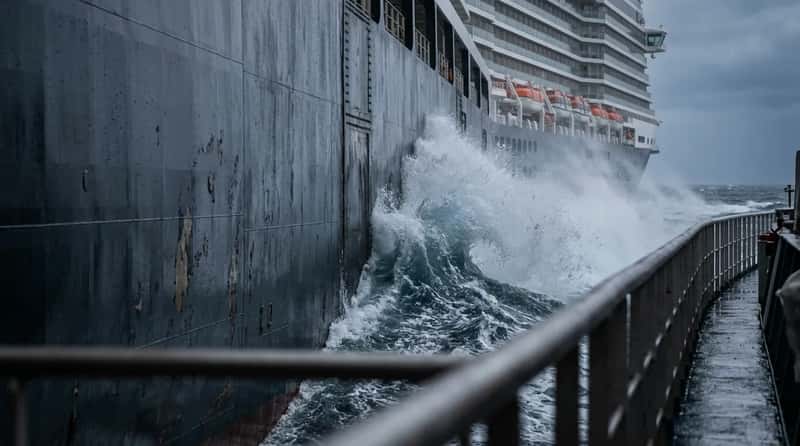
A single, low, resonant boom – sometimes felt more than heard – ripples through the entire vessel at once. Guests in every part of the ship notice it simultaneously.
This is typically hull flexing – the ship’s steel structure responding to a wave strike or a sudden shift in sea conditions. In rough weather a ship can creak, pop, and groan far louder in the middle of the night.
The hull is engineered to flex rather than resist – rigidity would be catastrophic. A large cruise ship’s hull can flex several centimetres in heavy seas – by design.
That boom is the sound of thousands of tonnes of steel flexing at once. Engineers find the question charming, because guests describe the exact same event completely differently depending on where in the ship they were sitting.
#9 is only heard in one specific location – but it’s impossible to ignore if your cabin is nearby.
#9 – The Rhythmic Thumping From Behind the Wall in Aft Cabins
A regular, mechanical thump – not random, but patterned – comes through the stern wall. It has a beat to it, almost like a slow drum.
This is propeller blade passage – each blade creating a pressure pulse as it rotates past a fixed point on the hull. That frequency has been measured directly on hull sections just above the propeller.
On a large cruise ship with five or six blades turning at controlled RPM, that beat stays rhythmic and persistent. The faster the ship travels, the faster the beat.
Guests who figure this out often find it strangely reassuring. Those who don’t can find it maddening after several nights.
Engineers say aft cabins on the lowest passenger decks are ground zero for this one – it’s one of the most common noise-related cabin change requests on the ship. #8 sounds completely different, and only shows up in specific weather.
#8 – The Wind Scream Through Higher Decks and Balcony Doors
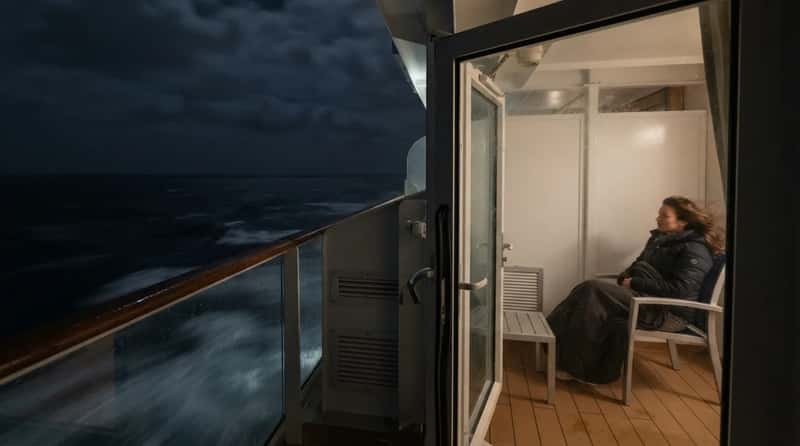
A high, fluctuating scream or moan – almost musical – increases in pitch as ship speed rises. It’s not an alarm, and it’s not mechanical. It’s air.
A cruise ship creates its own wind simply by moving. A ship doing 22 knots into a 15-knot headwind experiences near-gale conditions at the bow.
Gaps around balcony doors, ventilation grilles, and railings all become instruments. The shape of the superstructure decides exactly which frequencies get amplified.
Some guests describe it as ghostly wailing – which is exactly what it sounds like at 3 a.m. Engineers confirm this is the noise most likely to spark paranormal theories from guests.
It shifts with heading and speed, so it can appear and vanish instantly. When the ship changes course and it stops dead, guests are left genuinely baffled.
Quick Compare
- Mechanical noises – engine hum, thruster roar, purifier whine: constant, man-made, and traceable to one specific part.
- Environmental noises – wind scream, hull flex, waterline rush: driven by physics, and they shift with weather and speed.
- Structural noises – anchor drop, thermal ticking, water hammer: sudden and sharp, and easily mistaken for damage.
The noise at #7 is far more mechanical – and only the people directly beneath it really hear it.
#7 – The Mechanical Clunking When the Ship Changes Speed
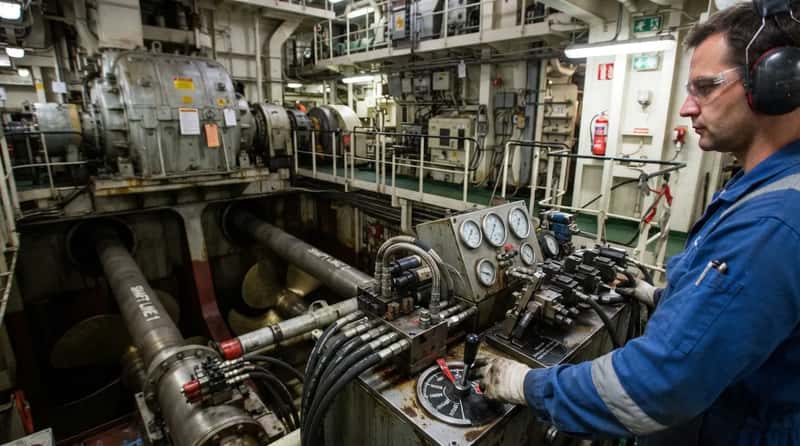
Whenever the bridge adjusts engine power – slowing to approach a port, or accelerating out of it – some guests hear a series of clunks and gear-like sounds through the structure.
Most large cruise ships run four to eight engines, mixing main engines for propulsion with auxiliary engines for power. Bringing engines online or offline, or adjusting propeller pitch, all creates transient mechanical sounds through the frame.
Controllable-pitch propellers – which change blade angle rather than RPM – are especially prone to this. The pitch adjustment mechanism produces a distinctive hydraulic clunk.
Engineers hear it as routine. Guests near the aft lower decks experience it as alarming – though it’s always brief.
#6 is the one engineers get asked about most in tropical ports.
#6 – The Loud Bang When Air Gets Trapped in the Plumbing
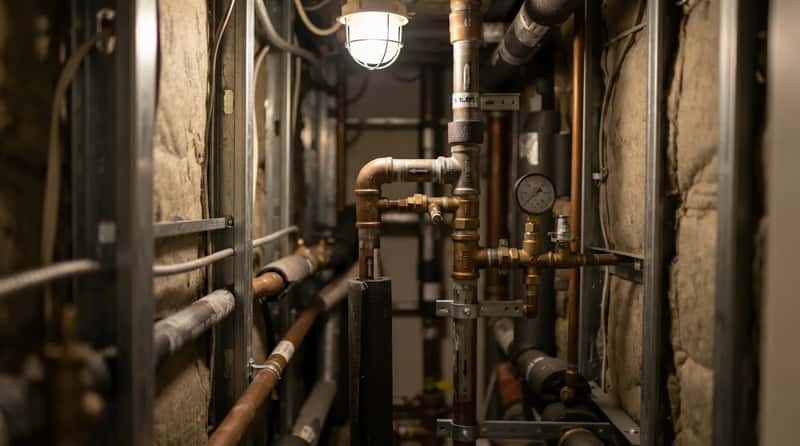
A sharp, single bang – sometimes startlingly loud – comes from inside the bathroom wall or under the sink. Not a drip. Not a rattle. A genuine bang.
This is water hammer – a pressure wave created when water flow is suddenly stopped or redirected. With thousands of guests running showers and flushing toilets at once, the ship’s plumbing runs under constantly fluctuating pressure.
When a pressure surge hits a bend or a valve, the impact transmits through the metal pipework like a gunshot through a barrel.
Engineers consider it one of the most harmless noises on the ship. It’s also frequently misreported to guest services as something structural.
It’s loudest first thing in the morning, when the entire ship wakes up at once. #5 is the one that gets guests genuinely convinced the ship is in trouble.
#5 – The Alarm-Like Tone That Plays Over the PA at Odd Hours
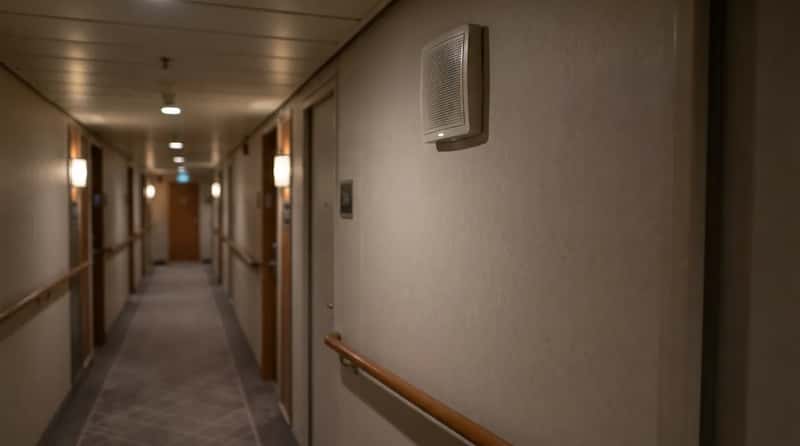
A tone – not words, not music – plays over the ship’s PA system in the middle of the night. Sometimes a series of them. Guests freeze, convinced it’s an emergency signal.
It isn’t. Ships use coded tones for internal crew communication, and a real emergency alert is entirely different – long, repeated, and paired with verbal instructions.
What guests hear at night is routine crew coordination: a department being paged, a call to the bridge, a shift change signal. Most cruise lines publish their emergency signal patterns – very few guests ever read them.
Engineers say this is one of the most consistent causes of late-night anxiety calls to guest services. Knowing the difference between a crew page and an actual alarm is genuinely useful information.
The noise at #4 sounds like it belongs in a submarine, not a passenger ship.
#4 – The Deep, Pressurised Hiss From the Ventilation System
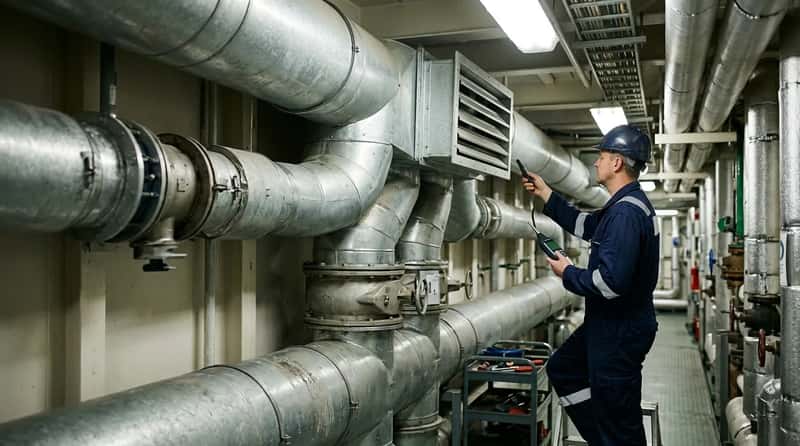
Not a whistle – a pressurised hiss, like air escaping under controlled force. It comes from vents, corridor junctions, and below-deck panels, and in some parts of the ship it never stops.
A cruise ship’s HVAC system is one of its largest and most complex engineering installations. It manages temperature, humidity, and air quality everywhere at once, from refrigerated food storage to guest cabins to the engine room.
The system runs under positive pressure in most passenger areas to keep air moving the right direction. The hiss is that pressure differential crossing ductwork junctions and adjustable dampers.
Modern ships use silencers and mufflers that can cut engine noise by up to 30 percent, but the HVAC system contributes its own constant sound signature regardless. Guests near duct junctions or ventilation risers hear it most clearly at night.
#3 is the noise that sounds the most like it’s coming from outside the hull.
#3 – The Whooshing Surge Along the Waterline at Night
Guests in lower-deck, lower-midship cabins sometimes hear it clearly: a rushing, whooshing surge of water along the outside of the hull, almost like standing beside a fast-moving river. At night, once the ship’s other sounds fade into the background, it becomes dominant.
This is simply the bow wave and hull wake passing the length of the vessel. A ship at cruising speed pushes a huge volume of water, and that water doesn’t just move away – it travels along the hull plating.
The hull plating acts like a drum skin, amplifying the sound straight into the cabin.
Engineers note that guests in inside cabins on lower decks are often surprised the sea is audible at all – they expected total silence. Those who find it soothing often say it’s the best sleep aid on the ship.
What’s at #2 surprises engineers even to be asked about – because it sounds so strange.
#2 – The Crackling and Popping After the Ship Has Been in Port
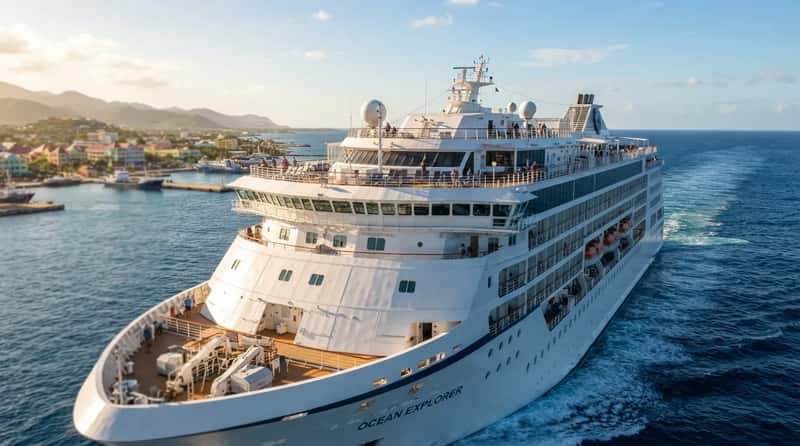
The ship has been docked for hours in a warm, sunny port. Then it gets underway again – and within the first hour at sea, passengers hear random, isolated pops and creaks from the superstructure.
Steady at anchor, noisy when moving. This is thermal expansion and contraction – the same physics that make a tin roof tick in the afternoon sun.
A cruise ship’s superstructure is built of aluminium and steel, and sitting in tropical sun heats those outer surfaces significantly. When the ship gets moving and cool sea air hits them, they contract – and the joins, rivets, and panels tick and pop in sequence.
In some conditions, a large ship’s hull can expand by several centimetres across its length from heat alone. It’s the same principle as a building settling, just happening in real time to a moving vessel.
Engineers say it’s almost always guests from colder climates who ask about this one – they’ve never experienced their own accommodation physically contracting around them. The noise at #1 is the one that’s been asked about most consistently across every type of ship, for decades.
#1 – The Foghorn Heard From Inside the Ship, Every Two Minutes, All Night
Multiple cruise passengers have reported a continuous, mysterious sound that keeps them awake at night. They describe it as a foghorn in the distance – heard not from outside on deck, but transmitted through the entire ship, seemingly rising from below.
It’s the ship’s own foghorn signal – required by international maritime law under COLREGS whenever visibility drops below a certain threshold. In fog, mist, or heavy rain at night, the officer on watch must sound it at regulated intervals.
The horn itself is mounted on the mast or forward superstructure. But the sound wave travels down through the ship’s entire steel frame and resonates in cabins throughout the vessel – guests hear it as if it’s coming from somewhere inside, not above them.
At a Glance
- Under COLREGS Rule 35, a vessel underway making way must sound one prolonged blast at intervals of not more than two minutes.
- A prolonged blast lasts four to six seconds by regulation – long enough to feel unmistakable through the hull.
- A vessel stopped and making no way through the water instead sounds two prolonged blasts, spaced about two seconds apart.
- The rule applies specifically in fog, mist, heavy rain, or any condition of restricted visibility.
Engineers call this the most emotionally loaded question they get, because guests who’ve never heard it before feel genuine anxiety. It does not mean danger – it means the bridge is doing exactly what the law requires.
When the fog clears, it stops. And then the silence itself is what wakes you up.
The Bottom Line
Ships are not quiet machines – they’re floating cities of steel running tens of thousands of mechanical parts at once. A standard cruise ship’s engine can exceed 120 decibels at source, loud enough that engine room crew are required to wear hearing protection.
Most of what guests hear is the residue of that enormous mechanical energy, filtering up through insulation, steel, and water. The crackling is cavitation. The bang is water hammer. The foghorn is the law.
Not one of the 16 sounds on this list is cause for alarm – but knowing what they are makes every cruise sharper, stranger, and far more interesting.
Have you heard one we missed? Drop it in the comments.
Bonus: The Cabin-Picking Trick Engineers Use for Their Own Families
Engineers who sail for a living almost never book a cabin at random – they pick location first, before price or view, because location silences most of the 16 noises above before they ever start.
The idea is simple: get as far as possible from the four biggest noise sources – the bow thrusters, the anchor chain, the propellers, and the engine room.
- Go midship, not forward or aft. This single choice avoids thruster roar, anchor-drop crashes, and propeller thumping all at once.
- Pick a deck at least two levels above the lowest passenger deck. Engine hum and cavitation crackle fade noticeably with every deck you climb.
- Avoid cabins directly below the pool deck or lido deck. Deck chairs, deck-cleaning machinery, and late-night furniture dragging travel straight down through the floor.
- If you’re already booked in a noisy spot, ask guest services for the deck plan and request a move on embarkation day – before the cabin next to yours is filled. Early requests get approved far more often than complaints made mid-cruise.
None of this costs extra, and it’s the one piece of insider knowledge that quietly prevents almost every complaint on this list before it ever reaches your ears.