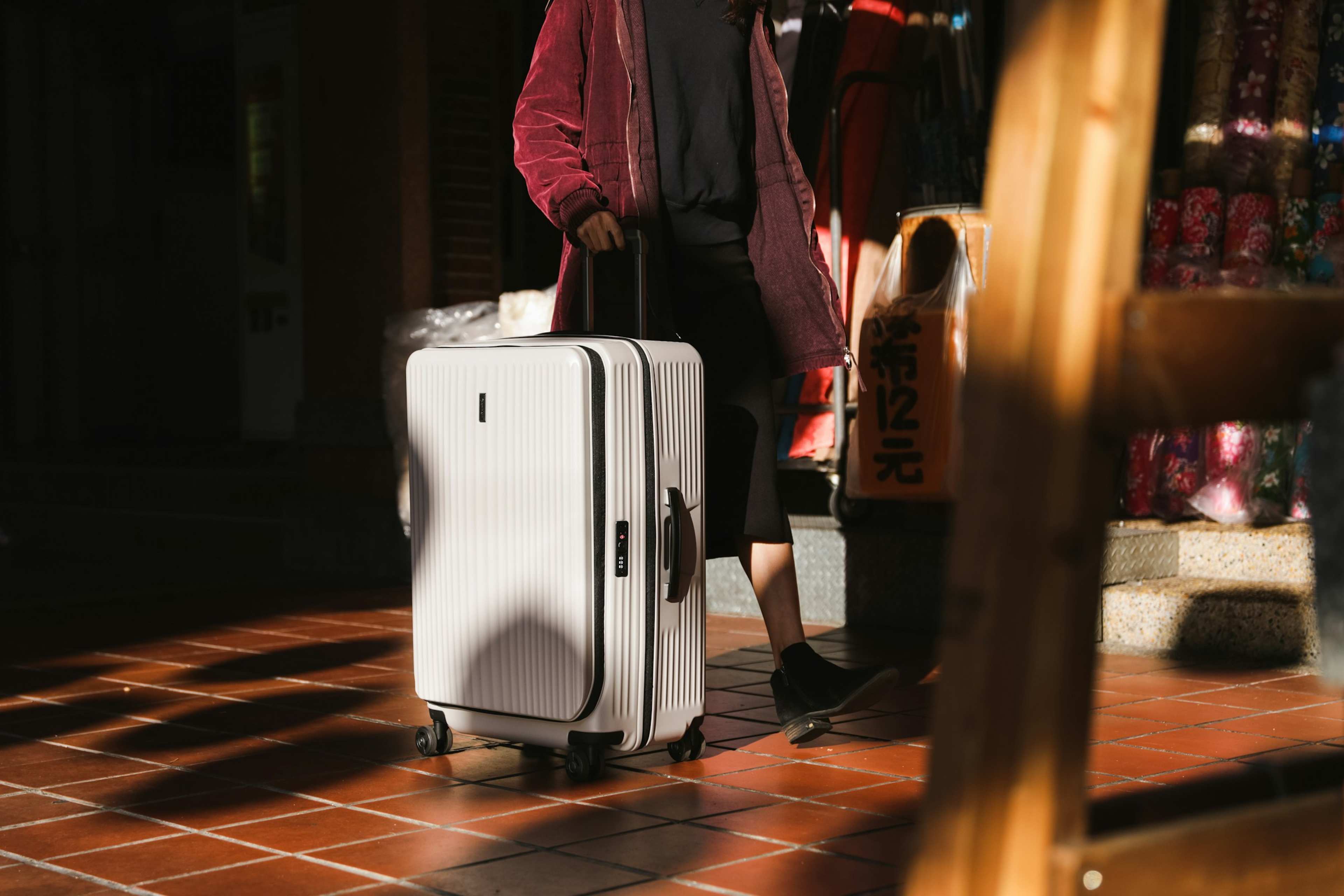
You land. The air smells different. You don’t have a word for it yet.
You want to dissolve into the city. You want the language to coat your tongue like something native.
But your hand keeps moving to your jacket pocket. Passport still there. You exhale. You do it again in thirty seconds.
This is the gap. The space between the traveler you perform and the person who cannot stop cataloguing exits. Between the romantic idea of full immersion and the cold, animal need to know exactly where your documents are at 2 AM in a city that doesn’t know your name.
Nobody warns you about this particular vertigo. The self you were at home is on hold. The self you’re building here doesn’t have full citizenship yet. You’re running two operating systems and neither one is loading properly.
The Temporary Identity

Travel acts as a systemic disrupter of our mental schemas – the cognitive frameworks we use to organize the world. When your existing framework for “a normal meal” or “a typical street” is confronted with a reality that doesn’t fit, a state of cognitive dissonance occurs. This mental discomfort is the catalyst for change.
But change requires a waiting period.
And in that waiting period, you are no one in particular.
You are the version of yourself still loading. The buffering screen between who you were at your kitchen table and who you might become after six weeks of navigating foreign transit maps and menus written in scripts you can’t parse.
The temporary identity is not a crisis. It is a corridor.
The problem is that corridors have no furniture. You can’t quite settle. You keep moving because standing still in a corridor feels wrong, like you’re blocking something, like you’re in the way of your own becoming.
Most people mistake this restlessness for wanderlust. It isn’t wanderlust. It’s the psychological discomfort of existing in a self that hasn’t been confirmed yet by anyone who actually knows you.
The Passport Reflex
It happens on the metro. In the restaurant. In the middle of a conversation with someone who laughs at something you said in their language.
Your hand moves.
Pocket. Passport. Still there.
This tendency stems from hypervigilance – the heightened state of scanning for potential threats or mistakes. It’s a common symptom of anxiety, rooted in the brain’s survival wiring.
The passport isn’t just a document. It is proof of origin. It is the one object that says: I come from somewhere specific. I have a government. I have a name that a nation-state recognizes.
When everything else is fluid – language, customs, currency, the direction traffic flows – the passport is the last hard fact about you.
Checking it isn’t paranoia. It’s a kind of existential grounding. You touch it to remember that you exist in a way that can be officially verified.
You touch it because the rest of you is up for debate.
The Immersion Myth
Travel culture has sold us a beautiful lie.
Get lost. Go deep. Eat where the locals eat. Don’t be a tourist. Be a traveler. Better yet, be a temporary resident. Invisible. Fluent. Belonging.
Cultural immersion stands as perhaps the most powerful element of transformative travel. Unlike surface-level tourism, truly immersing yourself in different cultures creates profound shifts in how you see yourself and others.
But here’s the part the Instagram caption leaves out.
It can be hard to fully immerse oneself in a new culture, although it can be worth the risk. The risk isn’t getting pickpocketed. The risk is that you crack open just enough to let the new place in, and then you’re not quite sure how to close back up when you leave.
You become fluent in the geography of a stranger’s city. You learn which bakery opens earliest. You have a favorite bench.
And then your flight is in four days and you realize the bench will exist without you, and something in your chest goes very quiet and strange.
The Exit Strategy
The anxious traveler always knows where the exit is.
Not just the physical exit – the door marked in green, the emergency stairwell, the side street that empties onto the main boulevard.
The emotional exit, too.
Fear of the unknown, concerns about safety and security, and disruptions to routine can all contribute to the anxiety that travels with you. But the deeper fear is subtler than all of those. It’s the fear of committing too fully to a place that will not commit to you in return.
So you keep the exit warm. You don’t unpack completely. The suitcase stays half-organized on the rack. The return ticket is saved in three different places on your phone.
This isn’t failure to adapt. This is a very sophisticated kind of self-protection.
If you never fully arrive, you can never be fully left behind.
The exit strategy is the architecture of the ambivalent traveler. You build the door into every room before you decide whether you want to stay.
The Identity Gap
I remember standing in a covered market in a city I won’t name, holding a coffee I’d ordered successfully in the wrong language, and feeling something close to euphoria.
And then feeling something close to grief, thirty seconds later.
The euphoria was about competence. I’d navigated. I’d managed. I’d briefly been someone who belonged here.
The grief was about the awareness that it was brief. That the woman at the coffee stall would forget me by afternoon. That this city did not need me in the way I was starting to need it.
Due to a change in customs, traditions and values, it can be challenging to maintain a sense of identity about a culture that feels now far in time and space. We may feel displaced – like we don’t belong anywhere.
That’s the gap. Right there, in the steam rising off the coffee cup. You are homesick for a place you haven’t left yet. You are already mourning the version of yourself that existed for forty minutes in a foreign market and felt, briefly, like someone who had figured it out.
The Hypervigilant Tourist
From navigating the barrage of security, customs, and passport control to the stresses of cramped planes and unfamiliar environments after landing, there are many stress points for travelers.
The hypervigilant tourist is not careless. They are the opposite of careless.
They have read the State Department advisory. They have offline maps downloaded in two apps. They have memorized the address of their accommodation in the local script, in case the cab driver doesn’t read Roman letters.
They have photographed their passport, emailed it to themselves, and told two people at home where they’ll be each day.
Airports, and foreign cities more broadly, feel to the anxious mind like a maze of hidden triggers. The ticking clock, the crowd’s hum, the security line that never moves – it’s a perfect storm for overthinking.
And still. Still they reach for the passport. Still they run the mental checklist at 3 AM.
Hypervigilance is love turned inward as fear. It is how a careful person keeps themselves alive in the world.
The Culture Shock Nobody Names
Travel stress or “culture shock” is a normal developmental phase of adjustment to a new cultural environment. It occurs when one’s values and typical ways of viewing the world clash with the values and viewpoints of the new culture. Typical reactions include feeling helpless, out of control, vulnerable, fearful, anxious, confused, or sad.
But there is a subtler shock that doesn’t have a clinical name yet.
It is the shock of watching yourself behave differently.
You are quieter here. Or louder. More patient in lines, more easily moved by architecture, more willing to eat alone at a table for two without performing contentment for anyone.
You catch yourself thinking in fragments of a language you don’t speak. You start timing your walk to match the rhythm of the city’s pedestrians. You stop reaching for your phone on the metro.
Who is this person?
They are you, released slightly from the container of your life back home. The shock isn’t the foreign place. The shock is the unfamiliar self it keeps producing.
The Weight of Documents
A passport weighs almost nothing. Ninety grams, perhaps. A small burgundy or navy booklet, worn at the corners if you’ve carried it long enough.
It weighs everything.
It’s common to stress about personal safety when traveling, especially internationally. Some people fear being scammed, encountering crime, or facing emergencies far from home. But the deepest fear is losing the document that proves, in bureaucratic black and white, that you have a country. That some government, somewhere, has agreed to let you back in.
The passport is your right of return.
And in places where you feel most foreign, most pleasantly unmoored, most thrillingly without context – that booklet is the only thread connecting you to the self the world has agreed to recognize.
You want to be anonymous. You want to be absorbed. You want the city to claim you.
But you will not let go of the thread. Because absorbed is wonderful until it becomes lost, and lost is wonderful until it becomes invisible, and invisible is wonderful until you need someone to see you.
The Return That Changes Nothing and Everything
Sometimes people overlook the fact that similar adjustments are necessary when returning home. New ideas, friendships, and experiences gained overseas will change you, and you will return home with a variety of new perspectives. You now have the task of determining how to integrate these changes into your life at home.
The apartment will be exactly as you left it.
The specific angle of light through the kitchen window. The shelf where you keep the coffee. The particular sound the radiator makes at night.
All of it will be unchanged. And you will walk through it feeling faintly like a tourist.
This is the cruelest trick of serious travel. It unsettles both shores. People who have lived away from their home culture for extended periods can experience reverse culture shock – a clinical course remarkably similar to the original. Your home becomes the foreign country. Your habits feel borrowed. You look at the mug on the counter and think: I have been somewhere. This mug does not know.
The displaced anxiety doesn’t end at the gate.
It just changes address.
The Gap as Home
Here is the thing nobody tells you at the departure terminal, printed on no boarding pass, announced over no PA system.
The transformative potential of travel lies in its ability to fundamentally alter the brain’s predictive machinery. It forces a move from a rigid, culturally-bound model of self to a more flexible, complex, and globally-contextualized one. But that flexibility has a cost. The cost is that you can no longer fully return to the fixed point.
You become a person who lives between coordinates.
Not rootless, exactly. Rooted in multiple, contradictory places at once. Rooted in the coffee shop in the city that forgot you. Rooted in the train platform where you made a wrong turn and it was the best hour of the trip. Rooted in every version of yourself that different time zones and different altitudes briefly allowed to breathe.
The displaced anxiety is real. It is not a malfunction. As you seek to manage the conflicts between your identities – the one that travels and the one that stays – the feelings of anxiety intensify. Living in accordance with your values and maintaining a sense of continuity proves to be a significant challenge. But the challenge is also the proof. It means you were present enough for the place to matter. It means something went in.
The passport stays in your pocket. The hand keeps checking. The anxiety remains precisely where it lives – in the narrow, luminous space between wanting to disappear into a place and needing the world to still know where you are.
You do not have to resolve it.
Some people spend their whole lives learning how to be somewhere without quite arriving, and they call it, quietly, a life.