You probably think the biggest secret you’re keeping at the spa is what’s underneath your robe. You’re wrong – the real reveal happened before you even sat down.
Trained therapists read your posture, your breathing, your jaw, your whole nervous system before they ask a single question. Here are the 15 things guests give away without saying a word – and the last one is the one almost nobody expects.
#15 – How You Walk Through the Door
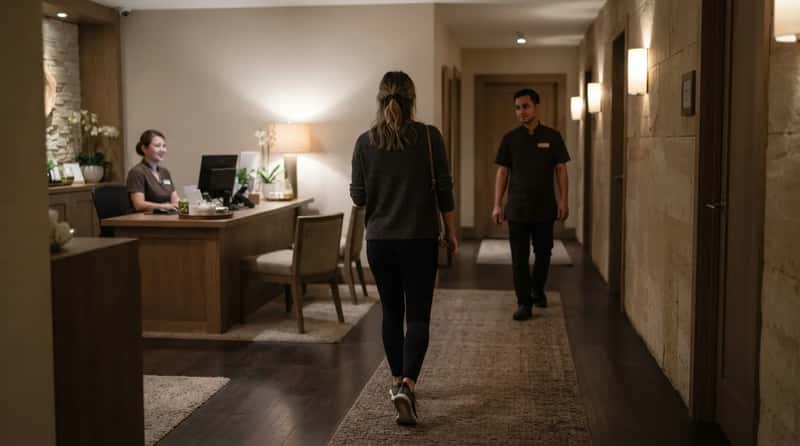
Your session starts before anyone lays a single finger on you.
The walk from reception to the treatment room already tells a trained eye which muscles are overworked – and which ones gave up fighting years ago. Whether you move like a robot or glide in loose and easy, your therapist is quietly reading your body language, including how you sat in the waiting room chair.
They’re not judging you. They’re collecting data so they can actually help.
Desk workers give themselves away fastest – forward head, rounded shoulders, tight hip flexors, all visible before the robe even goes on.
But that’s nothing compared to what we found about #14…
#14 – Whether You’ve Ever Been to a Spa Before

First-timers give themselves away instantly – and the staff adjusts everything around it.
Pre-arrival nerves show up in small ways: hovering by the desk, asking twice where the changing room is, apologizing for things that need no apology. Regulars move through the space completely differently.
They know where to hang the robe. They don’t ask twice about what happens next.
A first-timer’s hesitation at every transition is unmistakable to anyone working the floor. Staff quietly recalibrate their pace and explanations the second they spot it.
Quick Compare
- First-timers: hover near the desk, ask questions twice, apologize often
- Regulars: know exactly where the robe hooks are, move with ease
- Staff response: pace and explanations shift instantly once the pattern is spotted
But that’s nothing compared to what we found about #13…
#13 – Your Stress Level – Before You Say a Word

You don’t need to mention work. Your body already filed the report.
Every body has a signature stress pattern, and it’s more obvious than you think. Tight shoulders, stiff hips, a clenched jaw – your muscles keep an honest record of how you’ve actually been living.
The neck and shoulders react first, so a therapist pressing into your upper trapezius can often gauge how long you’ve been running on adrenaline. The jaw is often the most revealing spot of all – chronic tension there points to grinding, anxiety, or both.
Most guests have no idea they’re holding it at all.
But that’s nothing compared to what we found about #12…
#12 – What You Do for Work

Spa therapists aren’t guessing your job. They’re reading your body’s occupational record.
Many times, I can guess a client’s occupation by their symptoms and findings.
Massage Therapist
Truck drivers complain of low back pain from constant road jarring. Athletes often show groin strain from overstretched adductors.
Tradespeople – plumbers, electricians, carpenters – tend to arrive with overdeveloped forearms and a sore neck. Desk workers almost always show the same forward-head pattern, making their job one of the easiest calls a therapist makes all day.
But that’s nothing compared to what we found about #11…
#11 – Your Hydration (Or Lack of It)

Dehydrated guests don’t just feel it – they show it in ways that are hard to miss.
Taut, less elastic skin is one giveaway. Muscle stiffness and trigger points, especially in the upper back, become more pronounced when the body is running low on water.
Therapists are constantly assessing the density and “stuckness” of tissue. Chronically dehydrated muscle has a texture all its own.
Most guests think they’re adequately hydrated. Most of the time, they’re not – and the table tells the truth faster than any intake form ever could.
But that’s nothing compared to what we found about #10…
#10 – Whether You Prepared (or Definitely Didn’t)

Guests who rushed straight from a hectic day are instantly recognizable.
Heavy perfume in a small, enclosed treatment room is noticed immediately – it clashes with the calming scents staff have carefully chosen. So is a full face of makeup, or clearly skipping the shower.
Staff won’t say it to your face. But they notice, every time.
The guests who arrive frazzled, phone still in hand, mid-email, stand out even more. A therapist can feel the nervous system still running hot the moment their hands make contact – which means you’re paying premium rates just to decompress from your commute.
But that’s nothing compared to what we found about #9…
#9 – Your Relationship With Your Own Body

Whether a guest is comfortable in their own skin shows up in the first sixty seconds.
Tone of voice, eye contact, and where a client touches their own body while describing pain all send signals. A client complaining about work stress while continually touching their right shoulder is pointing to the real problem without realizing it.
Guests disconnected from their bodies describe pain in vague, general terms. Guests who know themselves well point to the exact spot – and therapists use that difference to shape the entire session.
But that’s nothing compared to what we found about #8…
#8 – Old Injuries You Forgot to Mention
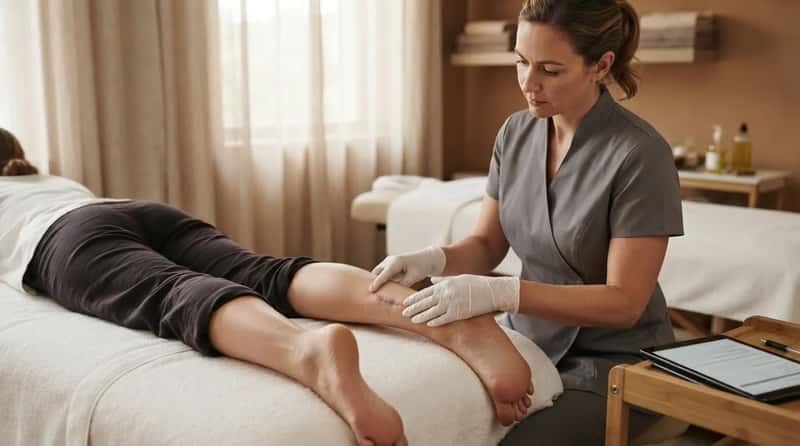
You might not remember that ankle sprain from five years ago. Your body hasn’t forgotten.
Therapists see scars as disruptions in the fascial field – little dams and walls in what should be smooth connective tissue. Scars can distort posture and nerve conduction in ways most people never connect back to the original injury.
A fresh scar prompts questions, mostly so the therapist avoids working directly over it. The body is an honest historian.
Uneven muscle development, a subtle limp, asymmetrical tension – it all points to injuries guests routinely leave off their intake forms, usually because they’ve simply forgotten they matter.
But that’s nothing compared to what we found about #7…
#7 – How You Handle Eye Contact

It’s not just shyness. Eye contact during intake reveals far more than most guests realize.
The frequency and intensity of eye contact signals confidence, trust, and readiness to engage. Avoiding it can point to shame, guilt, or discomfort the guest hasn’t named out loud.
Rapid blinking is another tell – someone speaking calmly but blinking fast may be far more upset than they’re letting on. A guest who can’t hold eye contact while describing symptoms is frequently carrying more than physical tension.
Experienced staff catch it immediately and shift tone – gentler, slower, less clinical.
But that’s nothing compared to what we found about #6…
#6 – Your Breathing Pattern

Most people dramatically underestimate how much their breathing gives away.
Shallow, high-chest breathing is one of the clearest signs of a chronically stressed nervous system – and it’s visible from across the room. Trained therapists watch the rise and fall of a client’s back before they even touch them.
If the breath barely moves past the collarbones, the body is stuck in low-level fight-or-flight – no matter how calm the guest insists they feel.
Worth Knowing
- High-chest, shallow breathing signals a stressed nervous system – visible from across the room
- Therapists watch how the back rises and falls before ever placing a hand on it
- Releasing stored tension can trigger sudden, unexpected emotion mid-session
Stress and old tension get stored in muscle tissue, which is why releasing it sometimes triggers an unexpected wave of emotion. Shallow breathers are the most likely to be blindsided by it – and good staff already know to be ready.
But that’s nothing compared to what we found about #5…
#5 – Your Posture’s Habitual Side

There’s a left-right imbalance in almost every guest. Therapists spot which side dominates within minutes.
Working from the head of the table gives therapists a clear view of a habitual head tilt a guest may have had since childhood. The chin and nose deviate slightly to one side – a lifelong postural fingerprint.
Desk-bound professionals develop a forward head posture that’s instantly recognizable – pattern recognition built from thousands of sessions, not a lucky guess. The dominant hand almost always matches a tighter shoulder and a higher hip on the same side.
Most guests have never been told this. Their therapist clocked it before the consultation even ended.
But that’s nothing compared to what we found about #4…
#4 – How Much of a “People Pleaser” You Are

This one is more common than anyone likes to admit – and it actively undermines the treatment you’re paying for.
Some clients don’t want to talk during a session; that’s fine, it’s their quiet time. The problem is a different kind of client entirely.
The people-pleaser says the pressure is fine when it isn’t. They smile through discomfort, agree when asked if they’re okay, and leave undertreated every single time.
Experienced therapists watch for micro-wincing, held breath, and subtle bracing instead – because some guests will never actually speak up. It’s one of the quietly frustrating patterns in this industry.
But that’s nothing compared to what we found about #3…
#3 – Whether You’re a Regular or a “Crisis” Visitor

Some guests come for maintenance. Others only show up when they’re broken. Staff can tell the difference immediately.
Industry surveys consistently find that most spa-goers frame their visits as self-care, with stress reduction topping the list of reasons people book time on the table. But there’s a meaningful split hiding inside that number.
The “crisis” visitor arrives with an acute complaint – a seized-up neck, a back that finally gave out – and their muscles reflect months of neglect. Their tissue is dense, their range of motion restricted, and their intake form reads like a novel.
Quick Compare
- Regular visitor: pliable tissue, full range of motion, knows exactly what they want
- Crisis visitor: dense, restricted tissue and an intake form that reads like a novel
- Recovery gap: crisis guests often need three sessions to match what a regular achieves in one
The regular’s body is more responsive and pliable, and they usually know exactly what they want before they even sit down. The “crisis” guest often needs three sessions to reach what the regular gets done in one.
But that’s nothing compared to what we found about #2…
#2 – How You Treat the Staff the Moment You Walk In

This is the one discussed in the back of house more than any other – and most guests have no idea it’s happening.
Using a staff member’s name signals you see them as a person, not an amenity. Staff remember it, mention it to colleagues, and quietly repay it later.
A guest who’s gracious to everyone reads as genuinely kind. A guest who saves the charm only for people with power reads as someone performing.
A guest who is dismissive at the front desk is noticed before they’ve even reached the treatment room. It won’t change the quality of care – professionals don’t work that way – but it absolutely shapes the atmosphere in the room.
And yes, the therapist usually already knows by the time you lie down.
But nothing on this list compares to what we found at #1…
#1 – Whether You’re Actually Present, or Just Going Through the Motions

The single biggest thing spa staff notice – and the one most guests never consider – is whether you’re actually there.
Stress relief remains one of the top reasons people book a spa session in the first place. But walking through the door doesn’t automatically switch the brain off.
The guests who mentally never leave their inbox are physically detectable. Their muscles resist, their breathing stays shallow, and their bodies never fully respond the way a genuinely surrendered nervous system does.
Words are only part of the story. Beneath what a client says out loud is an entire layer of nonverbal signal – tone, posture, breathing, eye contact – that often says more than the words themselves.
The guest who is truly present, phone off, mentally unplugged, gets a fundamentally different experience than the one who’s physically on the table and mentally still at the office. Therapists feel the difference in their hands – it’s the gap between working with a body and working against one.
The Bottom Line

Spa staff aren’t being nosy. They’re being professional, and their read on you starts the second you walk in.
From your posture to your tone of voice, they’ve built a working picture of you before a single question is asked – your tension, your old injuries, your stress, your mood. The guests who get the most out of a visit are simply the ones who show up hydrated, leave the phone at reception, and actually speak up when something doesn’t feel right.
Everything else, they’ve already noticed. Your body was talking the whole time – the only question is whether you knew it.